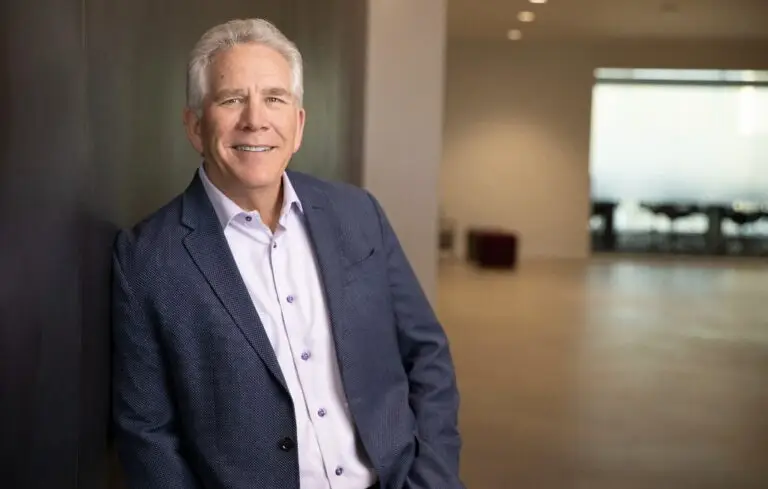
Marcy Syms didn’t plan on working in the family business, the once-storied New York-based retailer Syms, let alone becoming CEO. But when she joined the ranks to share her skillset in media and PR, “the entrepreneurial spirit at Syms really complemented my own sense of curiosity, my desire to grow my own experience. And my father, as my boss, never stopped me from bringing a new idea to the company or pursuing a new idea until it didn’t work,” she says.
“As Einstein says, failure is just a stop in success. You have to get through the failures to get to success. We went through some of that, and I was always willing to do whatever needed to get done.”
That curiosity and tenacity paid off for Syms as she worked her way up the ladder, and when Syms Corp had its IPO on the New York Stock Exchange in 1983, she became its first president and one of the youngest female presidents of a New York Stock Exchange company. She helped lead the company to become a national retailer with 50 stores, eventually holding the CEO title for over a decade.
Reflecting on her leadership journey, Syms shares how, ultimately, it came down to trust in her own capabilities. “After much analysis of self and environment, I’ve realized that I have to trust my gut,” she says. “And I learned more and more to do that as I was in situations where those people in the room… they were seen completely differently because they were men.”
Since the Syms Corporation closed in 2011, Syms has served as an independent director for private and public companies like Rite Aid and the NPR Foundation, is the founding trustee and President of the Sy Syms Foundation and the author of Leading With Respect: Adventures of an Off-Price Fashion Pioneer. She spoke with Women Leaders Connect to share lessons learned from being the only woman in the room, her wisdom from leading a family business, and what it takes to build a culture of respect, from top to bottom.
You worked your way up at Syms all the way to the CEO role. Can you share what that journey was like as you took on more and more leadership responsibilities?
I knew that joining the family business, with my father and three brothers, would be a deep commitment. That it would not be something I would have the opportunity of shrugging off if something went wrong.
I had the experience of other bosses, I had other work experience. I joined my father and the family business clear-eyed and excited. And the first job I did was exactly the skill that I brought to the enterprise of Syms, and that was media planning, public relations and customer relations.
In that position, I was happy to have the desk right outside of my father’s office where all the calls would go through me, and I became familiar with all of the people that were important externally and internally to the running of the business, a super platform for education, for a total overview of a company. And from there, the entrepreneurial spirit at Syms really complimented my own sense of curiosity, my desire to grow my own experience. My father, as my boss, never stopped me from bringing a new idea to the company or pursuing a new idea until it didn’t work.
It’s a real gift to be able to pursue, to exhaust and to find out if something can be successful, if an idea can be successful. As Einstein says, failure is just a stop in success. You have to get through the failures to get to success. We went through some of that, and I was always willing to do whatever needed to get done.
Were there particular lessons from working in a family business that still resonate with your work now?
Absolutely. I’ve done work as a family business consultant on transitions in family business. What really separates [businesses] in my opinion is culture. The family business culture in most cases, certainly in the initial generation of a business that makes it to the second generation, is the founder’s connection to other family members and their values and ethics. And those are the formative years of a corporate culture. Even a large and multi-generational company like IBM or Ford, they keep going back and mining the values and culture of the initial Ford founder or the initial Watson or whoever. Well, in a family business that is compounded, because generally speaking, those who work in the business can often be relatives. And so, the values are even more deeply shared. There’s more recognition that the values have a history.
The advantage of having values of one person and one family and extending that to the culture is how really infectious it is. It imbues everything. And it’s not something that you have to keep working at. From my experience, it helps if that culture has a lot of healthy ingredients that create a good working environment for non-family members. Because we can’t grow the family business necessarily without employing non-family members. And they need to feel as embraced and recognized by the culture as the family members.
I think one of the toughest things about working in a family business is the evaluation: “How am I doing? How do I get compensated?” And having some separation, having some boundaries between the time at work and the time that’s your personal time.
I know from my experience too, that when there are deep disagreements or there’s a breach of trust, which is probably the worst thing that can happen with any business, but in a family business, it goes back to the initial family unit. That breach of trust can really mean the beginning of the end for the business as a family enterprise.
And how do you go about building those values? What do you think are the best ways that business leaders can make sure that they have a healthy culture and stay grounded in those values even when you’re facing high-stakes decisions or a tough time?
Well, from the start, I think you must be clear in your communications. There shouldn’t be any guesswork about what is expected in your commitment to the business. The management’s commitment to the coworker, the coworker’s commitment to the business. These things have to be clearly spelled out, no surprises. There should be no secrecy about what it takes to be included, what it takes to be promoted, what it takes to be rewarded. These are things that must be openly shared and cannot be capriciously changed. A leader must be someone that people trust because there’s a stability about the leader.
That doesn’t mean that they can’t get upset. That doesn’t mean that they can’t have a bad day. But the consistency overall is about where the leader comes down on an issue. If the values keep changing, then they’re not deeply held, and no one will respect them. The clarity of the communications, the commitment, which from top down can create commitment from the bottom up.
Have you identified particular traits of good leadership—certain skills or practices that good leaders share?
I think good leaders are always thoughtful. Good leaders know who they are. They’re not searching for themselves. They feel they know who they are. That doesn’t mean that they never change or evolve. You certainly can change over time, but your core self, your core values, the core of who you are. I often say that at 11 I felt I knew Marcy and I can still see that core girl in myself. And I think most leaders have that kind of relationship with themselves.
A good leader does not pass the buck. A good leader has the ability to take responsibility, to share responsibility, but if there’s only one in the room to take the responsibility, a good leader will take it, own it and work with it. A good leader is someone you can trust. A good leader is someone who has creativity about solving problems. And if he or she doesn’t have the creativity for a situation in solving a problem, they really open up the tent in order to include people who might be smarter than them, and they don’t feel threatened.
I imagine a lot of that is making sure that you have the right people on board that fill in the gaps that you may have on your own. How do you make sure that you’re building a strong team?
The first ingredient is to have rigorous standards that suit your organization and your culture about how someone becomes a member of the team. We had a period where we went through a couple of CFOs in a row. What was the problem? The problem was that the CFO was a stepping stone to a bigger job, or they were looking to be a consultant. The fit between the person is usually not about the qualifications, because anyone could read a resume and see that the qualifications are there. But it’s about personality. It’s about drive, it’s about focus. It’s about this moment in their life, are they ready for this kind of commitment?
And all of that, in my mind and in my experience, weighs more heavily than the particular job. We used to hire people who didn’t know anything about clothing. We could teach them about [clothing], but if they had an incredible job base, started a hardware store in their area… entrepreneurial spirit is something that we really liked in hiring. I think most companies today need to be more welcoming and rewarding those with entrepreneurial ideas, those that are seeing things a little differently and willing to bring these ideas to the company they’re working for. I think that’s a glue that happens between the best companies and the best employees.
You were one of the first female CEOs in retail at a time when very few women held these kinds of leadership roles. How did that early experience shape your leadership philosophy?
After much analysis of self and environment, I’ve realized that I have to trust my gut. And I learned more and more to do that as I was in situations where those people in the room… they were seen completely differently because they were men. I entered a room, and I was seen as a woman.
I took the advice that when you are in a new situation, it’s best to listen. And that’s probably good advice all along the way. But I became a deliberate and disciplined listener and tried not to speak for as long as possible when I was in a new situation so that I could hear not only what was going on, but who was saying what and how my reactions to what I was hearing were going to prepare me to engage.
I learned because I didn’t have the same effect on a room that a man would have…I really had to become more and more trusting of my gut reactions to things and not look to others to necessarily have the same reaction. You get a little more resilient. I always felt that I needed to be overly prepared for a meeting. I learned that humor is a wonderful leveling way to communicate. If you say something that is funny at no one’s expense, including not your own, it’s a great barrier breaker. I always tried to do that with new people either I had to do business with, or had to engage with for the first time in the start of what hopefully would be a long relationship.
What advice would you give to women who are stepping into leadership roles or board seats for the first time?
Well, the first one, as I described earlier, is remember to listen. All eyes will be on you. As far as we know, just the act of being the newest one in the room, the most recent addition will have all eyes on you. If it’s three [women] out of 10 in the room, they’re just now going to feel the opportunity of some security in being able to speak their true feelings or their true judgment in a way that they don’t feel overly exposed or setting themselves up for too much criticism.
You don’t have to be the first quarter wonder. One of the things I learned over the course of many years of a career is you really don’t learn what someone’s made of until you get into tough times, until you ride out a down cycle. I think it was Eleanor Roosevelt who said, “Women are like tea bags. You don’t know how strong they are until they’re in hot water.” And I think in working with people, that is really important to keep in mind.
I’ve been, not just at Syms, but other boards where it was a hostile takeover or a CEO who became ill, the person who isn’t necessarily someone who comes up with the greatest answer in the moment, but has the resilience, the resourcefulness and even the focus to be there in the tough times.
So I would say to women, you don’t have to score every hit at bat. But have confidence in knowing what you bring to the table and make sure that what you bring to the table has been tested. That it’s not just your opinion, but that there is some basis for how you feel about it.
Let people know who you are. Don’t feel insecure. You don’t want to share everything in the first meeting, certainly, but you want to show who you are, what your beliefs are without proselytizing or alienating. One of the greatest compliments I had was when I left the Rite Aid board, and the lead board member said, “I want to thank Marcy for being our moral compass.” That doesn’t mean that I had a contribution at every meeting, but over time, that was a contribution that I was able to make. And if you are too nervous or uncomfortable or trying to prove something, you won’t be as able to give your best. So, I would tell women, I don’t want to be patronizing in saying this but, be yourself. Be authentically yourself.