As volatility reigns over the global economy, compensation, from frontline to C-Suite, is not immune. Our latest research finds traditional compensation structures and patterns shifting as leadership teams navigate the tradeoffs between retaining talent and managing costs.
CEOs may be taking the biggest hit. According to a survey of 237 CEOs fielded March 3-4 by Chief Executive Research, one-third of CEOs do not expect to receive any bonus for their 2025 performance. No surprise there: This is a pattern we see all the time in our CEO & Senior Executive Compensation Report for Private Companies, the largest compensation research project conducted annually in the U.S.
When times get tough, senior leaders at closely-held firms absorb the brunt of the impact. During Covid, for instance, our research found that 39 percent of companies reduced their CEO’s salary versus 33 percent of employed workers. That same dynamic appears to be happening once again amid the current unpredictable economic environment. As one CEO in our survey put it: “When things are tough, it is important to keep your frontline motivated.”
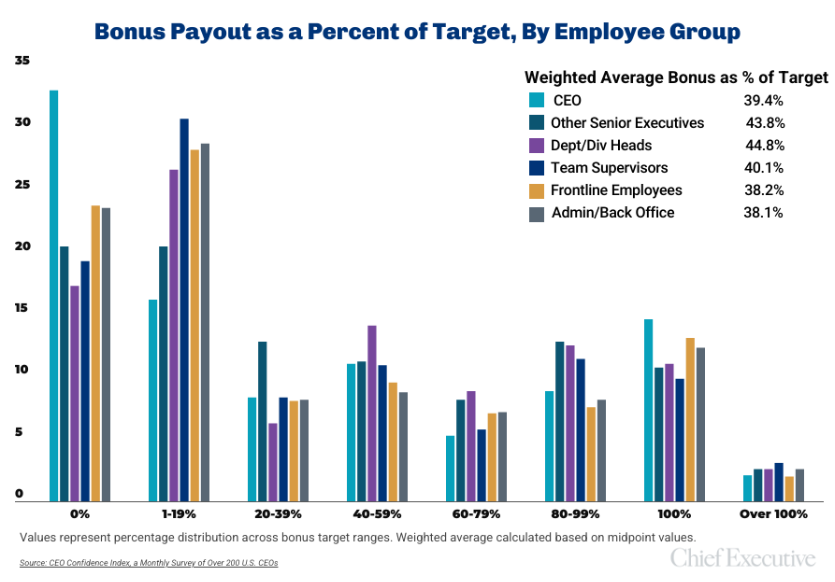
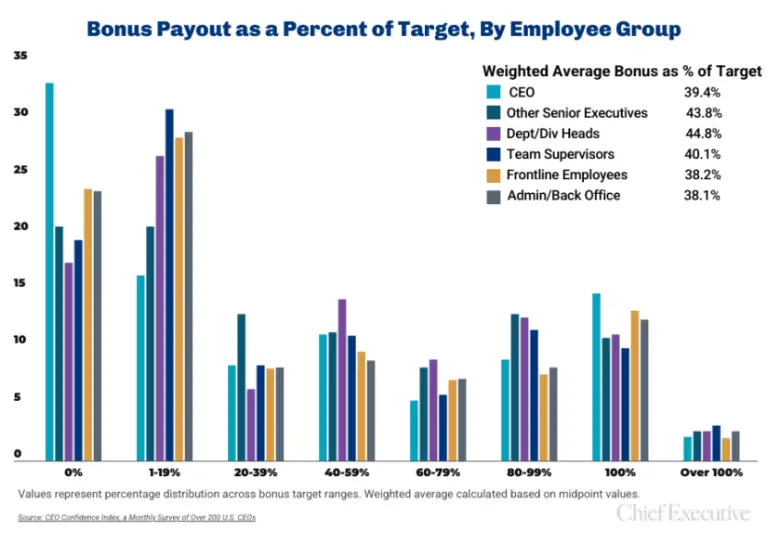
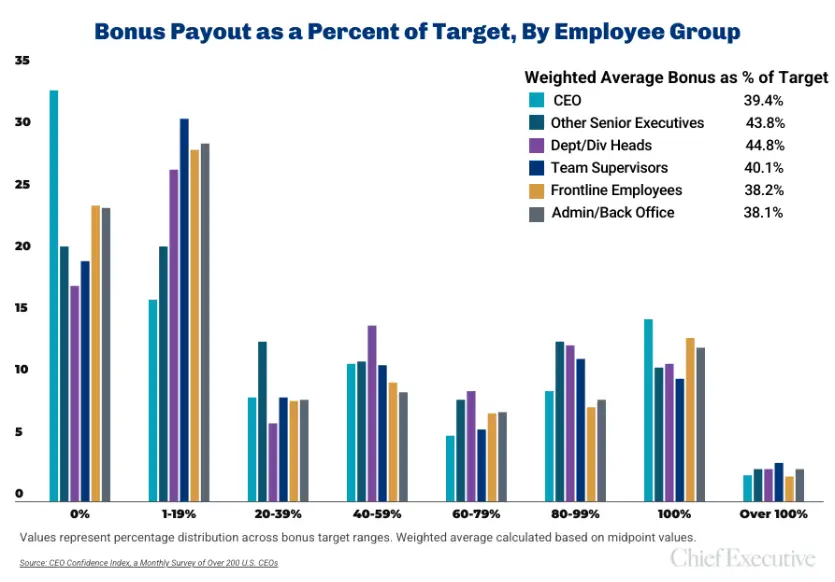
Looking deeper into the numbers we see that CEOs are receiving an average bonus payout of just 39 percent relative to their target—one of the smallest proportions reported across employee groups. Their median expected bonus for 2025 for private company U.S. CEOs has dropped to $80,000, the lowest level since 2020 after hovering near $100,000 from 2021 through 2024.
While the pattern of protecting frontline workers held true in previous downturns, 2026 could be an exception: Our surveys find that more senior executives, division heads and team supervisors are earning bonuses closer to their targets than entry-level employees.
Frozen Salaries
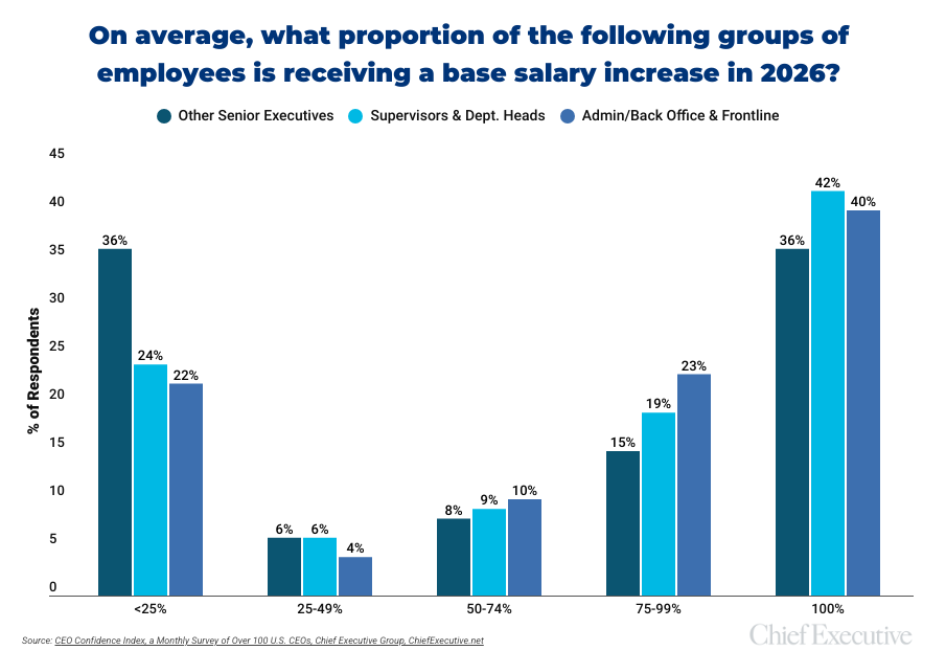
Beyond bonus payouts, base salary adjustments tell a similar story. In more than 20 percent of companies, some three-quarters of administrative, back-office and frontline employees are not expected to receive salary increases in 2026. That means in roughly one in five companies, the vast majority of lower-level staff are facing effective pay cuts when adjusted for inflation. “We have made it clear that currently there are no raises given while we navigate the current climate,” said one CEO, capturing a sentiment that appears increasingly common.
Forty percent of companies are still prioritizing supervisors and department heads, as well as admin/back-office and frontline employees, reporting that all of their staff in those areas will be seeing a salary increase in 2026. Senior executives, on the other hand, don’t fare as well. An equal proportion of companies (36 percent) report that either all of their senior executive staff will receive a raise in 2026 or less than a quarter will, and that proportion tends to fluctuate based on company characteristics.
While one in five senior executives (other than the CEO) are not expected to receive a bonus for their 2025 performance, department and division heads will receive the highest average bonus payouts at 45 percent of target, followed by other senior executives at 44 percent and team supervisors at 40 percent. Meanwhile, frontline employees and administrative staff are receiving roughly 38 percent of their bonus targets—lower than the CEO group.
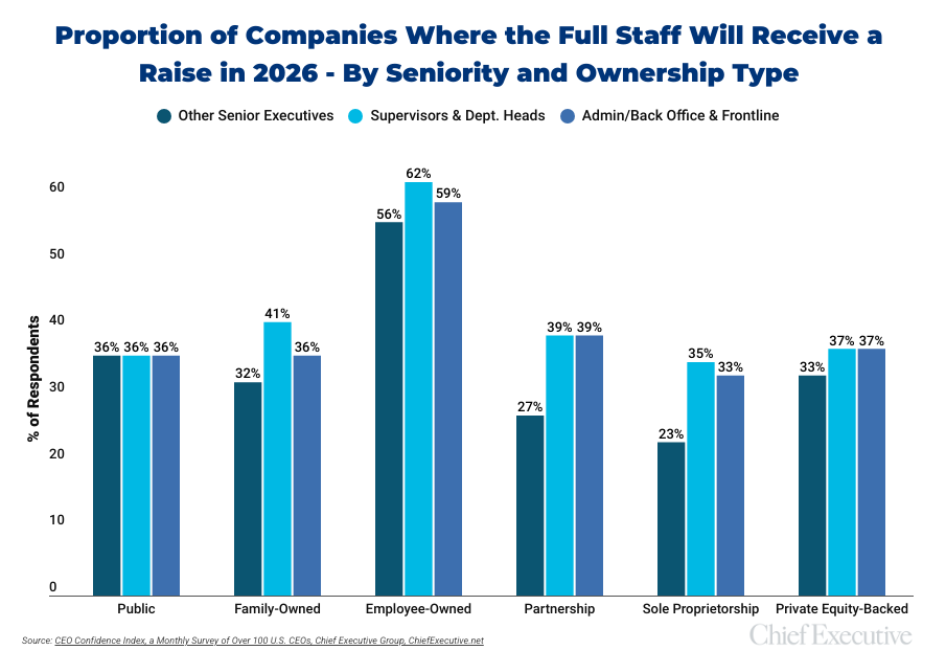
Industry plays a role here too, depending on how industries are faring economically. For example, CEOs in the still-booming construction/engineering sectors are the most likely to report raises for the full staff in admin/back-office and frontline at 63 percent, while CEOs in the increasingly pressured tech sector are the most likely to report that less than a quarter of their staff will see a raise this year.
More detailed information on the exact percentage of raises and how much senior executives are being paid can be found in our annual CEO & Senior Executive Compensation Report for Private Companies. The 2026 data is currently being collected. If you wish to participate, please email research@chiefexecutivegroup.com.