American chief executives came down with a severe bout of pessimism to welcome the new year, a rare reversal in a survey that has tracked corporate sentiment for more than two decades.
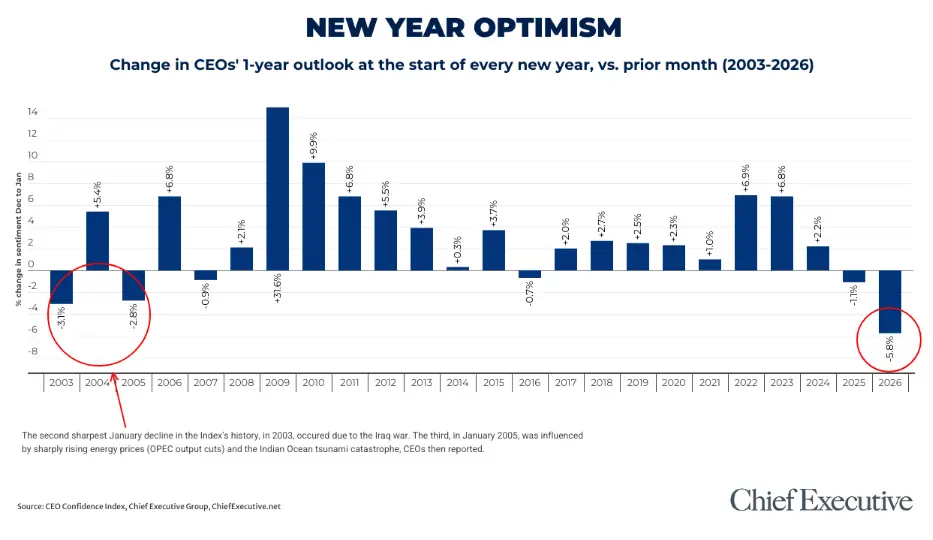
Chief Executive’s latest CEO Confidence Index reading, fielded January 13-14 among 250+ U.S. CEOs, shows both confidence and optimism on the decline this January—breaking a pattern that has held for the Index’s nearly entire 24-year history.
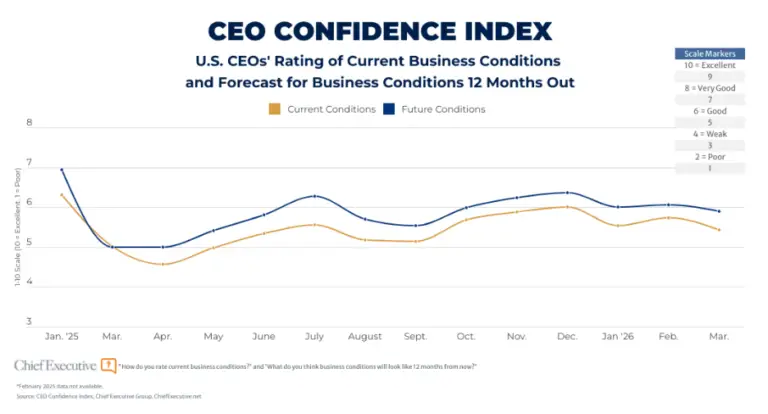
CEOs’ assessment of current business conditions in the U.S. fell to 5.5 out of 10 in January, on a scale where 1 is Poor and 10 is Excellent, from 6/10 in December—an 8 percent decline. It marks the first time CEOs have begun a new year with such a sharp drop in sentiment from the previous month.
And while CEOs forecast conditions will improve by year-end, the degree of the expected rally contracted by 6 percent in January compared with December projections. Those polled now forecast business conditions will reach 6.0 out of 10 by December, down from their previous estimate of 6.4.
The January decline represents only the fifth time in the Index’s history that the new-year outlook fell below the prior December—and the sharpest contraction by far.

Interest rates and cost of capital are constraining business planning, alongside broader cost pressures and limited visibility into the coming months. But the vagaries of President Donald Trump’s White House are the reason most CEOs surveyed cited as the principal concern weighing on their 2026 outlook. As one CEO put it: “uncertainty is the new certainty.”

Still, a growing share of CEOs expressed hope for improvement, particularly in the second half of the year. “I believe that we will experience lower interest rates the second half of the year along with all of the business-friendly rules and regulations from the One Big Beautiful Bill implemented,” said one CEO.
Others pointed to businesses adapting to the volatility as a potential catalyst for renewed investment. “Brands and retailers are settling into the new normal of tariffs, with possible breaks or reductions,” commented one CEO.
Added another: “With interest rates steady and new potential tax breaks from current admin, the chatter for investment is starting to improve.”
Some are banking on political dynamics to ease volatility. “A likely divided government after the midterm elections will reduce shocks to the economy and allow companies to invest with more confidence,” explained one CEO.
It’s the Economy…
Recession fears have declined since last year. Just 15 percent of CEOs expect a downturn in the first half of the year, while 57 percent anticipate economic growth, as improvements in economic data and technology investments provide some counterweight to prevailing uncertainty.

Yet nearly half of CEOs polled identified the U.S. economy as the top risk to their business. “The U.S. economy seems fragile and may turn down with little warning,” said one CEO.
Another described the broader economic mood in starker terms: “The national economy seems to be hanging on by a thread, maybe waiting for a bubble to burst, or maybe waiting for a dam to break, and nobody seems to have a clear prediction of which will happen.”
Another expressed concern about the sustainability of current growth drivers: “The U.S. economy is my biggest concern. It’s beginning to feel like consumer spending is propped up by high-earners and business spending is propped up by AI infrastructure and data centers.”

Focusing on Margins and Controllable Factors
Against this backdrop, CEOs are concentrating on operational levers within their control, with 54 percent citing “achieving target profitability” as their top priority for 2026.
The path to those margins, however, faces obstacles. Managing rising costs and finding ways to pass price increases through to customers emerged as the foremost challenges to growth. “Resisting downward pressure on pricing against upward pressure on costs,” one CEO said, citing utilities, labor rates and commodities as the principal concerns.
“Labor and benefits costs continue to rise but [there is] no opportunity to increase prices since raw material costs are flat,” added another CEO.


Still, corporate forecasts remain largely unchanged from December: 76 percent expect revenue increases (vs.75 percent in December), and 67 percent anticipate improved profitability (flat from prior month).
Investment plans suggest some underlying optimism persists. Forty-five percent of surveyed CEOs plan to increase capital expenditures in 2026, up from 42 percent in December—a 6 percent increase. Meanwhile, 53 percent plan to expand headcount this year, compared with 46 percent a month earlier, representing a 15 percent jump.