CEOs remain broadly optimistic about the months ahead—though less so than a month ago.
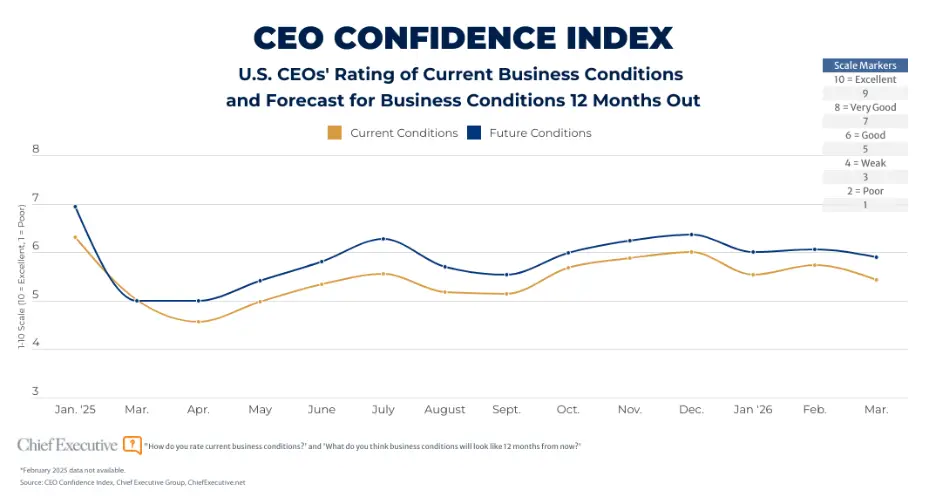
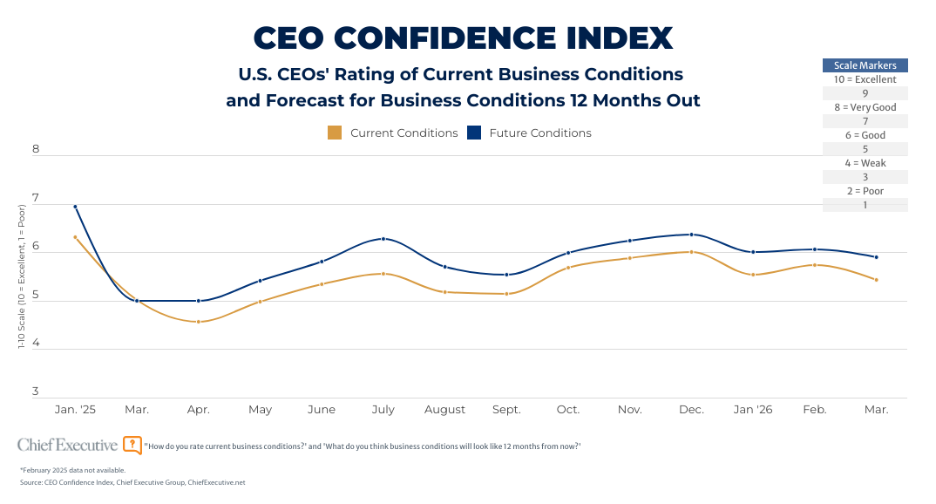
Chief Executive’s March CEO Confidence Index—fielded March 3-4 among 237 U.S. chief executives—shows CEOs lowering their assessment of current business conditions by five percent, to 5.4 out of 10 from 5.7 in February.
CEOs polled also revised their 12-month outlook, lowering their forecast from 6.1 to 5.9, a 3 percent decline from February.
The findings highlight the complexity of today’s environment: A growing share of CEOs expect business conditions to improve in the year ahead—48 percent, up from 45 percent in February and the highest proportion since August 2025.
At the same time, the gap between CEOs’ assessment of current conditions and their 12-month outlook has widened, from 6 percent in February to 9 percent in March, suggesting that while expectations have moderated slightly, CEOs still anticipate meaningful improvement from today’s levels.
“People are getting used to the unpredictability of the current administration, but it is becoming the new reality,” said Minnesota-based Jeff Stone, CEO of Navy Island, a family-owned industrial manufacturer with operations across North America, Europe and the Middle East. “Even though interest rates are still likely to stay the same, people have to move on with life and construction will continue.”
‘It’s the Economy…’
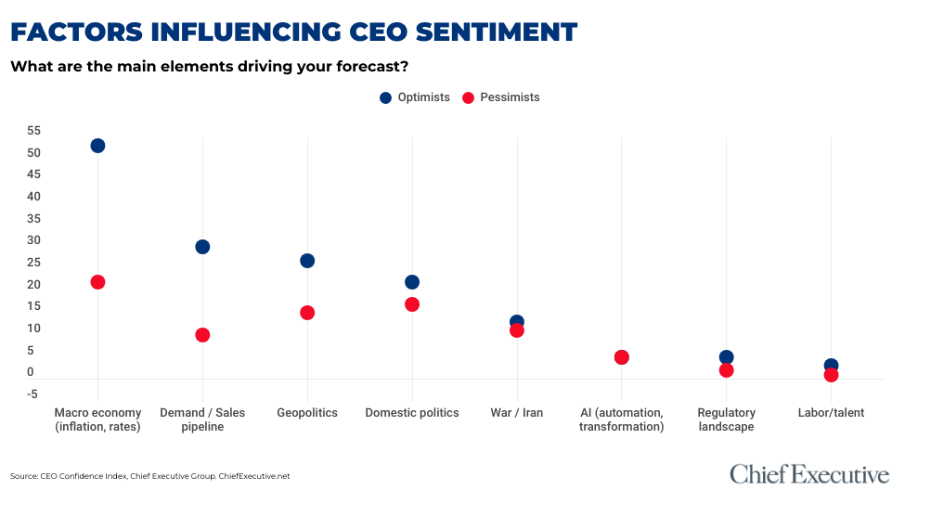
The macroeconomy is a dominant force shaping CEO sentiment—on both sides of the forecast equation. Half of the CEOs expecting conditions to worsen cited inflation or a potential economic slowdown as the primary reason behind their forecast, while a similar share of those expecting improvement pointed to moderating inflation and broader economic stabilization as reasons for optimism.
“There’s a lot of uncertainty in the macro environment right now—tariffs, Middle East, interest rates. I’m thinking a lot of this is settled in a year—hopefully,” said Scott Horn, CEO of ACI Learning, a Colorado-based PE-backed learning center with global operations.
When asked to forecast 12-month CPI, CEOs forecast an average CPI of 3.9 percent, up from 3.4 percent in February. Optimistic CEOs forecast CPI at 3.1 percent, while those expecting deteriorating conditions project 3.4 percent. Those expecting flat conditions in the months ahead appear to be the ones tipping the balance toward that overall 3.9 percent average.
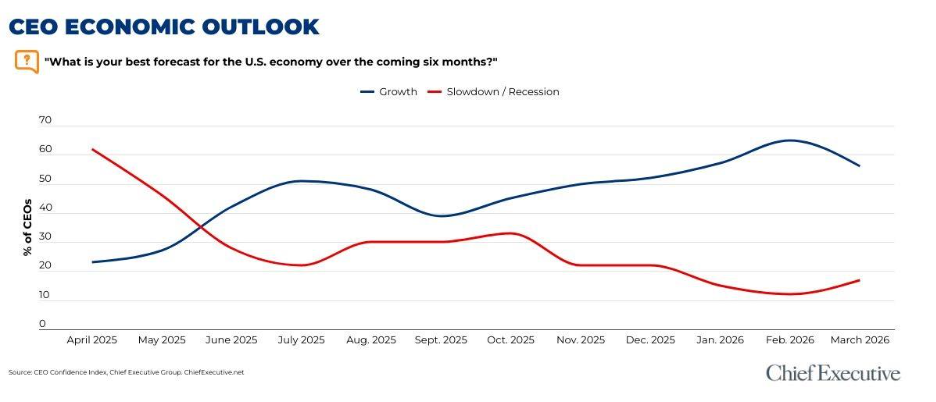
Despite this forecasted uptick in CPI, the share of CEOs expecting a recession has fallen by roughly half since last fall—and by more than 70 percent since this time last year, when President Donald Trump’s “Liberation Day” tariff announcements triggered a spike in recession forecasts. Since then, recession expectations have eased steadily, while growth forecasts have consistently outpaced recession projections.
At the same time, signs of caution are emerging. The share of CEOs forecasting a potential slowdown rose to 17 percent in March, up from 12 percent in February—the first increase in six months (since October 2025).
Beyond the Macro Economy
The political climate—both domestically and abroad—weighed on CEO sentiment in March, likely because the survey was conducted just days after the start of the war with Iran.
Among CEOs forecasting deteriorating conditions in the year ahead, domestic politics emerged as the second most-cited factor (39 percent), followed by geopolitics (34 percent). One-quarter specifically pointed to the war in Iran.
“The unrest and violence in the Mideast will, I believe, have a dampening effect on our economy,” said one CEO, echoing others.
These concerns also appeared among CEOs with a more optimistic outlook, though far less frequently than economic or demand-related factors. About one quarter of CEOs expecting conditions to improve mentioned geopolitics, while 20 percent cited domestic politics. Only 12 percent referenced the war in Iran specifically.
Inside Corporate Forecasts
Signs of caution are also showing up in CEOs’ expectations for their respective companies:
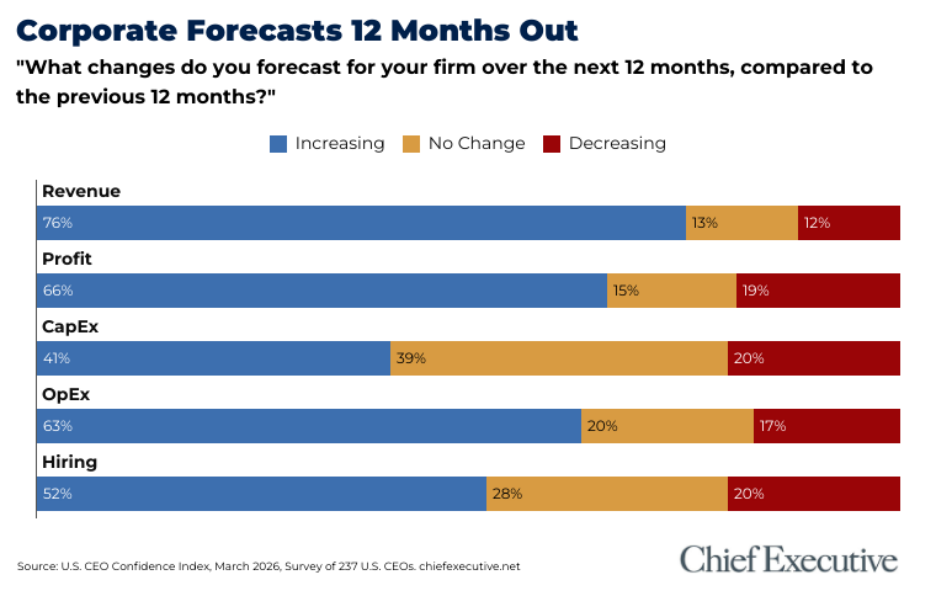
- 76 percent forecast higher revenues in 2026, vs. 81 percent in February
- 66 percent expect profits to rise, vs. 70 percent in February
- 41 percent now plan to increase capital expenditures, vs. 50 percent in February
In terms of capital allocation, CEOs say they are prioritizing operational improvements and digital transformation this year, with the top investment areas being ‘operational infrastructure and efficiency’ (26 percent) and ‘AI and digital transformation’ (25 percent).
Artificial intelligence also appears prominently in CEOs’ strategic plans for 2026, with roughly one in five leaders citing AI adoption or integration as their company’s biggest strategic move. Market expansion, customer acquisition and product innovation were also common themes.
On the labor front, the data suggests many companies are operating near workforce capacity, which may explain why hiring plans are ticking upward: 52 percent say they plan to increase headcount in the months ahead, up from 49 percent in February.
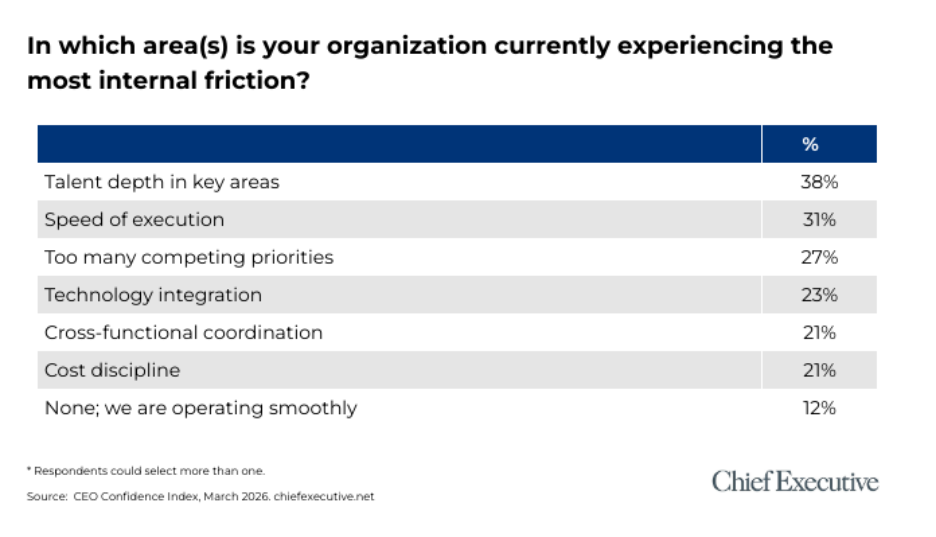
But CEOs say their biggest challenge is talent depth in key areas—not overall headcount—suggesting the issue is finding specialized skills rather than simply adding workers.
All in all, CEOs are confident in their ability to execute amid these conditions, rating their confidence 7 out of 10.