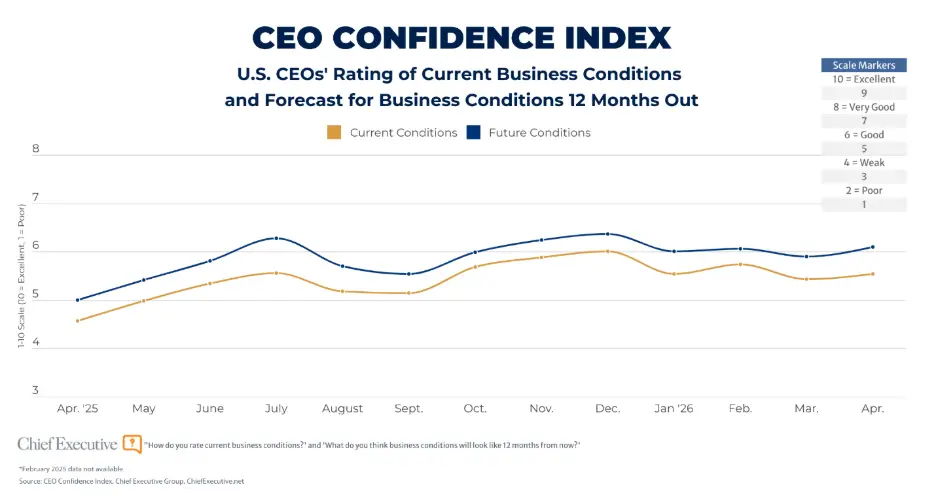
CEO confidence held steady in April, with business leaders reporting moderately improved views of both current conditions and the year ahead.
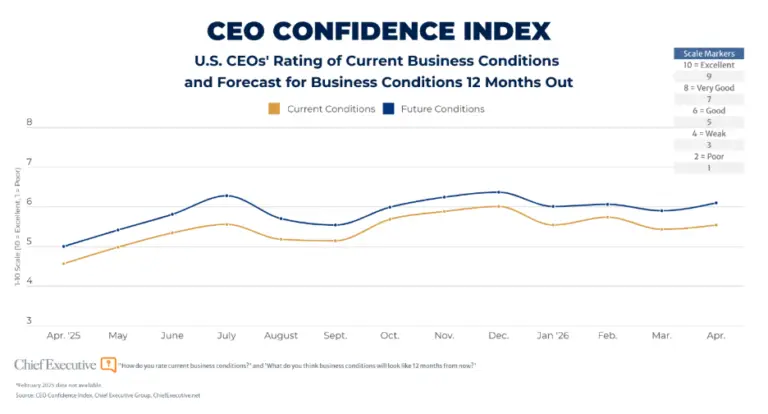
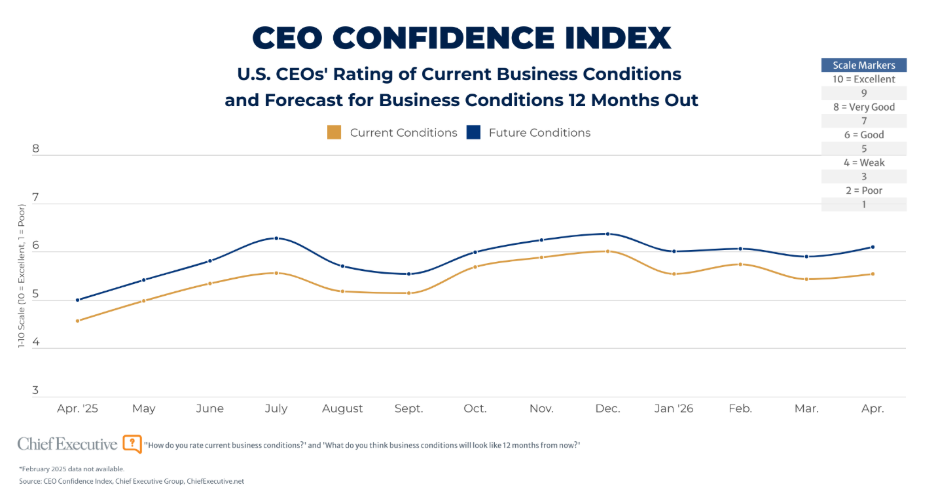
Chief Executive’s CEO Confidence Index rose 2 percent to 5.5 out of 10, back to where it began the year. The index remains 8 percent below its 12-month high of 6.0, reached in December.
CEOs’ expectations for the next 12 months also improved, rising 3 percent in April to the highest level for 2026. While the forward-looking index remains 4 percent below its 12-month high, it is now 10 percent above current conditions.
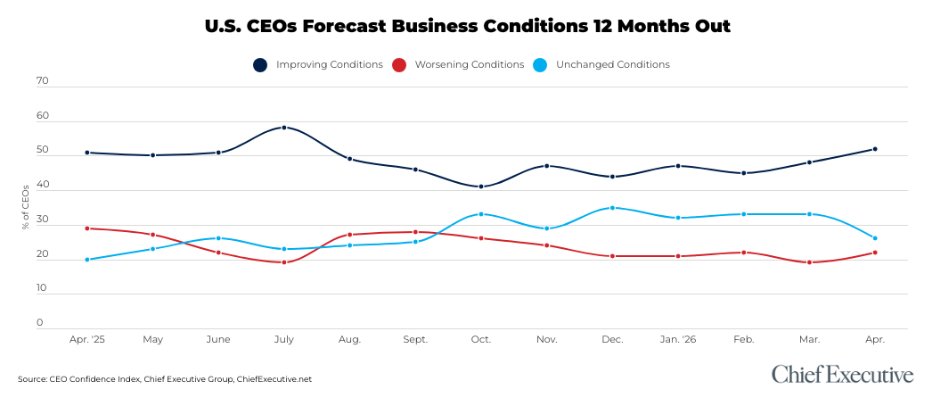
A growing proportion of CEOs are optimistic about the business environment—though a larger share than a month ago also expect conditions to worsen.
The share of CEOs expecting improving conditions this year rose to 52 percent in April, up from 48 percent in March. At the same time, the proportion expecting conditions to worsen increased to 22 percent, from 19 percent.
That’s because fewer CEOs are remaining on the sidelines in their views about where the economy is going: The share expecting flat conditions declined to 26 percent, down from 33 percent a month earlier.
“The uncontrollable factors facing our organization are at the highest level in my career by many magnitudes,” said one CEO who responded to the survey. “Tariffs, war, energy are creating conditions which require rapid assessment without over-reaction.”
Even among CEOs who are optimistic, there is acknowledgment of near-term softness. “No one is buying anything but the minimum, no new construction projects, and no new product development due to all of the chaos,” said the CEO of a mid-market manufacturing company.
Others see the current environment as part of a broader cycle. “Bottom of the manufacturing cycle has continued longer than historical trend; inventories are lower,” said another who expects conditions to improve.
And for some, demand is being deferred rather than lost. “I think there is a lot of pent-up demand that will be unleashed once this Middle East conflict is over.”
Impact of the War
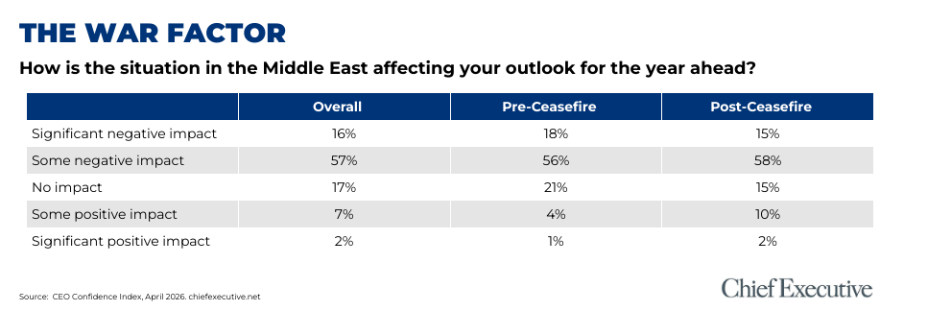
The situation in the Middle East emerged as a central factor in CEOs’ outlook this month, with nearly three-quarters saying it is negatively affecting their outlook and more than 40 percent citing it as a key driver.
While responses submitted after the ceasefire announcement showed modest improvement in sentiment, the overall level of concern about the conflict remained unchanged.
Economic Forecasts
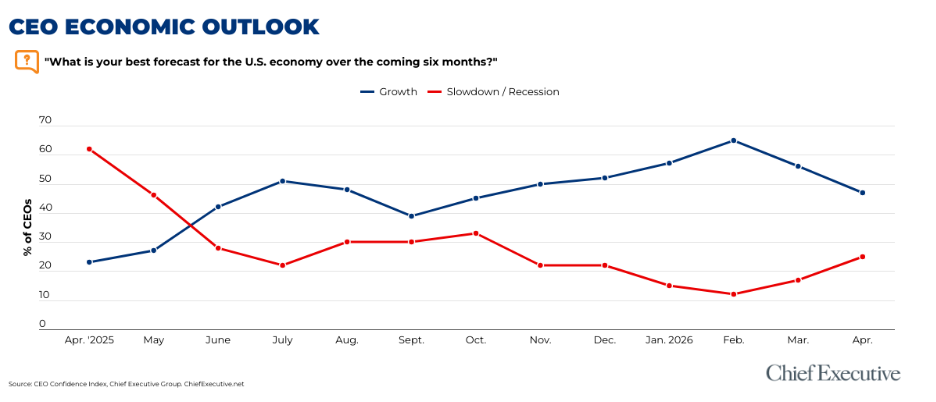
While most CEOs continue to expect the U.S. economy to grow in the near term, fewer are forecasting expansion at recent levels.
The share expecting growth fell to 47 percent in April, from 56 percent in March. Meanwhile, expectations for a slowdown increased, with 25 percent of CEOs now forecasting a recession or slowdown within the next six months, up from 17 percent.
Inflation expectations also moved higher. CEOs now forecast an average 12-month Headline Consumer Price Index rate of 4.6 percent, up from 3.5 percent in March. While the average can be skewed by outliers, the median also shows an increase: from 3.0 in both February and March, to 3.3 in April.
Corporate Forecasts
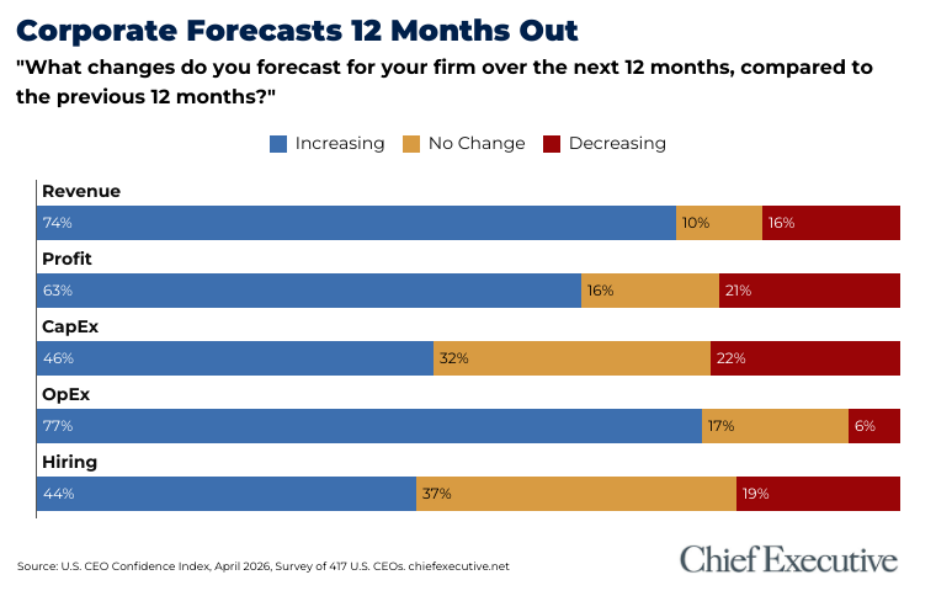
These shifts are reflected in company-level expectations. Fewer CEOs now expect increases in revenues (74 percent, down from 76 percent) and profits (63 percent, down from 66 percent).
Hiring expectations also fell in April after improving in March. Just 44 percent of CEOs now expect to increase headcount in 2026, down from 52 percent the previous month.
At the same time, 77 percent expect costs to rise in 2026, reflecting continued cost pressures across sectors.
Roughly half of respondents anticipate increasing capital expenditures, pointing to continued investment in operations despite the cost pressures.