Editor’s Note: With a bevy of stressors, every CEO knows—and fears—the truth about this job. It can be a killer. That’s led Chief Executive to team with the renowned faculty at Mayo Clinic Executive Health to help you rethink some of the most important—and too-often overlooked—aspects of maintaining good health as CEO. We’ve collected the articles in a growing library. We hope you find this initiative useful.
The following article is by Bright Thilagar, M.D., Mayo Clinic Executive Health
— Dan Bigman, editor
Senior executives who travel frequently face unique health challenges, but with proactive strategies, they can maintain optimal well-being and performance on the road.
A forthcoming Mayo Clinic and Chief Executive magazine survey found U.S. executives travel an average of five days per month, exposing them to long workdays, time zone changes, infectious agents and limited food options.
Here’s some of what we know about how best to cope:
- Pretravel preparation is essential. Executives should schedule a pretravel consultation to review their itinerary from a medical preparedness perspective. Mayo Clinic offers a travel consultation as part of their Executive Health review to discuss risk-reduction strategies and preventive immunizations. Carrying a travel health kit with necessary medications, documentation of medical conditions and extra doses is recommended. Prescription meds are better carried in bottles with the prescribing information visible.
- During travel, minimizing jet lag and travel fatigue is critical. Gradually adjusting sleep schedules before departure, seeking bright light exposure at the destination and using melatonin (3 mg at bedtime for 3–4 days) can accelerate circadian adaptation. Caffeine in the morning and/or physical activity helps maintain alertness. Hydration, periodic movement, compression stockings and limiting alcohol intake on long flights reduces deep vein thrombosis (DVT) risk.
- Executives should be vigilant about food and water safety, especially in resource-poor settings, to prevent gastrointestinal illness. Smaller, frequent meals may help with gastrointestinal tolerance during travel. When options are limited, prioritize safe, cooked foods and bottled water.[2][4] Eat in established restaurants and avoid street foods.
- Mental health and stress management are equally important. Travel and work stressors can be additive. Cultural adaptability training and mental health assessments before travel can help mitigate these risks.[2] Adequate sleep prior to travel and preparing work presentation ahead of travel rather than during the trip helps too.
In summary, successful executive travel requires preparation, vigilance and adaptation. The following table from the New England Journal of Medicine summarizes evidence-based recommendations for minimizing jet lag and travel fatigue, which are central to maintaining executive health on the road.
By following these strategies, senior executives can safeguard their health, maximize productivity and ensure safe, effective travel.
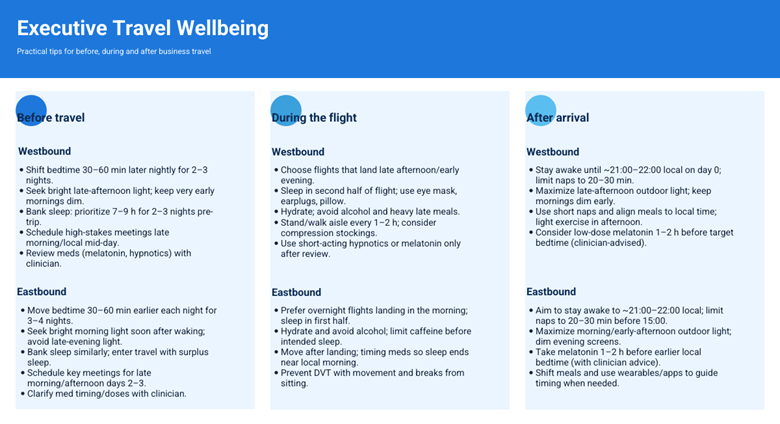
Source: Recommendations for Minimizing Jet Lag and Travel Fatigue. Sack RL. Clinical Practice. Jet Lag. The New England Journal of Medicine. 2010;362(5):440-7. doi:10.1056/NEJMcp0909838.
References
- The Pretravel Consultation. Rupert J, Groh T, Allen R. American Family Physician. 2025;111(3):245-253.
- The International Business Traveler. Davidson Hamer. CDC Yellow Book.
- Jet Lag. Sack RL. The New England Journal of Medicine. 2010;362(5):440-7. doi:10.1056/NEJMcp0909838.
- Jet Lag. Greg Atkinson, Alan Batterham, Andrew Thompson. CDC Yellow Book.
- Medical Advice for Commercial Air Travel. Powell-Dunford N, Adams JR, Grace C. American Family Physician. 2021;104(4):403-410.