Most entrepreneurs expect uncertainty to fade as their businesses succeed. More revenue, more experience, more proof—it should all add up to confidence. Yet for many seasoned founders, the opposite happens. The business looks stable from the outside, but inside, decisions feel heavier, stress is constant and the sense of being “on top of things” quietly slips away.
As businesses grow, uncertainty doesn’t disappear—it changes shape. And many experienced entrepreneurs respond in ways that quietly amplify stress.
In the Beginning, There Was Uncertainty
Entrepreneurs don’t follow well-marked paths. At the beginning of our entrepreneurial journey, we embrace uncertainty. We step into ambiguity, make bets without full information and build value where none existed before.
Many founders carry an implicit belief that this phase is temporary. That once the business is “successful enough,” uncertainty will fade and things will feel more solid. But as businesses grow, complexity compounds—more people, more handoffs, more dependencies—inside a world where everything is increasingly interconnected. Small issues now cascade faster, and disruptions can emerge from almost anywhere.
There’s a subtle and profound shift from “I can personally see the whole board” to “I’m running a system I can’t fully hold in my head.”
Our Relationship with Uncertainty Changes
As responsibility accumulates—payroll, customers, partners, reputation—uncertainty stops feeling like opportunity and starts feeling like threat, and control becomes the natural response.
Founders seek tighter oversight, make faster decisions and try to reduce unknowns. In doing so they become the bottleneck, the shock absorber, the place where everything unresolved lands. This creates stress and overwhelm, not because uncertainty has grown, but because their relationship to it has changed. That’s why seasoned entrepreneurs often feel more overwhelmed than they did at the beginning, despite being more capable, experienced and successful.
The problem isn’t uncertainty. It’s the belief that we should be able to eliminate it.
At this stage, ease doesn’t come from more control. It comes from recognizing the tensions that are shaping decisions, even when no single “right answer” exists.
Recognizing the Tensions in Your Business
In growing companies, the hardest decisions rarely have a clear right answer. They sit between competing forces—speed and quality, autonomy and alignment, innovation and stability—where progress in one direction creates pressure in another.
These tensions aren’t signs that something is broken. They’re signals that the business has outgrown simple solutions and entered a more complex phase.
When tensions go unnamed, they surface as chronic frustration, recurring debates, or decisions that keep reappearing in different forms. Naming the tension underneath the issue shifts the question from “What’s the right move?” to “What are we actually balancing here?” That shift alone can restore clarity in moments that previously felt stuck or urgent.
From Tensions to Insight
Once a tension is named, clarity comes from making the trade-offs visible, seeing what’s gained on one side and what’s risked on the other. This is accomplished by explicitly laying out the opposing forces at play, instead of carrying them implicitly in your head. When the upsides and downsides of both sides are visible at once, it becomes possible to see the whole picture, rather than reacting to the loudest pressure in the moment.
Take a common growth challenge: delegation. Many founders know decisions are bottlenecked with them and want leverage, however they experience delegation as increased uncertainty and a risk to speed and quality. As a result, they oscillate between pushing work out and pulling it back in.
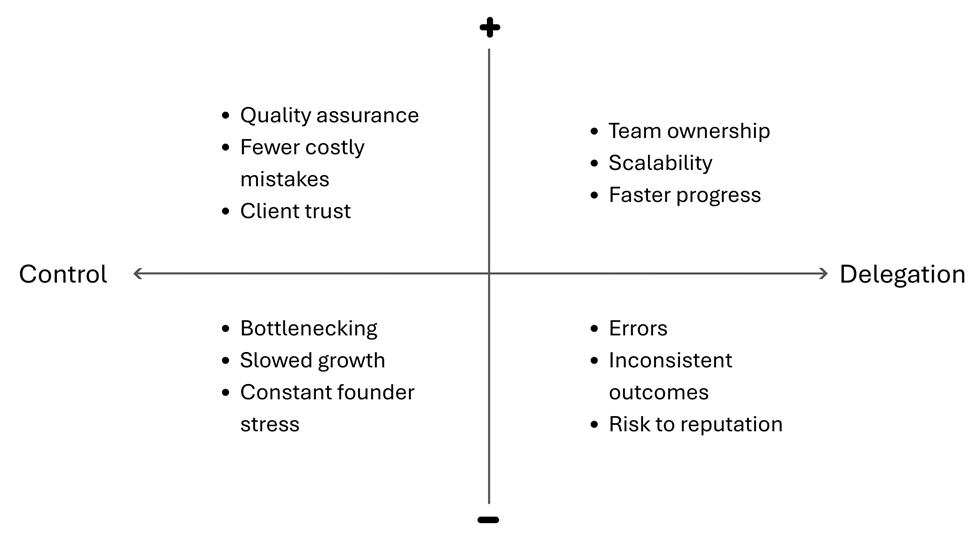
When this tension is visible, the decision shifts from “Should I delegate or not?” to “Where do we need quality assurance, and where can we tolerate learning and variation?”
Mapping a tension doesn’t resolve it. It creates enough perspective for decisions to be made consciously, rather than driven by urgency or fear. This doesn’t make uncertainty disappear. It changes how entrepreneurs relate to it by shifting uncertainty from something that feels threatening and urgent into something that can be worked with deliberately.
In complex businesses, certainty isn’t the goal. Clarity is. And clarity comes from seeing trade-offs explicitly, so founders can move forward without pretending those trade-offs don’t exist.