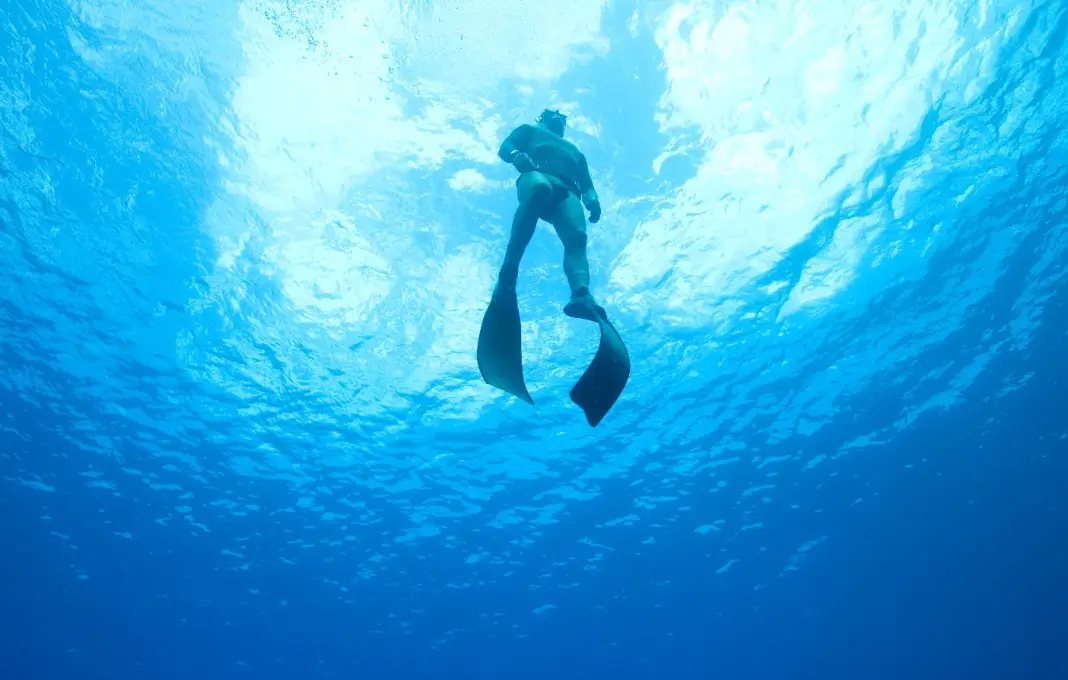
Long before Herbert Nitsch became known as “the deepest man on Earth,” he was simply a curious explorer of limits, of the mind, and of the quiet depths beneath the surface of human potential. Today, with 33 world records and a legendary dive to 253 metres on a single breath, Nitsch stands alone in a category of performance that almost defies imagination. But what’s most striking about him is not the record itself. It’s the system behind how he thinks, prepares, adapts and leads himself through extreme environments. Insights with profound relevance for leaders navigating the turbulence of today’s modern business.
In a world where executives face immense pressure from shifting markets, disruptive technologies, global tariff uncertainty, war, AI and increasing public scrutiny, few analogues are as apt or as vivid as watching a man descend into silence, darkness, crushing physical pressure and emotional stillness, and return not just unharmed, but triumphant. Free diving, at Herbert’s level, is not simply a sport, but a study in applied psychology, decision design, risk governance, discipline and the mastery of focus. And in conversation, he reveals these lessons with clarity that should capture the imagination of any senior leader striving to perform under pressure.
The making of a world‑class outlier
What stands out about Nitsch is that he achieved all of this while keeping a full-time job as an Austrian airline pilot. “My competitors were living free diving,” he notes, “and I was doing free diving as a side gig.” That forced him very early in his career to create a radically efficient approach to training—one grounded not in doing more, but in doing better. He didn’t have the luxury of endless hours underwater; he had to engineer performance through precision, intention and continuous refinement.
Herbert’s world was one built on constant adjustment. Conditions changed. Currents changed. Temperatures changed. His own physiology changed. “Even if you think something is perfect,” he told me, “there is always room for improvement.”
This mindset of being adaptive, curious and unafraid to rethink even the things that work is a leadership principle hiding in plain sight. In business, the external environment evolves constantly. Policy and regulatory landscapes shift overnight. Leaders who cling to past formulas because they once worked inevitably fall behind. BlackBerry is one of the clearest examples of a company whose once‑unassailable competitive advantage eroded rapidly. Organizations and leaders who, like Herbert, treat routines as living and evolving systems become more durable, more inventive and more resilient.
The discipline of focus in a distracted world
What happens inside Herbert’s mind in the final minute before a dive is perhaps the clearest window into his genius. “It’s better to focus solely on what matters,” he says. “Leave all the noise outside and live in the moment.” Even a flicker of excitement can be catastrophic because excitement consumes oxygen. He must be calm, not metaphorically, but physiologically.
Yet this isn’t something he stumbled into. It’s something he has trained for over decades. Other freedivers nicknamed him “the robot” because of his ability to enter an ultra-focused tunnel state at will. He describes it as a click, an internal switch that shuts out everything unrelated to the task. “All of a sudden there is this focused tunnel vision and nothing else matters,” he says.
For executives, this is a profound lesson. Modern leadership is full of noise, like emails, meetings, crises, shifting priorities, data streams and the constant hum of digital notifications. In fact, a report by HPCwire claims that 80 percent of global workers suffer from information overload, and in the U.S., 76 percent of workers feel that this overload contributes to daily stress. Furthermore, pressure amplifies the cost of distraction. High-stakes presentations, negotiations, boardrooms and crisis moments demand the very mental state Herbert has mastered: clarity, presence and the ruthless elimination of irrelevance.
Focus is not a personality trait. It is a practiced discipline.
Switching between the micro and the macro
Another vivid parallel exists in Herbert’s description of toggling between two modes: narrow focus during the dive and wide situational awareness immediately afterward. When he resurfaces, cognitive capacity returns slowly as oxygen rebuilds. Only then can he lift his head, scan the environment and make broader assessments.
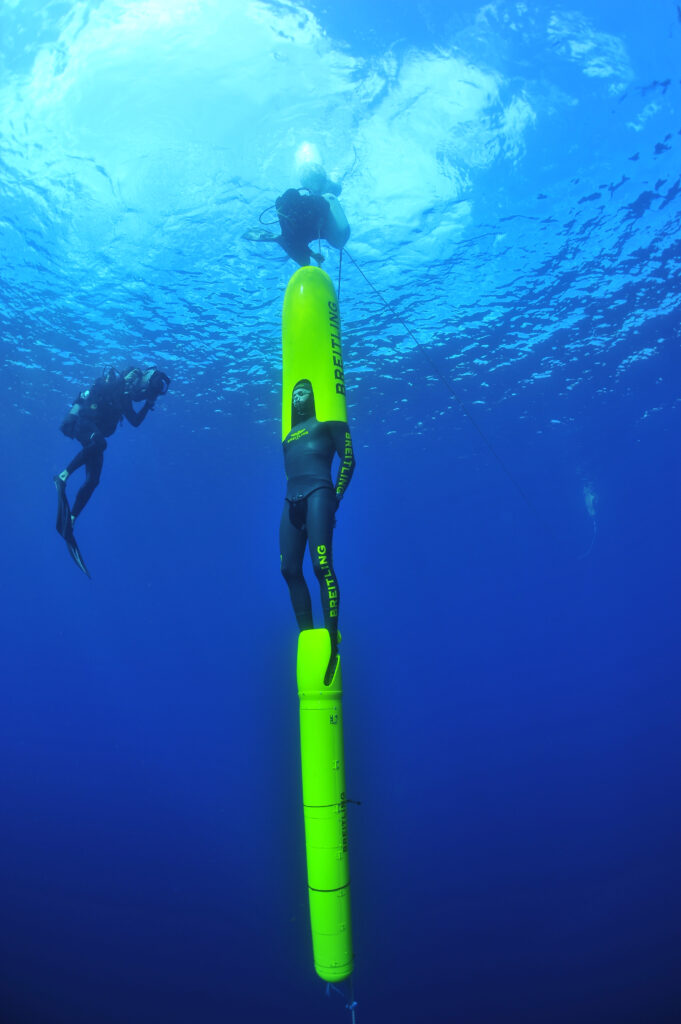
As I describe in my book, Outside In, Inside Out leaders must do the same, and move fluidly between the details that matter and the systems that shape those details. Strategy suffers when leaders stay too high for too long; execution suffers when they stay too deep in the weeds. Herbert’s approach shows this duality must be intentional. Leaders must practice moving between these modes with purpose.
Planning for risk before it arrives
Herbert’s philosophy on risk is one of the clearest leadership lessons he offers. At extreme depths, cognitive function collapses. Judgment narrows. Decision-making becomes unreliable. That means every critical choice must be predetermined. “Don’t think when you have a problem but think before about what kind of problem you might have and how to deal with it,” he says.
He continues with even sharper clarity: “The deeper you go, the less judgmental brain power you have. So, you need super simple plans—Plan A, Plan B and a clear rule for when to stop.” This is scenario planning in its purest, most unforgiving form. In free diving, the cost of improvisation is physical harm or even death. In business, the cost may be strategic misstep, reputational damage or financial loss. The best leaders, like the best divers, design their decisions in advance. They simplify questions before complexity hits. They develop stop rules before emotion enters. They reduce unnecessary branching. They remove ambiguity.
When uncertainty spikes, clarity saves organizations.
Discomfort vs. limits
One of Herbert’s most interesting insights revolves around the difference between discomfort and true limits. Physiologically, the urge to breathe is not the limit itself, but it’s an early warning mechanism. The actual limit lies further. But confusing the signal for the boundary is what stops most people.
Organizationally, the same pattern appears everywhere. According to McKinsey & Company, 70 percent of organizational change initiatives fail, often due to resistance stemming from ingrained cultural norms and human behavior. Leaders often mistake this friction for inability, retreating too early or pushing too hard. Herbert’s philosophy encourages a more nuanced approach: know when discomfort is just discomfort. But also know when a real limit is approaching, and respect that capacity threshold.
Purpose, motivation, and sustainable performance.
When asked why he continues to dive, Herbert’s answer is simple: curiosity. “You’re amazed by what you have achieved, and curious to see what more you can still achieve,” he says. It is not ego but exploration, and a drive to understand the boundary and what lies beyond it.
He also reflects candidly on longevity. “Your health is the most important,” he says. “You can’t buy a new body.” For leaders who burn themselves out in the name of performance, this is a sobering reminder. Sustainability is not the opposite of ambition. It is the foundation of it.
Depth reveals the truth
Herbert Nitsch’s achievements may exist in an extreme, uncommon domain, but the lessons behind them are universal. He shows that mastery under pressure, whether underwater or in the boardroom, comes from clarity, focus, preparation, adaptability and respect for the environment you operate in. In deep water, the pressure reveals the truth. In business, volatility does the same. Depth strips away illusion.
What remains is the quality of your thinking, the design of your decisions and the focused discipline you bring to moments that matter.
Herbert Nitsch has gone deeper than any human in history. But his greatest offering may be the leadership philosophy he surfaced with.