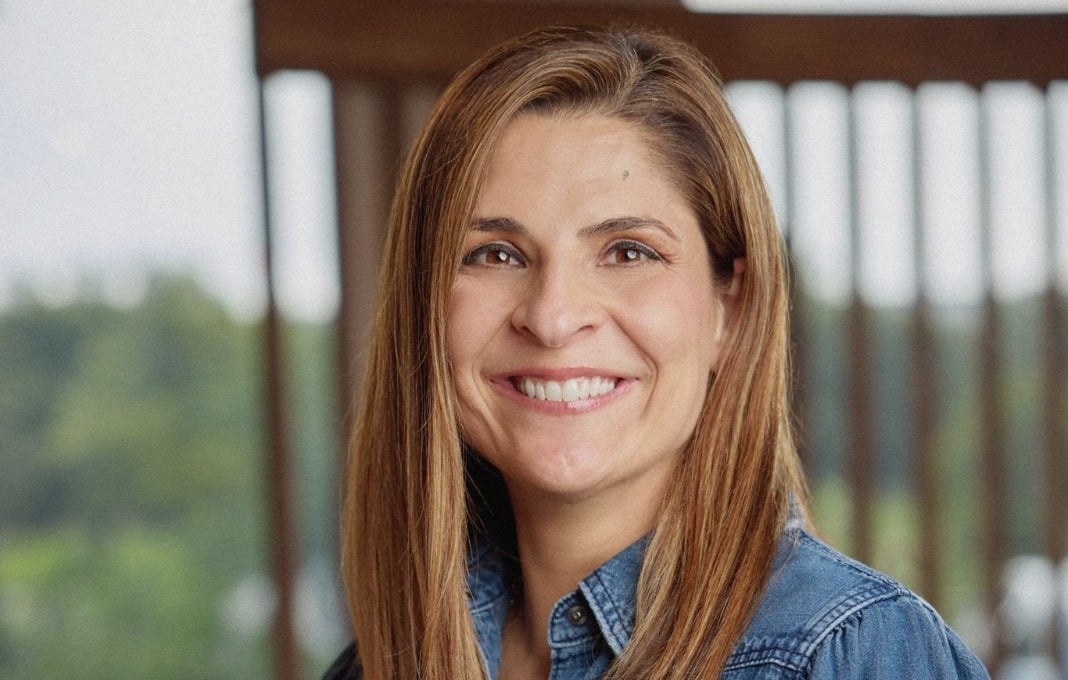
Veronica Schnitzius started her career at furniture manufacturer American Leather as an industrial engineer. Nearly 24 years later, she has worked her way across the organization—from engineering to sales to product development—before stepping into her current role as president and COO.
The journey has built a broad perspective on the business that now shapes how she leads the company. “When I did engineering, it was very rational. We design this and you get this. People’s behaviors, whether it’s customers [or] employees, is very much the same,” she says. “But it is really fun because I’m thinking three years in advance.”
In an interview, Schnitzius shares how she’s continuing to drive innovation in a slow-moving industry, how she’s tackling shaky consumer confidence and why failure is sometimes the goal.
What was it like switching from an engineering role to a strategy role, all the way to the C-Suite?
When I went to product development is when I really started seeing more the customer side. Even though you always are selling yourself, I just didn’t realize how much I was selling. But selling to a customer was different and I really liked it. I love selling. I love the challenge. And I think the fact that I was an engineer and I’d run manufacturing, I’d done the job, it gave me a lot of credibility. When you’re a salesperson you don’t have any idea the product that you’re building.
When I did engineering, it was very rational. We design this and you get this. People’s behaviors, whether it’s customers [or] employees, are very much the same. But it is really fun because I’m thinking three years in advance; where do I see American Leather in three years. Before, everything that I did was more short-term in many ways. Today is a bigger picture and we have a lot of moving parts: the market, the government, the economy, consumer confidence. It is very challenging, but in a very different way.
What would you say is the biggest challenge that you’re facing right now? You’ve been with the company for over two decades, so how has that changed from when you started?
A lot has changed. From the company, we like to change. I think one of the things that has kept me there is we always think, what can we do better? How can we do it differently? The furniture industry is not known for being super innovative. We don’t feel that it is okay just to be like everybody else. I love that we continuously change internally, process, equipment, people.
I think one of the biggest challenges for us today is consumer confidence. What’s happening externally with, be it tariffs, be it the world, be it the lack of [knowing] what’s going to happen in a year. Furniture is pretty much a luxury. You need a sofa, but you don’t need a $5,000 sofa. You can go to Ikea and buy a futon for $600. But it’s something that fills your house, is the center of your house. It is an investment. So when the market is up and down, when you don’t know if, six months from today, what costs this [amount] today is going to cost three times more, or less, that concerns me.
We cannot control it. We can control doing great product. We can control being ahead, being with the trends, but we cannot control consumer confidence. Today it’s probably my biggest concern. It feels very cloudy how there are rules that are changing that we didn’t think could change. But it’s happening. I feel more comfortable today than I felt a year ago. That it is what it is and we survived this year. That’s the challenging side. On the good side, being a domestic source has given us tremendous opportunities that maybe two years ago we didn’t have. There’s always some good with some challenging times.
What have been some strategies you found that have worked to navigate that uncertainty?
I think not being attached to the outcome. I think Covid was an amazing school for that. It made us more agile, more open. We are going to grow. But not being so fixated on a specific thing has helped us navigate and adapt. Adaptability has been huge for us. Like, hey, this is the challenge. Don’t cry over it. Let’s figure it out and let’s work together and we’ll get through it. Being open to [the possibility that] we may fail. I think one of the cool things for us also is we are okay failing. Sometimes you learn a lot more from failures than successes.
Do you have any notable failures that sparked a turnaround?
I wouldn’t say it’s a failure, but I thought the outcome would be bigger. We had this idea that we were going to create this shop-in-shop. I thought, how hard could it be? It wasn’t as easy. It’s one thing to build these shops, [then] it’s maintaining it, it’s making sure they see it the same way we do it. We cannot be policing how people sell the product, what they say about it, how they move the product after we leave.
But from that came a lot of good things that helped us do other stuff on the journey. It wasn’t necessarily a failure, the initiative. And if we had been fixated that that was going to be the outcome, it probably would have been different. When we went in with this idea, we were like, oh, this is not how this works. We pivoted and we took elements of that and are applying it to retail, and that has helped us. But it wasn’t as easy as I thought it would be.
I know lean manufacturing is something that you said you feel strongly about. How do you manage your supply chain and inventory when you have a highly customized product?
The term lean is so broad, and it means so many things to many people. To me, defining lean is like, how can you utilize your product better? How can you be more nimble to react to the process? And how do you build complexity where the employee doesn’t see it. Because at the end of the day, one of the most difficult things in manufacturing is learning curve. You and I can go and buy the same equipment, [same] raw materials in many ways, but it’s people and how they use it. To me, lean, it’s not like it’s a philosophy. It’s how we do things better every day. I don’t see us ever changing that.
From an inventory perspective, being domestically sourced is huge because we don’t have to waste six weeks for something to come from somewhere. Inventory is probably one of the most tricky things just because it’s a fashion business. Everybody likes green now, so we buy X amounts of green and everything is custom-made. It’s not like I’m building three months of inventory to sell. But that also has so many big advantages.
We do have probably more inventory than we want. We do probably have more obsolescence than we think we should have. But that’s part of doing business, right? You make a bet and sometimes you win, sometimes you don’t. I think also from the supply chain, the biggest thing for us is to have amazing relationships with the vendors. I cannot be a good manufacturer if I’m not fair to my vendors. We treat them well, we give them the respect that they deserve. They do the same to us. We do the same to our customers and to our employees. And the synergy is built. One thing we also try to do with suppliers is we don’t want to be nobody for a lot of people. We minimize the number of suppliers, so we can be very important to very few.
How do you think about your long-term strategy and your growth strategy working in a made-to-order space?
I just see even more opportunities, honestly. I know everybody talks about AI. You go in and you build an avatar of whatever in 10 seconds. This idea that I can get what I want super fast is only even beginning in many ways. Think about Amazon. You can order your shampoo [while you are] talking to me and it’d probably be at your home in two hours. It’s crazy. And that’s what the consumer is used to.
Imagine building what you want fast. On Amazon, you buy what they have, right? Having that ability to do customization domestically in a quick lead time, I think people are just starting to understand that that’s possible, that makes sense and want more of it. I think this idea before, that speed was cheap, is changing. People are like, oh, it was fast because it was totally cheap. That’s not necessarily the case, but it’s educating that end consumer that because it doesn’t take 20 weeks doesn’t make it less quality.
Speaking of AI, how are you leveraging technology?
Honestly, we are leveraging technology all the time. All our cutting processes are machine controlled, the systems, ERP, paperless, QR, things like that. And with AI, it’s customer experience training bots so we can respond to customers faster.
You talk about inventory, those algorithms are so powerful and they can compute data so fast that we can dump a bunch of data and it can predict maybe better some of the patterns that we could do with the tools that we have. It just is everywhere. Product development—we can create models, put it in a space visually without having to cut anything and spend any money.
It is interesting, we talk about this all the time. I believe people are the biggest asset. This technology is not going to replace people, but we’re utilizing their skills better because sometimes it’s hard to find skilled labor. We have to be very careful that, if we don’t need skilled labor, how can we utilize technology instead?
I know the talent question is a big stress point for manufacturers. How are you approaching it?
When we designed the company, we designed the process and the product to make sure that we minimize the learning curve. We utilize a lot of technology with CNC, with instructions, with color codes. We joke that we have more engineers than any furniture company, and that can be a curse and a blessing because we tend to complicate things sometimes more than we need to. But it’s like putting a lot of engineering thinking through the process so that is easier for that employee, so the skill level is less, or at least the learning curve is shorter.