After years of workforce volatility, new data from Chief Executive’s Financial Performance Benchmarks Report shows headcount growth slowing sharply across frontline, sales and other roles, with most organizations opting to hold staffing levels steady rather than expand aggressively through 2025. Expectations for 2026 suggest that the trend won’t continue, with a majority of companies projecting increases to overall headcount for the year ahead.
But beneath the overall stabilization, a new factor is reshaping workforce decisions: artificial intelligence. Survey respondents from nearly one-third of companies—31 percent—said they had already slimmed headcount thanks to the use of AI in their organizations, making it the third most common reason for frontline workforce reductions in 2025.
Staffing trends over the past three years tell a clear story of expansion followed by a degree of easing back. In 2024, companies were still in growth mode. More than half (53.9 percent) reported increasing frontline headcount, with 11.6 percent growing by more than 10 percent. Only 14.2 percent of firms reduced frontline staffing that year.

By 2025, that growth momentum had faded. Just 35.2 percent of companies reported any frontline headcount increase, and only 10.2 percent grew by more than 10 percent. At the same time, reductions became more common: 21.3 percent of firms cut frontline headcount, while a plurality—43.4 percent—reported no change at all.
The shift suggests companies increased hiring amid demand and labor availability, then reassessed in 2025 as cost pressures, revenue concerns and economic uncertainty reshaped priorities. In fact, when asked about the primary factors driving the change in headcount, regardless of whether the company increased or decreased the number of their frontline employees, a change in company revenue was the most popular response—selected by 71 percent of companies who increased frontline headcount in 2025 and 59 percent who decreased.
Investigating second and third most impactful factors for each reason reveals even more information about company strategy. For those who increased frontline headcount, the next most popular factor was expansion—at only 31 percent—compared to 71 percent who selected a change in revenue. When looking at companies who decreased frontline headcount in 2025, cost-cutting initiatives follow closely behind revenue change at 52 percent.
The third most popular factor for reducing frontline workforce in 2025 was artificial intelligence reducing workforce numbers—already happening for almost one-third of companies, at 31 percent.

While AI’s impact on headcount is still emerging, it’s already matching or exceeding traditional drivers like restructuring and M&A as a force shaping workforce strategy. Nonetheless, revenue is the biggest driver of headcount change. The pattern becomes even clearer when examining frontline employee headcount change by each company’s revenue growth rate. Companies with flat or negative revenue growth in 2025 are overwhelmingly reporting higher proportions of decreasing their frontline headcount, while companies with increasing revenue are reporting growing their headcount.
For example, 43 percent of companies with revenue declines up to 5 percent report reducing frontline headcount. When looking at companies with revenue growth up to 5 percent that number shrinks to only one quarter. For companies with even faster-growing revenue, up 5 to 10 percent, half of the proportion (12 percent) report reducing frontline headcount compared to companies with growth up to 5 percent.

When examining the frontline employee turnover, we see a related story. It’s no secret that churn and turnover hit record levels around the pandemic and took some time to even out. Data from the report shows clear growth in frontline employee retention from 2022 and onward. In 2025, 43 percent of companies reported frontline employee turnover under 5 percent, this is up from 42 percent in 2024, and much higher than the 28 percent who reported the same in 2023. Despite this, the proportion of companies reporting high turnover rates (25 percent+) climbed slightly in 2025 to 12 percent, from 10 percent in 2024.

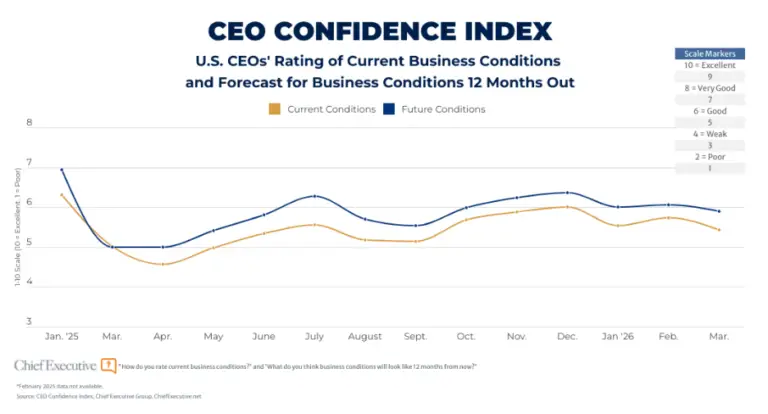
Looking ahead, data from the January CEO Confidence Index shows that 53 percent of companies plan to increase their overall employee headcount in 2026, with 47 percent of the increases concentrated below 10 percent. 18 percent of companies reported planned reductions to headcount, while 29 percent plan no changes.
This is a clear change from 2025, when cost-cutting, agility and reactionary measures were top-of-mind and only some 35 percent of companies ramped up headcounts. Whether AI will accelerate or moderate these hiring plans remains to be seen, but with nearly a third of companies already experiencing AI-driven headcount reductions, the technology’s influence on 2026 workforce decisions may be significant. Early data is showing that 2026 may shape up to be a year of growth and hiring, although it may be too soon to tell.

For a detailed breakdown of employee trends by company size, industry and revenue growth rate, +5 more breakouts, and to benchmark your own business performance, refer to the 2025–26 Financial Benchmarks Report for U.S. Companies from Chief Executive Group. Additionally, keep updated with monthly updates to our CEO Confidence Index for a first-look at strategic moves.