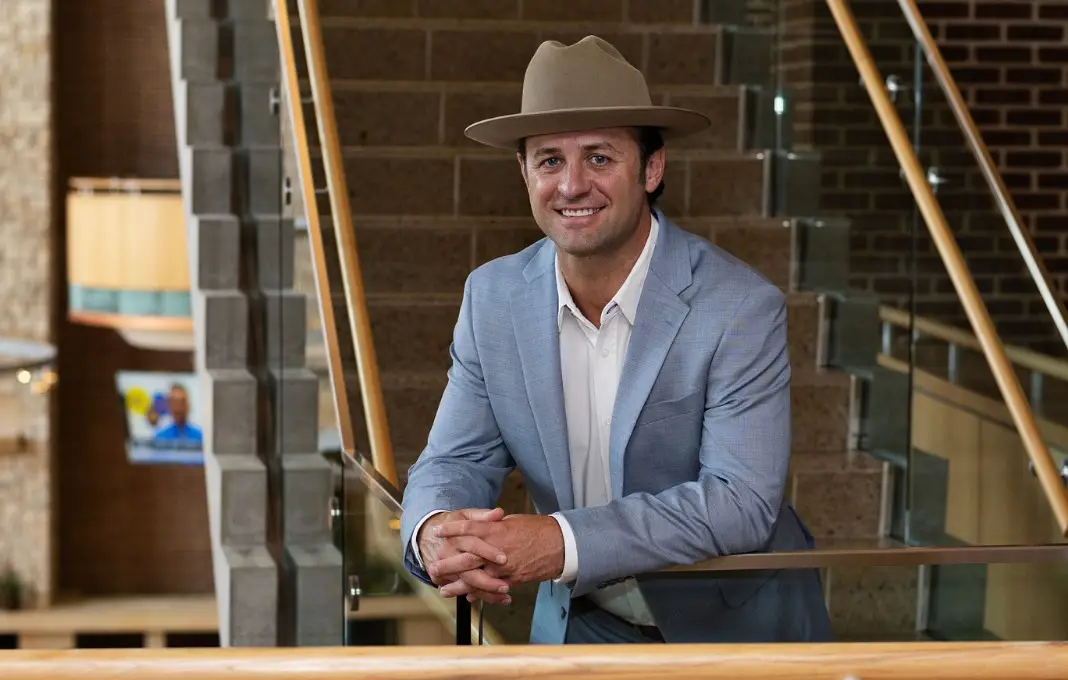
At All Metals Fabricating, evolution has been a constant rather than a reaction. The third-generation, family-owned Texas manufacturer has steadily expanded its capabilities and complexity, growing from a traditional sheet metal shop into a contract manufacturing partner serving industries like aerospace, telecommunications and energy.
Today, CEO Lance Thrailkill is accelerating that trajectory through deep investments in digital manufacturing, automation and connected systems. In an interview, he shares how he is improving visibility, throughput and scalability while positioning the business to meet rising demand tied to AI, electrification and data infrastructure.
What is the history of your company and how has it evolved over the years?
All Metals Fabricating was founded in 1953 as a Texas sheet metal shop built on craftsmanship and reliability. The pivotal moment came in 1978, when my grandfather, Bill Thrailkill, acquired the business. He didn’t just upgrade equipment—he raised expectations. In his first year, sales quadrupled because he brought discipline, accountability and an unwavering commitment to customer value.
That foundation carried forward through my father, William “Billy” Thrailkill Jr., who expanded our capabilities and helped transition the company into a full-service metal fabrication and contract manufacturing partner. Today, we are a third-generation, family-owned company, serving customers across telecommunications, aerospace, defense, medical, energy, transportation and industrial markets.
What hasn’t changed in more than 70 years is how we operate: We keep our word, we think long-term and we invest ahead of the curve. What has changed is the scale, complexity and technical depth of how we deliver on those commitments.
You’ve been identified as an industry trendsetter for embracing next-generation technology and Industry 4.0. Tell us about that.
We made a clear decision early on: Manufacturing excellence in the future would be digital, automated and data-driven, or it wouldn’t be sustainable. At All Metals, Industry 4.0 isn’t a concept—it’s how we operate.
We’ve integrated JobBOSS, enterprise resource planning software for manufacturers, as well as machine connectivity, real-time analytics, automation and robotics across our facilities, so decisions are based on facts, not assumptions. Our teams—from operators to leadership—have real-time visibility into performance, flow and capacity.
We’ve invested heavily in advanced robotic welding, automated bending, high-speed laser and punch systems, machine monitoring and an automated, digitally-driven quoting software. The result has been meaningful improvements in throughput, predictability and engagement.
Technology at AMF is not about replacing people. It’s about equipping skilled professionals with better tools and better information so they can perform at their best. Recognition from ECI, JobBOSS and IndustryWeek matters—but what matters more is that our customers experience the difference every day.
What’s next for All Metals Fabricating?
We’re not slowing down; we’re being very intentional about how we accelerate.
We’re continuing significant investments in automation and digitally connected manufacturing to improve speed, precision and scalability. At the same time, we’re moving beyond automation toward smarter, more autonomous workflows, where data helps guide decisions before problems arise.
We’re doubling down on our role in critical infrastructure manufacturing, particularly for data centers and power generation, where reliability, speed and precision are non-negotiable. As AI, cloud computing and electrification expand, the infrastructure behind them must scale just as fast—and we’re building specifically for that demand.
We’re also expanding our machine shop into a core pillar of the business by investing in multi-axis machining, automation and lights-out capabilities. That allows us to increase vertical integration, shorten lead times and deliver more complex, higher-value assemblies under one roof.
Just as important is how we run the business. We’re investing in software and AI to improve quoting, scheduling and decision-making—not to add complexity, but to remove friction. Our goal is to scale responsibly, operate intelligently and create a better experience for both customers and employees.
At the end of the day, our focus is straightforward: build critical infrastructure better, faster and more intelligently, while setting a higher standard for modern American manufacturing.
You also co-founded PRINT3D Technologies with Craig Pettit. Tell us about that.
We started PRINT3D because the construction industry hasn’t meaningfully changed in decades, even as costs, labor shortages and housing demand continue to rise. Our focus is practical innovation. We’re not trying to reinvent architecture; we’re focused on reinventing how homes are built so builders can construct faster, more consistently and more affordably without sacrificing quality or design.
Accessibility is the key word. If 3D printing is going to make a real impact on housing, it has to work within the existing building ecosystem. That means systems that are reliable, repeatable and compatible with how builders already operate. Our goal is simple: put advanced construction automation into the hands of builders who actually build homes every day.
What’s next for PRINT3D, and how does it fit alongside your broader vision as a manufacturing leader?
For PRINT3D, the next phase is about making 3D-printed homes both scalable and architecturally familiar.
One of our major development efforts is a rotary printhead designed to print a square bead, allowing walls to resemble a traditional brick pattern. This is an important step because widespread adoption doesn’t happen when homes look experimental—it happens when innovation blends seamlessly with traditional architecture. Our goal is to enable builders to 3D print homes that look and feel familiar while benefiting from the speed, efficiency and consistency of automation.
We’re also moving from concept to execution. This year, we started construction on the first-ever 3D-printed wilderness and wellness Airbnb retreat in Mingus, Texas. This project is designed to prove what’s possible—not in a lab, but in the real world—by combining advanced construction technology with thoughtful design and livable spaces.
At the same time, we’re building a rural Opportunity Zone housing project. It gives investors a way to defer capital gains taxes while providing solid returns, and, more importantly, it helps deliver affordable housing where it’s needed most. For us, innovation is only meaningful if it solves real problems and creates lasting value for communities.
PRINT3D complements everything we do in manufacturing. Whether it’s metal fabrication or construction technology, the principle is the same: Use automation, data and disciplined execution to solve problems at scale—without losing sight of people. That’s where real impact happens.