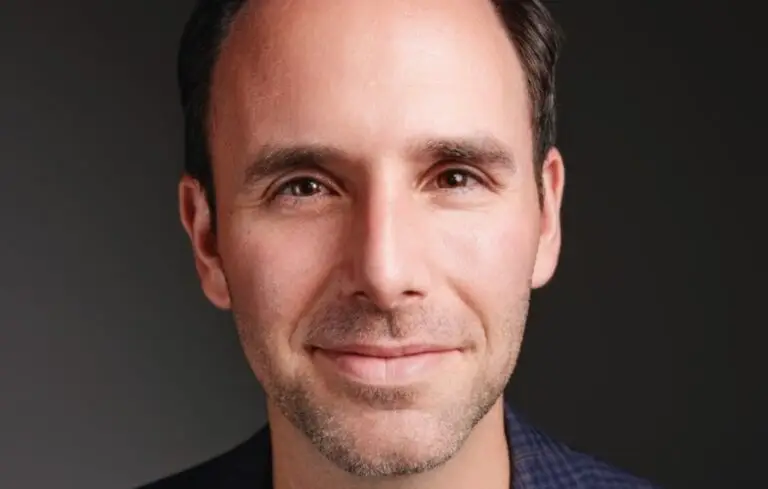
Editor’s note: The following is excerpted from The Perception Revolution: How to Turn Neurodivergent Insights into Competitive Advantage(Fast Company Press, August 2026). It’s by Peter Allen Mann, the CEO of Oransi, a Virginia-based maker of air filtering and cooling products who fully reshored his operations to the U.S. over the last few years, one of the first manufacturing firms we know of to do so. He’ll detail how he did it—it’s really smart and ties in with this excerpt in unexpected ways—at our upcoming Manufacturing Leaders Summit in St. Louis, May 4-6. It’s coming up fast. Join us >
From the Introduction: “The Day Everything Changed”
The alarm sounded at 0300 hours. We were in the Red Sea, tensions high. An unknown aircraft was approaching our ship at high speed. I was serving a six-month deployment toward the end of the first Gulf War. It was the first time I, and most of the sailors on board, had been to a war zone.
In the Combat Information Center, the nerve center where life-and-death decisions are made, my superior officer was screaming at the technicians, his face red, white foam forming at the corners of his mouth. Have you ever seen someone so angry they foam? It’s unsettling. It’s like watching someone become their own barista, but the only specialty they are serving up is rage.
The captain watched for exactly 90 seconds before making his decision. “You’re relieved,” he said quietly to the raging officer. Then, turning to me, he said, “Mann, you have the watch.”
In that moment, I learned something that would shape my entire approach to business: When toxic leadership threatens the mission, protecting your people isn’t just right; it is essential for survival.
My superior never forgave me for remaining calm when he couldn’t. For months afterward, he found countless small reasons to scream at me, seemingly in retaliation for this perceived humiliation. But the crew? They gave me something more valuable than forgiveness. They gave me their trust. And I gave them mine. And with that trust came something I’d later recognize as the foundation of all sustainable success: establishing genuine, authentic relationships regardless of the stress level of the environment.
What I didn’t understand then, what would take me decades and a late-in-life autism diagnosis to fully comprehend, was that my ability to remain calm wasn’t coldness or detachment. It was a different way of processing chaos, a heightened perception that could sense patterns in the noise, feel the crew’s real needs beneath the crisis, and create stability where others created storms.
‘I Wasn’t Alone’
At 55, after building successful companies, I received an autism diagnosis that reframed my entire life. My wife had called me in to watch a CBS Mornings segment about an autistic woman at the National Geospatial-Intelligence Agency. As the woman described her ability to hyperfocus and see patterns others couldn’t, something clicked.
Finding out you’re autistic at 55 is like finding out there’s an instruction manual you didn’t know existed after assembling IKEA furniture without one for five decades. Oh, so that’s why I alphabetize my anxieties. Suddenly, everything made sense: Why I didn’t speak until third grade. Why I could predict business outcomes with accuracy. Why certain people made my skin crawl within seconds of meeting them. Why my greatest strengths were labeled as weaknesses.
But the real revelation came next: I wasn’t alone. According to research, 15–20 percent of the population—and more recent studies show the number being closer to 30 percent—shares this heightened perception. We’re not broken. We’re not too sensitive. We’re precisely calibrated detection instruments in a world that profits from numbness.
And here’s what changes the way we should be seen: The very traits that make us targets for toxic people also make us invaluable assets for innovation, problem prevention, and authentic leadership.
How to ‘Thrive’
Right now, the global economy is hemorrhaging value at a rate that should terrify every leader, investor and worker alive. According to the World Health Organization, depression and anxiety alone cost $1 trillion annually in lost productivity. In the U.S., organizations spend up to $223 billion in turnover costs over five years, while workplace stress contributes $125 billion to $190 billion annually in health-care spending.
But here’s what those statistics don’t capture: These departures largely consist of the nearly 30 percent of the population who process information more deeply—individuals who are neurodivergent, highly sensitive or both. They’re our most perceptive, innovative people who can see problems months before they explode. They leave not because they’re weak employees who “can’t handle pressure” but because they see problems others miss and so, when environments become toxic, they’re the first to recognize it and the first to go.
I achieved a 95 percent team retention rate not by using different strategies in different contexts but by honoring the same biological truth everywhere: When people’s nervous systems feel safe, they thrive.