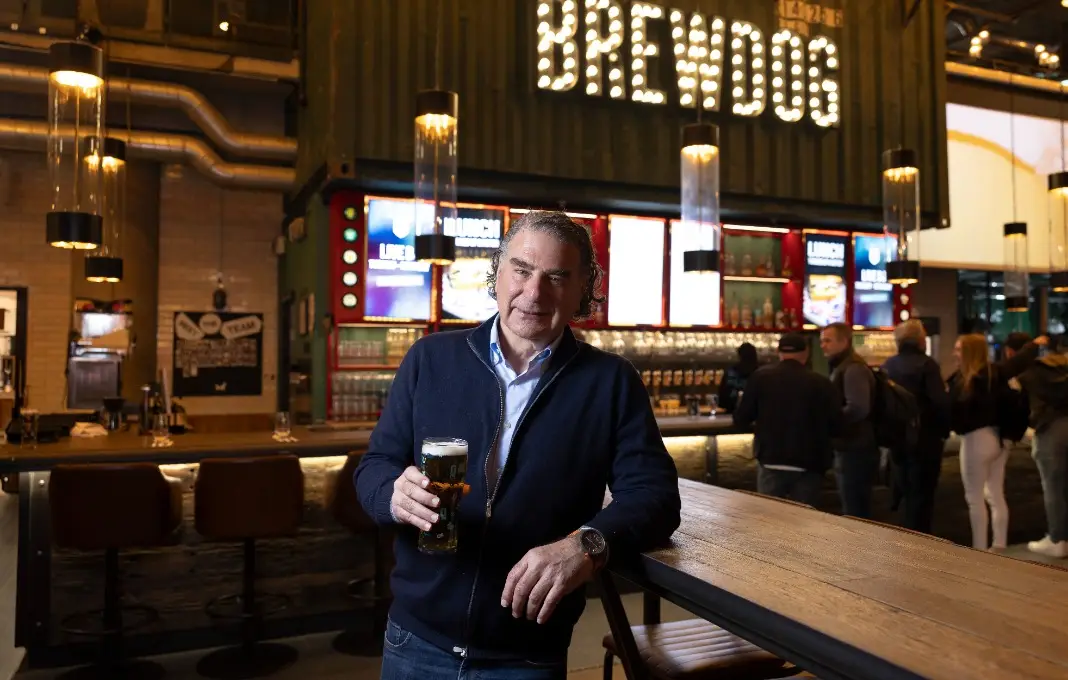
For more than three decades, Irwin Simon has made a career out of skating to where the consumer is headed. The Cape Breton–born operator built Hain Celestial into a multi-billion-dollar natural and organic powerhouse before “better for you” was a category, much less a strategy theme, then walked straight into the fire again by taking over Aphria in 2019 and helping forge what is now Tilray Brands. Today he’s trying to do something most CEOs are trained to avoid: build a global, multi-category business at the center of an industry regulators still haven’t finished defining.
Simon’s résumé reads like a classic consumer-goods success story—Haagen-Dazs, SlimFast, founder, roll-up artist, public-company mainstay—but he talks like a founder who never quite left the scrappy phase. He is blunt about the deals he didn’t do (including a billion-dollar acquisition his own team voted down the night before closing), the people decisions he got wrong, and the missed chances to hand the company to someone better suited to the next chapter. He will tell you his best and worst calls have both been about people, that some of his own successors were “messiahs on motorcycles” who didn’t work out.
At Tilray, the constraints are different but the themes will be familiar to any CEO navigating a complex regulatory environment. Federal cannabis reform in the U.S. remains perpetually on hold, so Simon has used diversification—into craft beer, beverages, spirits and hemp-based wellness—as his workaround for scale. He talks about cannabis as a medical platform that will cannibalize parts of the beverage industry, about the need to throw a wide net now and later decide what to spin off, and about the unglamorous math of funding research, innovation and regulatory compliance long before the category’s promise fully shows up in the P&L.
If there’s a through line in Simon’s story, it’s his obsession with building teams and boards that will actually challenge him. In the far-ranging conversation that follows, Simon talks candidly about how he thinks about diversification, discipline and succession—and what he’d tell his younger self about building something that lasts in markets that won’t sit still.
You have built and led multiple category-defining companies. What through line do you see in your career, and what do you think you consistently got right as a leader in very different markets?
First and foremost, I am someone who sees possibilities and envisions future opportunities. Sometimes I see great things and sometimes I see ghosts. What I’ve gotten right is recognizing the good opportunities and staying away from the ghosts. Second, some of my best decisions in life have been about people and some of my worst decisions have also been about people. Third, I rely on my gut. And fourth, I seek out a lot of opinions and advice from others.
I don’t believe in arrogance or thinking I’m the smartest person in the room. I value sound advice, and while it’s lonely at the top and someone ultimately has to make the decision, you can’t make decisions by just throwing things against the wall.
I’ll give you an example. When I had Hain, I worked on this big deal trying to buy Dole. We spent time on it, we were all set to finalize. The night before, I sat with my team of nine people and I went around the table. Eight voted against it, and I was the only one who voted for it. I went home that night, didn’t sleep, ripped everything apart—and we didn’t go with it. It could have been transformational. It was a billion-dollar deal. One of the toughest things I had to do was call this guy David Murdock and tell him no. I’m big on consensus, but taking that consensus and then deciding whether I’m going with it or not [is tough]. I’ve had some great success, I’ve had some good success and I’ve had failures. You have to accept when you have a failure.
When you look back at taking Hain from idea to multi-billion-dollar global business, what are one or two decisions you’d still make again today and one you might do differently?
I spent 25 years at Hain, and my three takeaways are: One, along the way, I had multiple opportunities to sell the company. [Today], I’m big on, it’s okay to ring the bell because nothing is forever. Two, I think you’re seeing it today, everything has a shelf life. As a CEO, as a founder, after 10 years, should you have moved on to executive chairman and brought a new CEO in as you get set in your ways? And the third, I did good things for people and I did make mistakes with people.
On the other hand, when I left Hain, it was a $3.5 or $4 billion-dollar market cap. Today it’s less than a hundred million. That’s very disappointing. As a founder, as a CEO, is there a time to sell the business to someone else that could take it to the next level? Is there a time to bring in a CEO and you move to the chairman seat? The people who bring it along the way—were they always the right people? I think the strategy on the acquisitions—we did 65, 70 acquisitions. Was every acquisition perfect? No. But the majority of them worked and they were very much about growing the company domestically and internationally. I’m also big on diversification. They’re the big things that you think back afterwards about what were the mistakes and what were the positives. I talk about them today to multiple people and want to share it, hoping people will take my findings and use them.
Tilray defies easy categorization—it’s part cannabis company, part craft-beer conglomerate, part wellness brand. When the market struggles to label you, is that a competitive advantage or a communication challenge?
When I had Hain, I was a consumer packaged goods company and labeled as a consumer packaged goods company. I could sell to Walmart, Whole Foods, Target, whoever.
Tilray has been unique because of the evolving regulatory environment in regards to cannabis. It is not federally legal in the U.S. and only legal internationally for medical use in certain countries. As a result, I’m restricted at where and how I can operate.
So if you want to grow and scale, you have to diversify. There are four legs on a chair, there are four legs on an animal—so what are the different pillars you need to support the business? You have to diversify.
And don’t forget, the legal cannabis industry is groundbreaking, something new. So I’m going into new territory there, both recreational and medical. Now, why did I go into the beer business? The beer business has not been easy, with less consumers drinking beer today and a lot of craft beer. There’s times I sit back—and you saw our announcement with Carlsberg to bring them market infrastructure—but because of the regulatory headwinds that I have against me, because of the toughness in the category and the medical research I wanted behind it, I’ve gone into categories where each one has unbelievable opportunities and each one has restrictions.
I believe cannabis has tremendous opportunity from a medical standpoint in Canada, the U.S. and worldwide. I see that what’s cannibalizing alcohol today is cannabis. I see the cannabis industry ultimately taking a big chunk out of the beverage industry. There’s a medical growth opportunity in regards to pain, anxiety, sleep and cancer. To some degree I’m throwing a net out there, but hopefully I’ll be able to bring all these together under one [roof]. If not, do I spin one of these off in future years?
The big thing in running the business and building what I’m trying to build is my cost of being a public company, my cost of infrastructure, my cost of research, my cost of innovation. I’ve got to have a certain business scale to be able to afford that. That’s why I have to diversify the business to get to a scale, because cannabis can’t get me to that billion-dollar number today. Beer’s a big business that’s not going away, and my whole thing is: How do I make beer fun again? With our wellness business in Manitoba Harvest and our hemp, I’ve been there before and I look at wellness. How do I bring all these together and look at each one with a common denominator of bringing people together, while dealing with the regulatory piece?
The U.S. cannabis market has been perpetually “almost there” on federal reform. How do you make long-term capital and strategic decisions when you can’t control or predict the regulatory timeline?
Great question. That’s why today, as I build out the business, I focus on creating strong, independent verticals—a successful beverage business, a successful wellness business and a strong cannabis platform across medical and adult-use where federally permissible.
We’ve conducted many medical cannabis clinical trials across Canada and international markets and we’re continuing this work.
We’re taking that research, those clinicals, and bringing it to the FDA and DEA here to help guide on future approvals from a medical standpoint.
You said some of your best decisions and some of your worst decisions have been people. What’s been the “secret sauce” in attracting and developing the best—and where have you made mistakes?
Everybody wants to go and get somebody who’s gone through the P&G or the Pepsi training and gone through the big-company training. And they go through some great training. But at the end of the day, have they had training wheels on their bicycle the whole time? They never really had to make a payroll. They never ultimately had to make a number because it tied up into a bigger number. Do they have those entrepreneurial bones in their body?
I have a philosophy now: I’ll never hire somebody coming out of a big company like a Nestlé, like a Pepsi, where I’m their first job after they’re coming out. It’s like, and again I’ve been married, it’s like you never want to be the first person someone dates after they’re divorced. I never want to hire somebody where I’m their first job after they’ve come out of a big corporation.
Second, I have another philosophy: If I can’t call you on weekends and I can’t reach you then, and you’re not willing to have meetings and not willing to work weekends, I’m not interested.
Third, you’ve got to believe in what we’re doing. I’m not asking you to smoke cannabis—I don’t smoke—but you’ve got to believe in what we’re doing.
Last but not least, I’ve got to understand what you’re bringing to us that we’re missing today and that you believe you’re going to learn from us.
I’ve gotten it wrong, trust me. I’ve had people that were the messiah on a motorcycle driving in and they were my successors, and I got it wrong when I hired the person to replace me at Hain. I’ll probably have PTSD, if I ever leave Tilray, in finding my successor. I’ve gotten it wrong on a CFO where I had EY and lots of people interview the person. When you get it wrong, you’ve got to make that decision quickly.
At the end of the day, you have to ask: Do they have entrepreneurial instincts? Have they ever had to make payroll or truly own a number?
How do you make sure people know you’re not looking for yes-men—that you want the truth?
I hate “yes people”—don’t “yes” me. Don’t accept what I say as the answer. Challenge me, tell me I’m wrong. That’s important, to be challenged and speak up. I’m big on a flat organization. Organizational charts are important—we have to have them, succession planning, we go through it with our comp committee and our board. But everybody knows their role, everybody knows who they work for. I hate boxes. You shouldn’t be in your box. When you die, maybe you should be in your box, but I hate people [who think] you’ve got to be in your box. It’s important to have people where it’s okay to come out of your lane.
I’m accepting when it’s not my message that has to be delivered. When there’s quotes, it doesn’t have to be Irwin’s quotes, it’s other people’s quotes. I’m big on other people owning stuff.
You’ve said you’re relentless about team-building and pushing people to bring solutions, not just problems. How do you balance that high bar with creating a culture where people feel safe taking risks, admitting what they don’t know and failing?
I have a philosophy: There’s a 48-hour rule here. You’ve got to make decisions within 48 hours. Second thing is, it’s okay to fail. You miss numbers—why did you miss numbers, what’s the problem and how do we fix that? And if there’s bad news, don’t wait till Friday afternoon to give it to me, because bad news is not like wine, it doesn’t get better with age. I’m okay with making mistakes—but it’s, what did you learn from that mistake and how are we not making that mistake again.
High-performing executives today have different expectations than 30 years ago. How has your leadership style evolved to meet changing expectations of the talent you most want?
I don’t believe you need to be in the office five days a week. We offer flexibility while maintaining accountability.
Secondly, I’m big on open-door policy to bring that generation in to know what’s going on. They can’t learn just from emails and press releases. I’m big on bringing in that next generation into meetings, board meetings. I will bring them into decisions. I will bring them in to be part of acquisitions and let them learn from that. I have four kids and they went to great universities, [but] when they come out of university, they are not prepared for this outside world. I was self-taught because I had to be.
One of the biggest problems we’re still feeling is Covid—everybody on a computer at home, behind the screen, in pajamas, never had those disciplines. That’s what we have to overcome today: be part of a work environment, develop people with a lot of extra mentorship they don’t get when they come out of school.
I’m big on promoting people within. How do you grow within and what is succession planning? We can all get hit by a bus tomorrow—who steps in? Every year we put in place: If something happens, if someone left, who would be the immediate successor? Can we promote within? What would we do in 30, 60, 90 days? I’m facing that in one of our businesses today. When you keep a founder and it’s not working, there’s competency and loyalty. I hate firing people. But you can’t keep people around that are not getting the job done because it’s not fair to the company, not fair to the shareholders.
You’ve spent most of your career running public companies. Given the current environment, would it be easier to be private?
When I left Hain, I always said I never want to run a public company again—and very quickly I was back into it. I don’t mind being a public-company CEO. It forces you to have processes, disciplines, reporting, disclosure. In 35 years, I’ve done over 150 earnings calls. I’ve run a public company for over 30 years. I’ve had to answer to shareholders, to a board, to my banks.
Running a private company, you are absolutely reporting to somebody, but are there teeth behind the reporting, the timetables and obligations? I don’t mind being a public-company CEO. Some are afraid, scared, petrified of it, but it’s been great for me.
If you could write a memo to your younger self, the Irwin just starting at Hain, about what really matters in leadership, what would be in your first three bullet points?
Number one, I’ve got to have passion about the products. I’ve got to have passion about what I’m selling. Number two, I’ve got to really work with a team. I’m not good [as an] individual. Number three, I’m a global guy. So how do I build something where I needed to go to the moon, how would I get back down?
Then you put your parameters around this. I’m big on not having debt. Debt gets you into trouble. How do I finance that, what’s my affordability? Sometimes your eyes get bigger than your stomach and you want to go do all these things. I’ve seen where you do bad deals and you get yourself into trouble because you’re way too leveraged. I’m big on EBITDA—it’s great—but cash at the end of the day is what pays for everything.
Ultimately, it’s understanding the parameters—if your heart doesn’t work well, the rest of your body is not gonna be in good shape. You can have the passion, the strategy, the people, but the numbers have to work.
When you’re ready for your next chapter, what would make you look in the mirror and feel, “I did what I wanted to do”?
At Tilray, I want to be remembered for helping legitimize cannabis. This isn’t about “weed” or getting high—it’s about medical and consumer innovation.
In the beverage business and beer, how do we make beer fun again? How do we change beer where it’s not looked at as my father’s oatmeal? I want to be remembered as somebody who’s been an innovator and a change agent in products. Retirement is never something I would dream of.
Part of the problem in America today is when you hit that retirement age of 65, you go to Florida and play golf. I’m not a golfer. I think when the brain stops working is when plaque builds up within it, and that’s why we see diseases and dementia and Alzheimer’s—I think people just stop using the brain.
But you know, when I look back, I hope I’m remembered as a change agent.