Inflation be damned.
From persistent cost pressures and elevated financing costs to shifting policies, the war in Iran and consequential midterm elections, the list of challenges confronting American businesses is long. But it appears insufficient to derail CEO confidence.
Chief Executive‘s latest CEO Confidence Index, fielded October 6–7 among 321 U.S.-based CEOs, finds business leaders expecting many of those challenges to persist into 2027. Yet they’re still planning for growth.
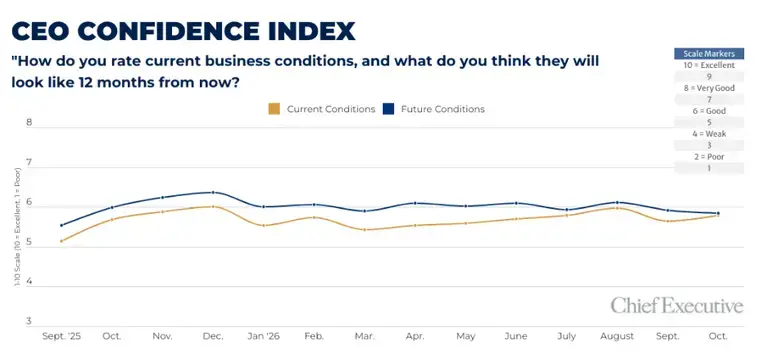
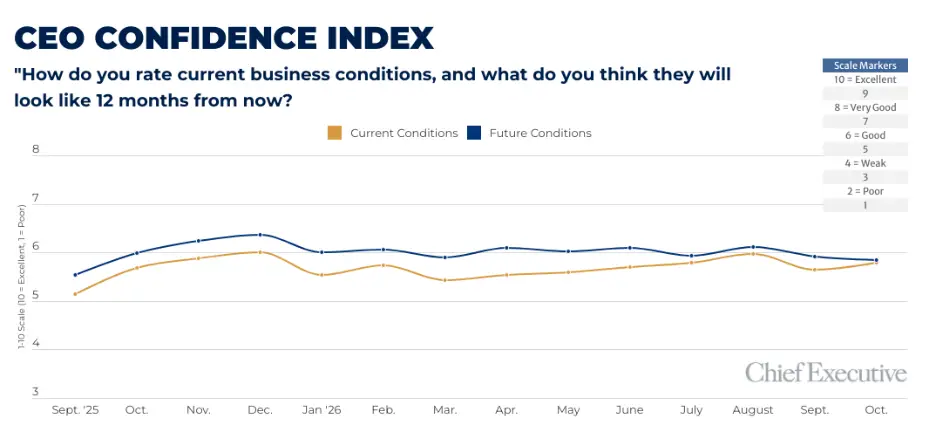
CEOs’ assessments of current business conditions climbed 3 percent from September, to 5.8 out of 10—the second-highest level of 2026 and 5 percent above where they started the year.
Their 12-month outlook, meanwhile, slipped below 5.9, to its lowest level since September 2025.
That narrows the gap between current conditions and the year-ahead outlook to just 0.06 points—highlighting their expectations for very slim improvement in conditions, if any at all. In January, the difference was 0.46 points, meaning CEOs started 2026 expecting healthy improvement in the business climate. They now expect more of the same.
Uncertainty Cuts Both Ways
Asked what’s driving their outlook, CEOs point to many of the same issues: inflation, costs, politics, policy and uneven customer demand.
Politics and government policy feature in the comments of 31 percent of CEOs forecasting improvement, compared with 36 percent expecting deterioration and 28 percent anticipating no change.
The difference is in how they expect those forces to play out.
For some, November’s midterm elections offer the possibility of greater policy stability. Others worry about changes in congressional control, increasing regulation or continued unpredictability in Washington.
“The political environment and policy choices are damaging everything from cost, confidence, capital improvements and growth,” says Angela Bovill, CEO of nonprofit Ascentria Care Alliance.
“I expect better conditions next year, once the midterm elections are over, regardless of who wins,” says Chris Kappes, president of Ultimate Service Associates, an industrial equipment supplier in Tulsa, Oklahoma.
For some CEOs, the outcome matters considerably. “Midterm elections will flip Senate and House,” said one CEO, explaining his forecasting a decline in business conditions from 7 out of 10 today to 4 next year.
Geopolitical developments create a similar divide.
Some CEOs expect the war in Iran to wind down, easing pressure on energy prices and inflation. Others anticipate continued disruption.
Jim Nelson, president and CEO of Parr Instrument Company, forecasts business conditions improving to 8 out of 10 over the next year. But that outlook rests on several assumptions: “an end to Iranian conflict, decreasing energy prices and slowdown of crazy tariff activity.”
The split illustrates an important distinction: Some CEOs are optimistic because business conditions are already strong. Others are optimistic because they expect today’s disruptions to subside.
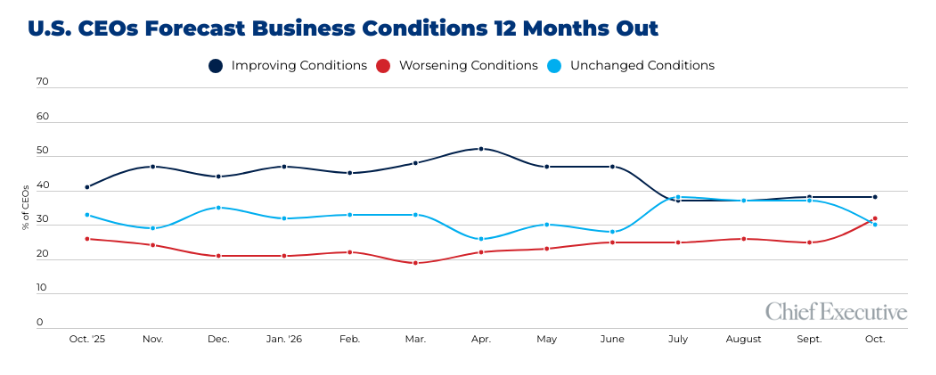
That’s reflected in the overall results. Thirty-eight percent expect conditions to improve over the next 12 months, while 32 percent anticipate deterioration and 30 percent expect little change.
For CEOs whose customers are still spending and whose order books remain healthy, conditions today may be reasonably good. But that doesn’t necessarily translate into confidence that the strength will persist.
Size and Sector Matter
The outlook also varies depending on company size.
CEOs at businesses generating less than $50 million in annual revenue rate current conditions at 5.7 out of 10, below the overall Index. Yet 44 percent expect conditions to improve over the next 12 months, compared with 30 percent of CEOs at larger companies.
That optimism comes from a lower starting point. While the smallest companies anticipate a modest improvement in the business climate, their larger counterparts generally expect conditions to hold steady or deteriorate slightly.
“We are a small business. The economic uncertainty has much more impact upon the small business community than large businesses,” says the CEO of a technology company. “It is more difficult for small businesses to weather the ups and downs of the economy, mostly created by this administration.”
Sector differences are equally pronounced.
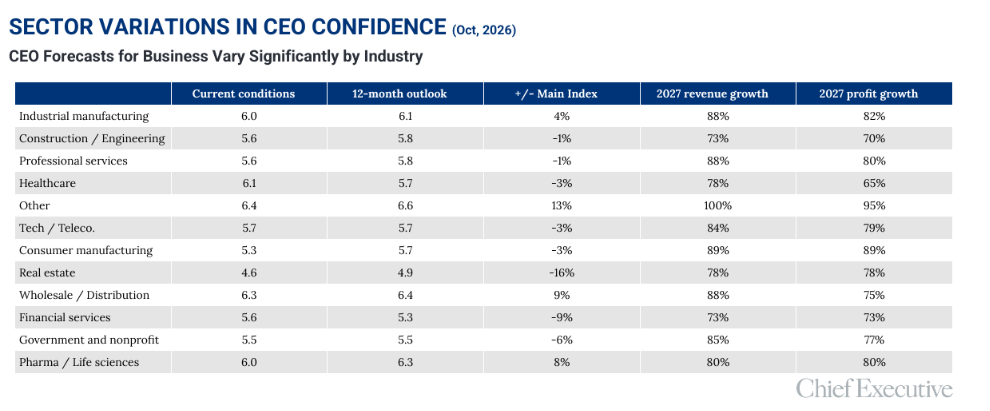
Industrial manufacturing CEOs rate current business conditions at 6.0, above the overall Index, and expect them to improve slightly to 6.1 over the next 12 months. Eighty-eight percent are targeting revenue growth in 2027, and 82 percent expect higher profits.
But the strength in demand appears confined to selected markets.
“Outside of data center-related activity, most other primary manufacturing markets remain soft, with demand either down or continuing to trend lower,” said an industrial manufacturing CEO at a mid-sized company.
As Sani-Matic CEO Peter Ensch puts it, “There continue to be hot and cold spots in U.S. manufacturing. We are fortunate to be playing in the hot spots.”
Real estate CEOs report a much tougher environment. Their assessment of current conditions stands at just 4.6, and while they anticipate some improvement, their year-ahead rating of 4.9 remains well below the overall Index.
The gap underscores how different CEOs are experiencing the economy. For some, healthy demand and long-term projects continue to support growth. For others, financing costs and uncertain demand remain significant obstacles.
Growth Is Still the Plan
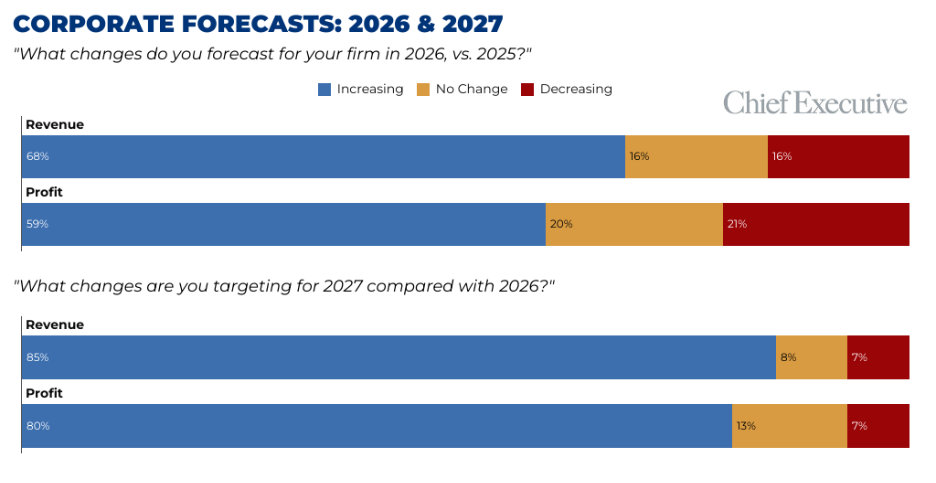
Perhaps one reason CEO confidence remains in “good” territory, according to the Index scale, is that business leaders remain considerably more optimistic about their own companies than the broader economy: 68 percent expect to finish 2026 with higher revenues than in 2025, and 59 percent anticipate higher profits.
Those proportions are down from 73 percent and 61 percent, respectively, in September, but a majority still expect growth despite economic uncertainty.
As one respondent in the events business explains: “Another great year for revenue, unfortunately, I do not understand how it can be so strong given what’s going on with geopolitics, the war in Iran and Ukraine, and United States inflation.”
What’s more, CEOs expect that growth to continue—and in some cases accelerate—in 2027. Among those surveyed, 85 percent expect to generate higher revenues next year, and 80 percent anticipate higher profits.
And this isn’t simply a case of already-growing businesses expecting more of the same. Among CEOs who anticipate flat or declining revenues in 2026, 69 percent forecast revenue growth in 2027. Similarly, 62 percent of those who don’t expect profit growth this year set targets for higher profits next year.
One CEO experienced the mind shift firsthand: “I am changing my thinking. Too much uncertainty is an opportunity… Being CEO is making decisions. Just needed that reminder for myself, too.”
A Hiring Shift
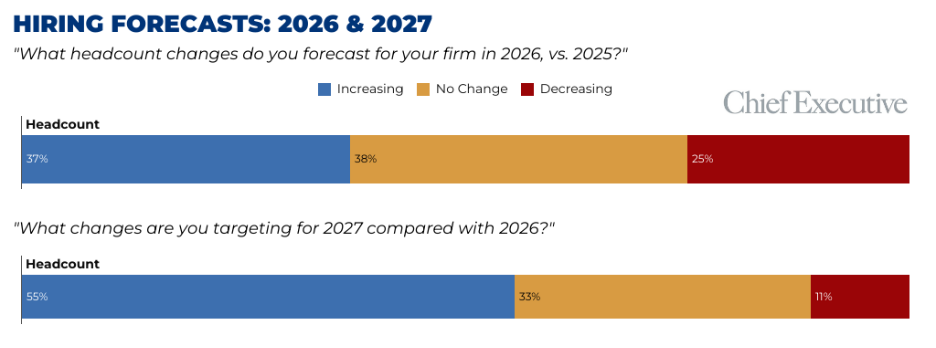
Perhaps the most striking shift is hiring.
Just 37 percent of CEOs expect to end 2026 with more employees than in 2025, down from 45 percent in September. But 55 percent are targeting workforce expansion in 2027.
And the anticipated pickup isn’t limited to companies already expanding their workforce. Among CEOs expecting flat or declining headcount this year, 40 percent are planning to increase hiring next year. That’s a notable reversal after months in which CEOs have been forecasting revenue and profit growth without corresponding increases in employment.
Still, hiring remains the weakest of the major growth forecasts. More than four in ten CEOs expect to hold headcount steady or reduce it in 2027, even as 85 percent anticipate higher revenues and 80 percent target higher profits.
Inflation Remains a Headwind
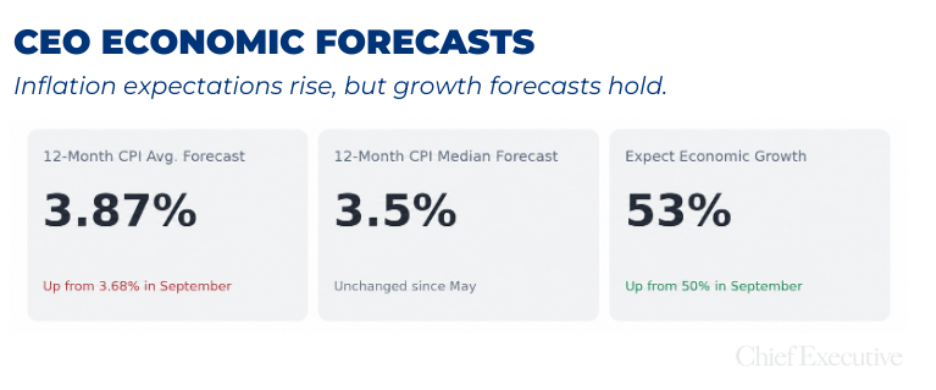
The proportion of CEOs anticipating economic growth over the coming six months increased to 53 percent in October, from 50 percent in September, even as the broader 12-month confidence index declined.
But inflation remains a concern.
The average forecast for headline CPI over the next 12 months climbed to 3.87 percent in October, from 3.68 percent in September—the highest monthly average so far this year.
The median, however, has remained unchanged at 3.5 percent since May.
That difference is important because it means the increase in the average does not reflect a broad-based upward shift in inflation expectations; rather a smaller group of CEOs projecting particularly high inflation may be contributing disproportionately to the rise.
Taken together, the findings reveal an economy CEOs increasingly expect to navigate rather than one they expect to improve substantially. They may be less hopeful about the broader business climate, but their own growth plans suggest they haven’t lost confidence in their ability to succeed within it.