In Chief Executive’s “America’s C-Suite: A Health Checkup,” fielded with Mayo Clinic ahead of 2026, a majority of senior leaders were already reporting elevated stress and early signs of burnout as they tried to navigate a growing list of demands. They told us their health habits were slipping, recovery time was shrinking and work was bleeding further into nights and weekends—even as they remained broadly confident about their companies’ ability to grow. Those findings look like an early warning that the pressures of the role were only building.
BCG’s new CEO Insomnia Index suggests that prediction is now playing out. Drawing on a survey of roughly 500 CEOs and five years of S&P 1200 turnover data, the study finds that more than 70 percent of CEOs report job-related stress levels above the clinical threshold for “high stress,” with an average score of 66.7 on a 0–100 scale. It also shows that near-term fires—meeting growth targets, managing costs, satisfying boards and keeping employees onside—are consuming a disproportionate share of many CEOs’ time, sometimes crowding out the work that will actually determine their legacy.
Where CEOs Feel the Most Pressure
The sharpest pressure remains on performance. Hitting growth targets tops the list of anticipated stressors over the next six months, with managing costs close behind. Meeting board expectations and keeping the workforce satisfied round out the top tier, underscoring how much of the modern CEO job is about reconciling competing demands from people who sit very close to the role.
What’s different now is the bandwidth squeeze. A majority of CEOs in the BCG study say near-term issues are consuming a disproportionate share of their calendar—not just longer to-do lists, but more fragmented ones, with boards, investors, regulators, employees and customers all pulling attention in different directions. That raises the odds that important but less urgent work—rewiring the operating model, rebuilding the talent bench, reshaping the portfolio—gets crowded out by whatever is screaming loudest this week.
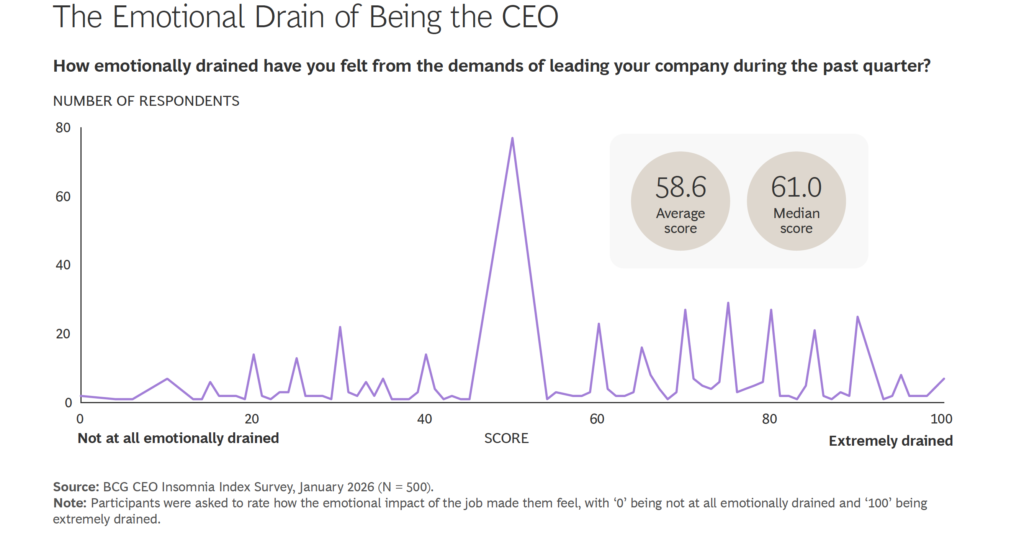
Christine Barton, who leads CEO Advisory in North America for BCG and co-authored the report, sees the impact directly. “When you’re operating at that level, it starts to show up in how decisions get made. Leaders become more reactive and more focused on what’s immediately in front of them. Over time, that can narrow perspective and creativity and can reduce flexibility in thinking.” At the CEO level, she notes, that matters acutely: “The job requires making complex, high-stakes decisions with incomplete information. In fact, when a problem or risk reaches the CEO, many competent leaders have already tried to solve or mitigate it. When corrosive levels of stress become a constant backdrop, it can push leaders to reactions ranging from being overly cautious or, at times, making faster and more impulsive calls.”
Early warning signs include prolonged sleep disruption, trouble focusing, decision fatigue and increased irritability. “You can still function but it takes more effort, longer time to recover, confidence suffers and performance narrows,” Barton says. “That’s when near-term issues begin to dominate time and energy, and longer-term priorities start to get crowded out.”
The Risks CEOs May Be Underestimating
If growth and costs are front-of-mind stressors, the Insomnia Index also highlights areas where CEOs may not be losing enough sleep—yet.
AI is one. In the survey, AI ranks only ninth on a list of 11 potential stressors. Most CEOs say they feel more energized than stressed by it—one of the few parts of the job that pulls them out of the daily grind and into thinking about the company’s future. The catch is that enthusiasm can outrun accountability. “Every public commitment to AI raises the bar for delivering returns,” Barton says. Over the next year, she expects pressure to build on early movers to show real, measurable financial impact—not just experimentation. Late movers, meanwhile, will have to declare actual bets, not just investments in literacy and competitiveness.
Shareholder activism is another blind spot. In the Index, activism ranks dead last among near-term stressors. But BCG’s turnover analysis tells a different story: When a company is targeted by activists, the probability the CEO exits jumps materially. The implication isn’t to obsess over activists, but to manage the conditions that invite them—delivering against your own guidance, building a shareholder base that understands your long-term thesis and knowing the gap between your current valuation and intrinsic value before an activist tries to close it for you.
Finally, there’s a worrying disconnect between how stressful CEOs find their employees and how seriously they take disengagement risk. Employees rank as the second most stressful stakeholder group, yet fewer than four in 10 CEOs say they’re concerned about rising disgruntlement. “Employee sentiment tends to surface indirectly,” Barton notes, “and by the time it reaches the CEO, it’s often diffuse, filtered or incomplete.” BCG’s turnover model offers a simple warning: When net employee entry drops meaningfully, CEO turnover risk rises. If your people quietly vote with their feet, your own job security is at risk—even if other metrics look solid.
A Practical Playbook For Stressed-Out CEOs
Data is only useful if it changes what you do next. Here are seven moves, drawn from the Insomnia Index and Chief Executive’s own reporting, that you can start on this quarter.
1. Treat judgment as a finite resource
- Block 90–120 minutes most mornings for your three most consequential decisions of the day—no staff meetings, no email.
- Push routine updates, approvals and informational briefings to afternoons or one designated “administrative” day each week.
- Ask your chief of staff to triage decisions into three buckets: must be me, could be me, should not be me—and enforce it.
2. Make your calendar match your strategy
- Take one recent month and categorize every hour by theme (short-term performance, long-term growth, people, board/investors, personal recovery).
- Set explicit targets for the next quarter (for example: at least 30 percent of your time on long-term growth, at least 20 percent on people and culture) and have your assistant color-code your calendar against those targets.
- Once a week, do a 10-minute review: what did you say “yes” to that didn’t deserve CEO time, and how will you avoid that next week?
3. Turn your CFO into a co-architect, not a competitor
- Schedule a working session with your CFO and lead independent director to write a one-page “value creation charter” that both you and the CFO sign.
- On that page, spell out: what you own (purpose, strategy, talent, culture, external narrative), what your CFO owns (financial integrity, capital allocation, cost, cash) and where you explicitly share ownership (board and investor communication, value creation roadmap).
- In the next board meeting, present that charter together and answer performance questions as a team, reinforcing that alignment.
4. Get ahead of AI accountability with targeted proof points
- Instead of broad “AI everywhere” pledges, pick one or two functions (for example, customer support or pricing) where AI can deliver measurable impact in 12–18 months.
- Define a single, concrete metric for each (handle time reduction, revenue per rep, forecast accuracy) and align your team and board on a clear target and timeline.
- Communicate to the broader organization why you chose these areas first, what will change in those roles and which functions are likely next.
5. Make activism less of a surprise
- Once a quarter, sit down with your CFO and head of IR and answer three questions in writing: Where do we see a gap between price and our view of intrinsic value? What are the top two or three levers we’d pull if we were activists? Which holders would likely back that thesis?
- Use that memo to shape your own value creation narrative—and to identify one or two long-term investors you should build deeper relationships with over the next six months.
- Ask for a simple “shareholder quality” dashboard: top 20 holders, their time horizon, turnover behavior and stated thesis on your stock.
6. Pierce the CEO bubble on employee risk
- Each quarter, hold at least two small, unscripted listening sessions with eight–10 employees two or three levels down, from different functions and locations. Ground rules: no presentations, no prepared talking points, just questions and listening.
- Commit to answering at least one “small but symbolic” question in every all-hands (for example, travel policy, return-to-office quirks, cafeteria prices) to signal transparency and approachability.
- Identify one long-tenure, low-ego “truth teller” in the organization and meet with them monthly as a proxy for how decisions are landing on the front lines.
7. Manage your own energy like a balance sheet
- For two weeks, keep a simple log at the end of each day: three things that gave you energy, three that drained it. At the end of the period, look for patterns and eliminate or redesign at least one high-drain recurring commitment.
- Put two non-negotiables on your calendar for the next 90 days (for example, seven hours of sleep five nights a week, or three 30-minute walks) and ask your assistant and chief of staff to protect them the way they protect a board meeting.
- Join or reinvest in a small, trusted peer group—formal or informal—where you can test ideas and talk about the job without every conversation becoming an action item.
You don’t control inflation, geopolitics or market tantrums. You do control where you spend your time, who you rely on and how you show up mentally. The leaders who take those levers seriously are the ones most likely to still be in the chair—and proud of their legacy—when the next round of surveys comes out.