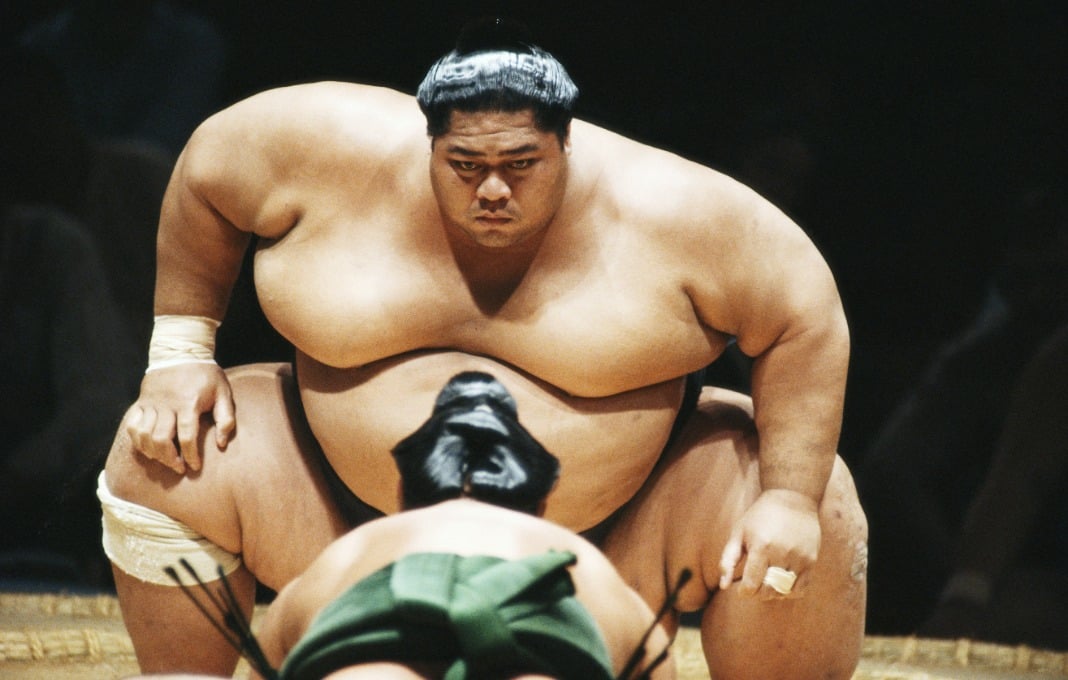
I grew up watching Konishiki Yasokichi. From a small living room in the UK, I remember sitting on the floor cross‑legged, staring at the television as this enormous, calm presence stepped onto the dohyo. Even as a kid, I could tell something was different. He didn’t look or move like the others, yet match after match, he kept crushing his opponents.
Years later, when I recently interviewed Konishiki, I finally understood why. Konishiki wasn’t exceptional just because he was the first non-Japanese, Hawaiian-born wrestler to reach ōzeki, or because he won three top-division championships. He was exceptional because at roughly 287 kilograms, he redefined what size and athleticism could look like in a tradition‑bound sport. He also mastered one of the hardest balances in any high‑performance system, which is knowing exactly when to fit in and when to stand out.
You have no authority: the outsider’s first reality check.
One of the first things Konishiki said sent me backwards: “When you come in to sumo, you have no authority. You have no stance. Especially when it’s something that you know nothing about.”
What struck me wasn’t the toughness of sumo, but the clarity. Konishiki didn’t arrive in Japan expecting the red carpet. He arrived, understanding that submission and humility came first. He talked about walking into sumo “blind,” unable to speak Japanese, and consciously choosing to “just shut up and listen.”
I’ve noticed this same tension of blending in versus standing-out show up any time someone joins a strong business culture. It’s a balance echoed in Stanford Human-Centred AI research. To align, you first learn the local model of agency (independent vs. interdependent); to stand out, you apply your own background to bring insight that insiders can’t see.
That mindset matters. Because in legacy systems, whether it’s a sumo stable, a family business or a century-old institution, authority is not granted. It’s accumulated quietly, through behavior.
Earning credibility from the inside.
Sumo rewards endurance. Konishiki described cleaning toilets at four in the morning, wiping floors by hand for months, preparing meals for senior wrestlers and taking orders from everyone above him. None of it was symbolic. All of it was real.
“Everybody goes through that. It wasn’t something that was only for me.” That’s the piece many outsiders miss. You don’t earn trust by explaining how different you are. You earn it by proving you respect the rules before trying to bend them.
This is how you neutralize what Medium describes as the organizational immune system, which is the collective habits and norms that attack anything perceived as foreign or disruptive. Konishiki didn’t try to fight that immune response. He absorbed it. Then he outperformed within it.
Silence, results and the discipline of restraint.
When we talked about external doubt, from media criticism, public skepticism and cultural resistance, his response was simple. He said, “I don’t waste my time fighting things I can’t control.” He adds, “If you’re an athlete, the only way you respond is through action. Shut up and work. Put out numbers.”
There’s something deeply Japanese in that restraint. Konishiki spoke about learning the idea of invisible strength, called Mugen in Japanese, which is strength that can’t be seen, only felt. He explains, “They were trying to teach me something deeper,” and over time, he learned to pull the fire inward rather than broadcast it outward.
I think that’s why he unsettled people. He wasn’t performative. He was calm. And in high‑pressure environments, calm is threatening.
Turning different into an advantage without letting it become a liability.
Yes, his size mattered. Konishiki was bench‑pressing over 500 pounds and squatting more than 600 as a teenager. However, he adds, Japan had never seen a man that heavy move that fast with power. But what really stood out to me was how intentional he was about controlling his difference.
He told a story about being criticized for once saying, “sumo is a fight,” which was a comment that clashed with the cultural framing of sumo as ritual, beauty and form. It wasn’t that he was wrong. It was that he hadn’t yet learned the language of the culture he was operating in.
That moment taught him something crucial. Being different doesn’t give you permission to be careless. Difference unmanaged becomes risk. Difference disciplined becomes advantage.
Split‑second decisions: calm beats clever.
Konishiki described decision‑making at the tachiai. The split second when everything happens at speed. No pauses. No resets. He was clear that the work isn’t done in that moment, but it’s done long before it. “Once the plan is set, you don’t second‑guess it,” he told me. “If you think for even a moment, you’ve already lost.” What I heard in that wasn’t aggression, but preparation.
What surprised me most was how calm he said he felt right before impact. “I’m very relaxed,” he said, almost casually. He talked about how tension first shows up in the body. In your hips, your stance, your breath and how that tension steals clarity. Watching opponents long before the clash, reading eyes, posture and even subtle changes in skin tone, he wasn’t reacting, but recognizing patterns.
For me, that maps cleanly to leadership. Those who struggle in high‑stakes moments aren’t short on intelligence, but they’re short on calm.
What business leaders can learn from the dohyo.
Listening to Konishiki, a handful of practical lessons kept surfacing. Lessons that apply directly to leaders entering legacy organizations or complex systems:
- Preparation earns permission. Konishiki repeatedly emphasized preparation as the first rule of credibility. Know the environment before you challenge it.
- Respect precedes influence. “I would never be bigger than sumo,” he said. That humility made his dominance sustainable.
- Discipline beats intensity. Discipline wasn’t about doing more, but it was about doing the basics consistently, especially when tired or injured.
- Calm wins under pressure. His ability to stay relaxed at the tachiai mirrors research on leadership under pressure and split-second decision-making cited by Harvard.
None of this is glamorous. That’s exactly why it works.
Why this story still matters to me.
What stayed with me most wasn’t the championships, or the size or even the aura I remember from childhood. It was the realization that humility and dominance are not opposites.
Konishiki decided to fit in first, completely, relentlessly and without complaint. Only after earning that right did he allow his difference to fully express itself. And when it did, it changed the sport forever.
There’s a saying in sumo, Keiko wa uso wo tsukanai. Training never lies. Neither do results.
Konishiki’s career is proof that the path to standing out often begins with the discipline to disappear into the training, until excellence makes you impossible to ignore.