After five long years of Covid shortages, sudden tariffs, spiraling costs and geopolitical tumult, the supply chain conversation is now a C-Suite conversation. Less clear: whether the information traveling up the chain to you is accurate—or whether the people closest to the work feel heard when they raise the alarm.
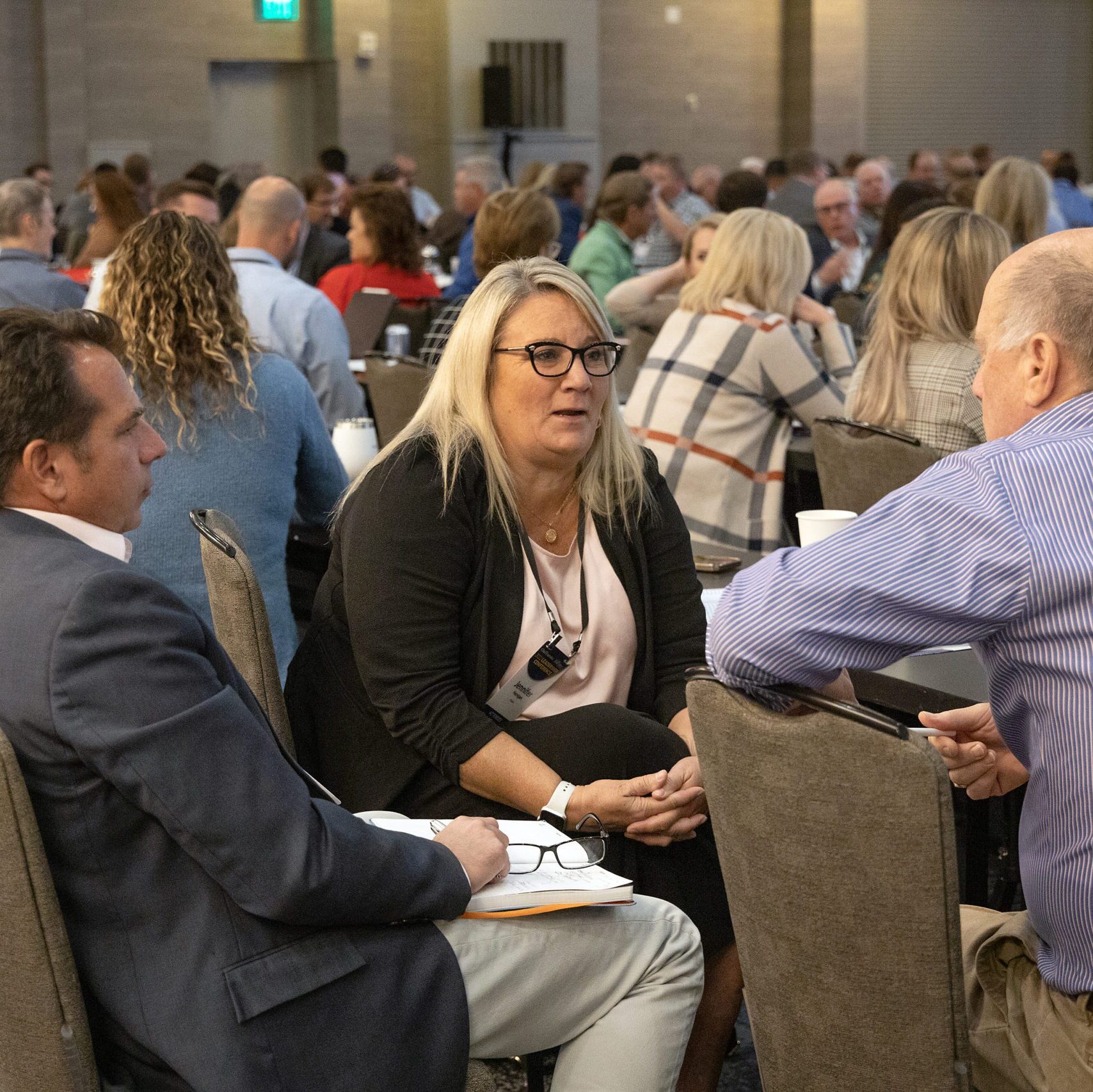
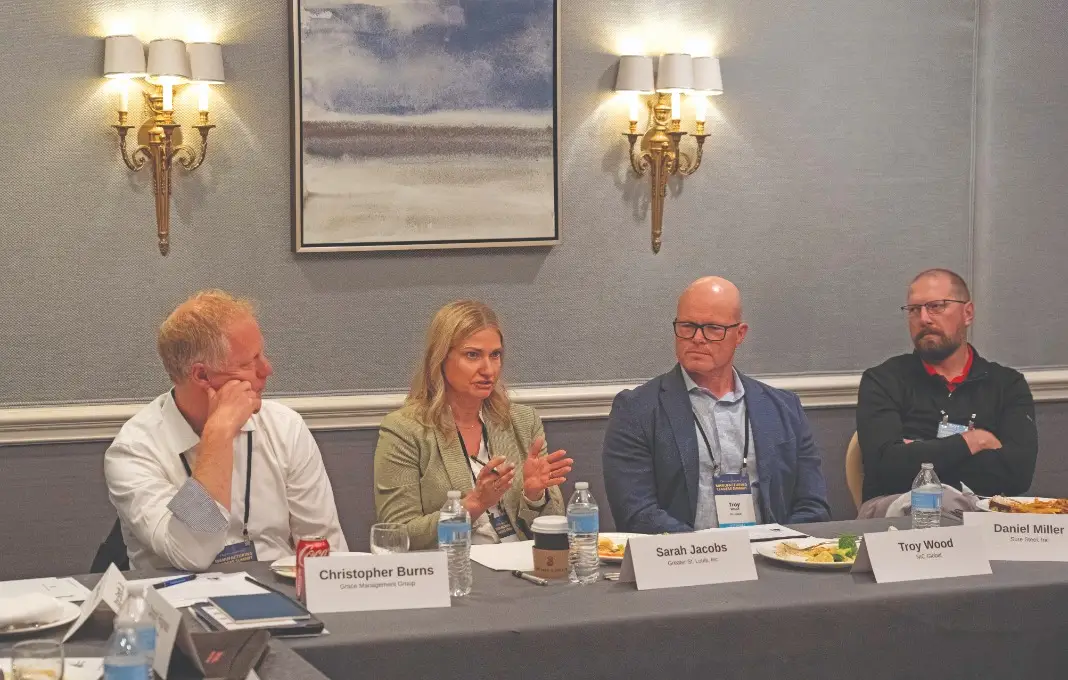
At Chief Executive’s Manufacturing Leaders Summit in St. Louis this past May, held in partnership with Greater St. Louis, we gathered a group of supply chain managers, operations leaders and COOs from mid-sized manufacturers for a not-for-attribution discussion on the communication gaps, workforce challenges and emerging risks shaping today’s manufacturing environment.
“This is no longer just an operational discussion,” said Sarah Jacobs, senior director of business growth at Greater St. Louis, who spends her days with regional manufacturers figuring out where to invest and how to grow. “This has been elevated to the CEO level because it plays such an important part and has been very volatile the last few years. Companies are really trying to figure out what do we localize, where does automation really pay off versus where it doesn’t, when do we redesign products and when is it easier to either price through or even just step away?”
What followed was encouraging and uncomfortable in equal measure. Here’s what the practitioners in that room wanted their CEOs to know.
Bringing It In-House
Companies that spent years outsourcing are now bringing things back in house. Not for ideological reasons but because they had to—an idea they hoped the C-Suite might start to get their heads around in the years to come.
“Some of our stuff, just the turnaround time to get that stuff was eight to ten weeks,” said one manufacturer who’d just opened a new 140,000-square-foot fabrication facility. “And now we can control a lot of that. So if we have something hot, we can stop what we’re doing and move on to that process.” Another participant made similar moves across formerly outsourced operations. “Had we known this 20 years ago,” he said, “we’d have made this decision 20 years ago.”
The flip side: If you’re a supplier to large OEMs, their vertical integration ambitions are a direct threat. A participant whose company supplies three different industries watched all three move in this direction. “A lot of internal players thought, ‘well, we are so good at what we do—that’s not a legitimate threat, they can’t vertically integrate and substantially eat into our business,’” he said. “But we have seen that determination stick in all three industries. We’ve seen some erosion of work to vertical integration.” His conclusion: Assume nothing about loyalty. Keep delivering real value.
Several CEOs recounted deliberate decisions to move away from Chinese and Indian suppliers. It was tough—tougher than leadership expected. The domestic supply base for some categories has hollowed out after decades of offshoring.
One supply chain director reported what the decision actually cost in the short term: “We had a lot of struggles in 2019, 2020, 2021—like, okay, are we making a really stupid move here? Our competitors were saying we’re not caring about being the best, we just want to be the cheapest. And then people would source to that cheapest one.”
The weathering was hard. Accounts payable stretched. Vendors got skittish. “People have long memories,” he said. “When you’re going through struggles, your accounts payable stretches out. Vendors don’t want to work with you because they’re thinking, ‘I’m not sure you’ll ever pay me.’ If I can’t get product, I can’t build anything. And if I can’t build anything, I can’t sell anything.” The company nearly didn’t make it. But “we weathered the storm and now we’re doing fantastic,” he said.
Automation, Finally
Five years ago, the automation conversation had a predictable punchline: Someone bought a cobot and it ended up dribbling a basketball in the breakroom because nobody could run it. That conversation has changed; and manufacturers who’d made automation investments said the workforce piece, long the hardest part, was more manageable than expected.
One described reframing automation for workers through profit sharing. “They see it as, ‘Hey, we’ve got fewer people to share with, so it’s a bigger check for us at the end of the quarter.” Getting workers to think like owners, several agreed, is the real unlock. De-skilled jobs also mean you’re less exposed to no-shows—and can afford to take care of the skilled workers you keep. “I don’t care where you’re at,” said one participant. “It’s tough to find good people.” Automation doesn’t solve that. But it changes what the problem costs.
One wrinkle is a supply squeeze for those sharing suppliers with the booming AI data center industry. “Data centers are exploding because of AI,” said one COO. “We’re having trouble on two sides—we sell to mechanical contractors building data centers but our product doesn’t go in data centers. And, on the supply chain side, some fans and equipment we use are also used in data centers. Our lead times are stretching.” He’s watching for a supplier to emerge that serves manufacturers. “The data center bubble’s gonna burst at some point,” he said. “Hopefully. But that’s the squeeze we’re feeling right now.”
Cash Is King
None of that changes the fact that cash on hand determines how aggressively you can adapt, pointed out a participant with a background in business turnaround consulting. His first move with any struggling client: find the cash forecast. Or discover there isn’t one.
“Nine out of 10 times nobody had a cash forecast,” he said, urging CEOs to always know their position six to eight weeks out. Customer terms and milestone payments can quietly sink those with long cycles, such as 15-18 months to build a single unit, he adds. “You don’t want to end up in a situation where you took 20 percent upfront but will need 30 percent for materials. Am I playing the bank here? ‘Cause if I’m playing the bank, I’m not going to survive.”
His other principle: decide your margin first, then back into the budget. “If you want to start with 15 percent, then you’ve got to figure out how you’ll build 85 percent into it. But your profit is your starting point.”
What CEOs Don’t Know
Multiple participants described a gap—some a chasm— between what’s reported up the chain and what’s actually happening in procurement and production. One tracked down the president of a chronically late supplier on LinkedIn, got him on a call and watched the man realize in real time that his team had been lying to him. The president flew in to meet face-to-face. “He was quite embarrassed,” the participant said. “He said, ‘Wow, shame on me for trusting people I thought were telling me the truth when they weren’t.’”
Another participant described a maddening internal loop: Engineering kept telling the supply chain team there was no alternative to a vendor, regardless of price. “I got told so many times, ‘It has to be them.’” His half-joking solution: hire another engineer to fight it out with the company’s engineers and get a second opinion.
The fix isn’t complicated—weekly reviews of long-lead items, active vendor communication, metrics visible at the senior level—but it requires a culture where bad news travels fast rather than getting smoothed over on the way up. “If they’re lying to you,” said one CEO, “you need to get a new vendor.” The harder problem is internal: making sure your people feel safe enough to tell you what’s really going on before it becomes a crisis.
Jacobs closed where she’d opened—with the big picture. “Everybody thought, ‘if we can just get through Covid, everything will settle down again,’” she said. “That has not been the case.” Nor is it likely to be for a long time to come.