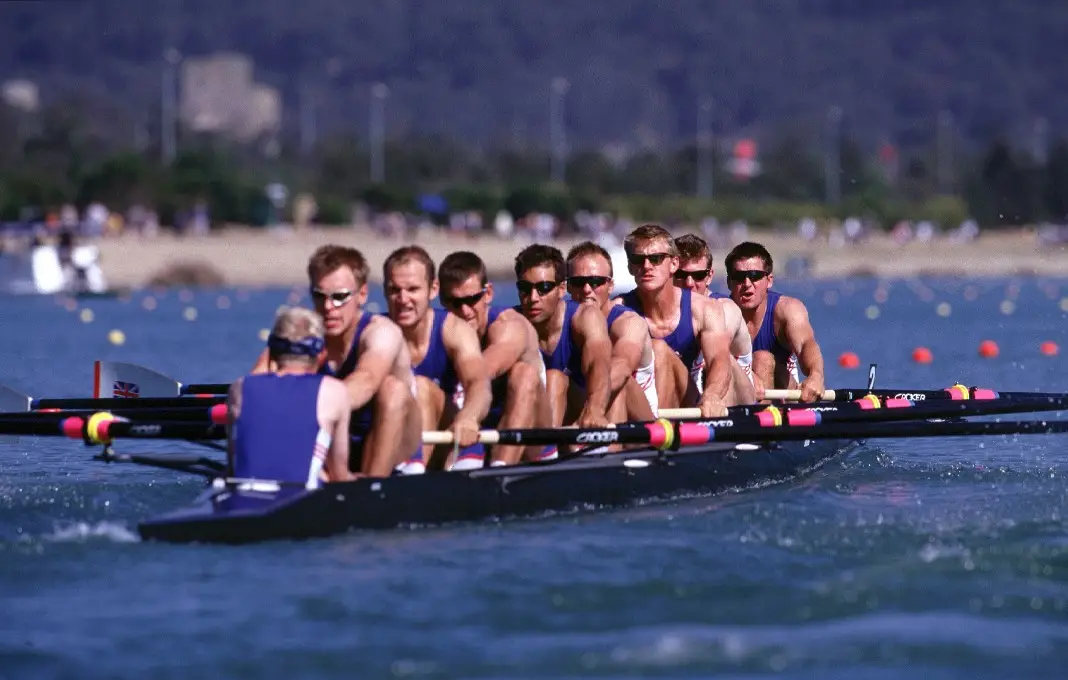
Before Ben Hunt-Davis and the British Men’s Eight won Olympic gold in Sydney, they spent years finishing seventh and eighth. Their breakthrough did not come from discovering extraordinary talent. It came from changing how they worked together.
What transformed them was something far more relevant to business: an obsession with teamwork, disciplined execution and a shared operating system that aligned dozens of daily decisions around one objective, which was winning gold. Their filter was famously simple: Will it make the boat go faster?
1. Turn ambition into alignment.
Every transformation begins with a choice.
Looking back, Hunt-Davis does not point to a revolutionary training method or a sudden surge in talent. He points to a deliberate change in mindset. The team first had to agree that being Olympians was not enough; they needed a bigger collective mission. As Hunt-Davis explains, “It started with a shared goal, a shared vision.” Their coach helped “paint a picture of what the future could look like,” creating the catalyst for change.
Importantly, belief did not arrive overnight. Hunt-Davis recalls, “It took a whole lot of conversations,” gradually moving the team’s mindset from “we might be able to” to “we will do this.”
Business leaders often focus on acquiring better talent. Yet many organizations already have good people. What they lack is a compelling destination and a crew that genuinely agrees on where the boat is heading. For the British rowing team, that destination gave the crew direction; the next challenge was deciding what to focus on each day to reach it.
2. Stop worshipping the scoreboard.
One of the most powerful ideas from Hunt-Davis is the distinction between performance and results. “We are generally rewarded on the results we achieve,” he says. Yet the discipline comes from stepping back and asking, “What were the things that really made a difference?”
The rowing team had become obsessed with hit rates, timing metrics and numerical targets. Everything was measured against theoretical gold-medal benchmarks. But their coach pushed them to focus on something less tangible and more important. Hunt-Davis explains, “What we’re looking for is a feel. We’re looking for a rhythm.” Instead of judging every session on speed alone, they focused on the ingredients that produced speed.
That instinct is supported by research. A meta-analysis published in the International Review of Sport and Exercise Psychology suggests that process goals can have a stronger positive effect on performance than outcome goals because they focus attention on controllable actions. In business, it is the difference between obsessing over quarterly revenue and improving client conversations, decision quality, innovation or customer relationships.
3. Use one question to cut through the noise.
Every high-performing team needs a decision filter. For the British Eight, it was the question that cut through competing priorities: Will it make the boat go faster?
Hunt-Davis believes many leadership teams struggle because every function optimizes for its own priorities. Sales wants revenue. Marketing wants awareness. HR wants retention. Finance wants margin. The challenge is creating a north star bigger than departmental scorecards. “What’s most important is boat speed,” Hunt-Davis explains. “We worked really hard on decision-making, on trying to make better decisions based on the information available and getting alignment around it.”
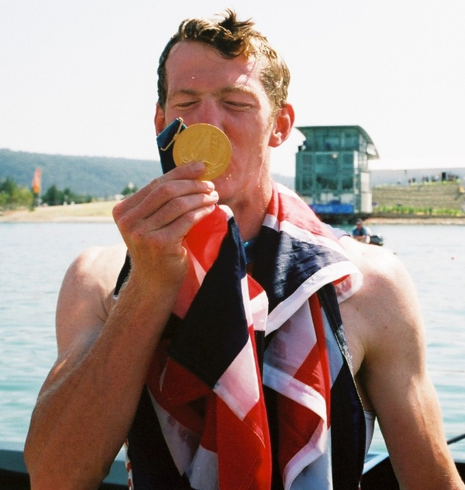
One of the team’s disciplines was surprisingly simple. Regularly challenge assumptions, agendas and activities rather than automatically accepting them. Hunt-Davis also makes an important distinction. Discussions are not decisions. A decision only matters when everyone commits to it. As he puts it, “I will do it whether I like it or not.”
Most organizations are not suffering from too little work. They are suffering from too much drift.
4. Make the rules real.
A decision filter creates clarity, but clarity only becomes performance when it shapes everyday behaviour. Most companies have values hanging on walls; few have rules people remember and follow. The rowing crew developed and continually refined explicit team rules covering behaviour, accountability, professionalism, and focus. “They developed with us,” Hunt-Davis explains. “Having the same understanding and the same expectations is really important.”
Rather than treating rules as compliance exercises, the crew used them as a shared language. Everyone knew what good looked like.
Research highlighted in Forbes reinforces the point. Team norms reduce ambiguity, accelerate decision-making and increase accountability by creating a shared playbook. Like a well-timed stroke, small behavioural agreements compound into significant competitive advantage.
If a business cannot quickly explain its operating principles, it probably does not have any.
5. Choose candour over comfort.
Elite teams are not conflict-free. They are feedback-rich.
That principle changed everything. As Hunt-Davis put it, “If you see something that’s not as good as it can be, and you choose to say nothing, you’re choosing to help us lose.” The crew held uncomfortable conversations, discussed frustrations openly, asked for feedback proactively and learned how to challenge one another without damaging trust. Hunt-Davis repeatedly returned to one question during difficult moments: “What’s most important, boat speed or being right?” Their sports psychologist, Dr. Chris Shambrook, and coach, Martin McElroy, reinforced this culture continuously. Together, they helped the team develop the emotional intelligence required for honest dialogue.
Research archived in the National Library of Medicine’s PubMed Central repository describes accountability as an adhesive that helps hold social and organizational systems together. A business culture where feedback is viewed as assistance, not criticism, drives performance. Silence is often far more expensive than discomfort.
6. Under pressure, trust the system.
One of the most counterintuitive lessons from Sydney was that discipline becomes more important, not less, as pressure increases. Under pressure, people get distracted. They overreact, chase shiny opportunities, and abandon proven habits. Hunt-Davis’s advice is simple: “Stick to what we know.”
The team spent significant time preparing for the distractions of the Olympic environment. They anticipated them, discussed them and created routines strong enough to withstand them.
This mirrors business during major acquisitions, technology implementations, IPOs or market crises. The temptation is always to invent something new. The winning approach is often to execute the fundamentals exceptionally well. When pressure peaks, do not abandon your operating system. Pressure does not create character. It reveals whether your systems are strong enough to survive.
Olympic gold was not the product of one breakthrough. It was the compound effect of hundreds of aligned choices, which the crew practised, tolerated, challenged and prioritized every day.
Every leadership team has its own version of boat speed, i.e. the outcome that should align decisions, behaviour, feedback and effort. The real test is whether that objective remains clear when pressure rises and competing priorities take over.
So, before the next meeting, initiative or investment, ask one deceptively simple question: Will it make the boat go faster?