America’s CEOs are feeling better about current business conditions, but they’re less convinced things will get much better from here.
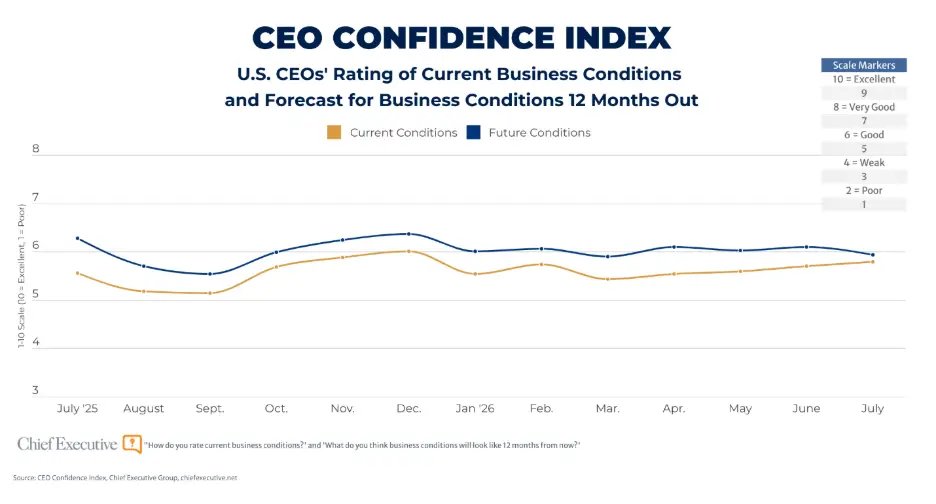
Chief Executive’s latest CEO Confidence Index, fielded July 7-9 among 321 U.S. CEOs, shows leaders’ assessment of current conditions rising for a fourth consecutive month, up 2 percent from June to 5.8 out of 10—the highest reading of the year.
Their year-ahead outlook, however, softened. CEOs now expect business conditions to reach 5.9 by this time next year, 3 percent below the 6.1 they forecasted in June. That is still a 3 percent improvement over current conditions but far below the 8 percent improvement they’ve forecasted, on average, each month this year.
The shift does not signal a broad turn toward pessimism, though. The share of CEOs expecting business conditions to improve over the next 12 months fell to 37 percent from 47 percent in June, while the share expecting conditions to stay about the same rose to 38 percent. Only one-quarter expect conditions to worsen, sentiment that has remained largely unchanged throughout 2026.
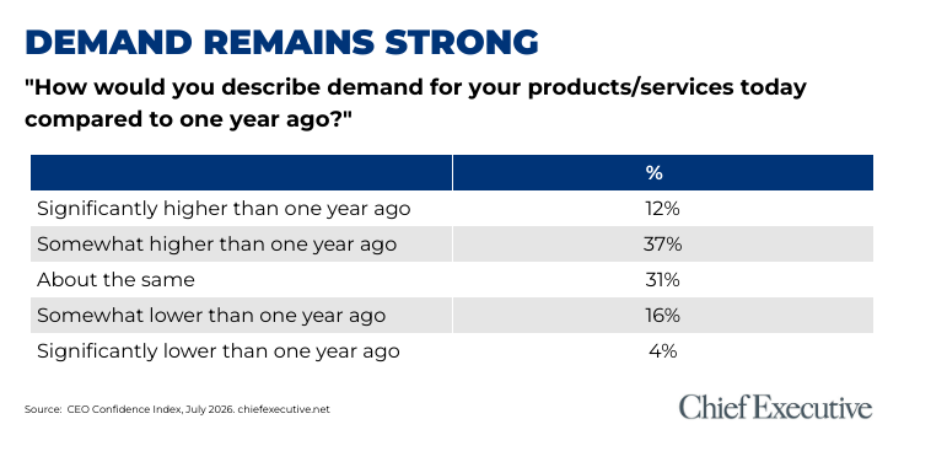
Asked what’s driving their outlook, nearly half (49 percent) say demand for their company’s products or services is higher today than it was a year ago, while another 31 percent say it’s unchanged. Just 20 percent report weaker demand.
Even among CEOs who expect business conditions to worsen over the next year, 51 percent report higher demand today than a year ago—slightly higher than the share among optimists and neutral respondents, both at 48 percent.
But stronger demand is being offset by cost pressures. CEOs cite price volatility, healthcare and energy costs, rising wages and the difficulty finding and retaining talent.
Greg Immell, CEO at Saporito Finishing Company, an anodizing and metal finishing manufacturer in Illinois, says demand and revenues are increasing at his company. “However,” he said, “healthcare, energy and wages have increased. The battle is to improve efficiencies to protect margins.”
As another CEO put it: “Opportunities are significant, but the overall environment is very unstable right now. Challenging times.”
Robert Colescott, CEO of Southern Specialties, sees AI as one way to ease the pressure on operating margins: “Artificial intelligence, automation and other digital tools provide us with opportunities to reduce costs, eliminate inefficiencies, improve decision-making and streamline many of our business processes.”
The U.S. Economy
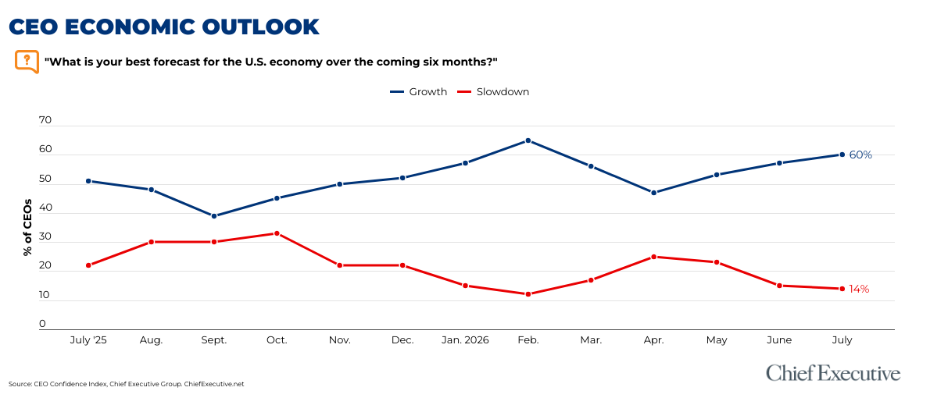
The six-month view of the U.S. economy remains more growth-oriented than recessionary. Sixty percent of CEOs expect either strong or mild growth over the next six months, while 26 percent expect the economy to remain flat. Fourteen percent expect a mild or severe recession.
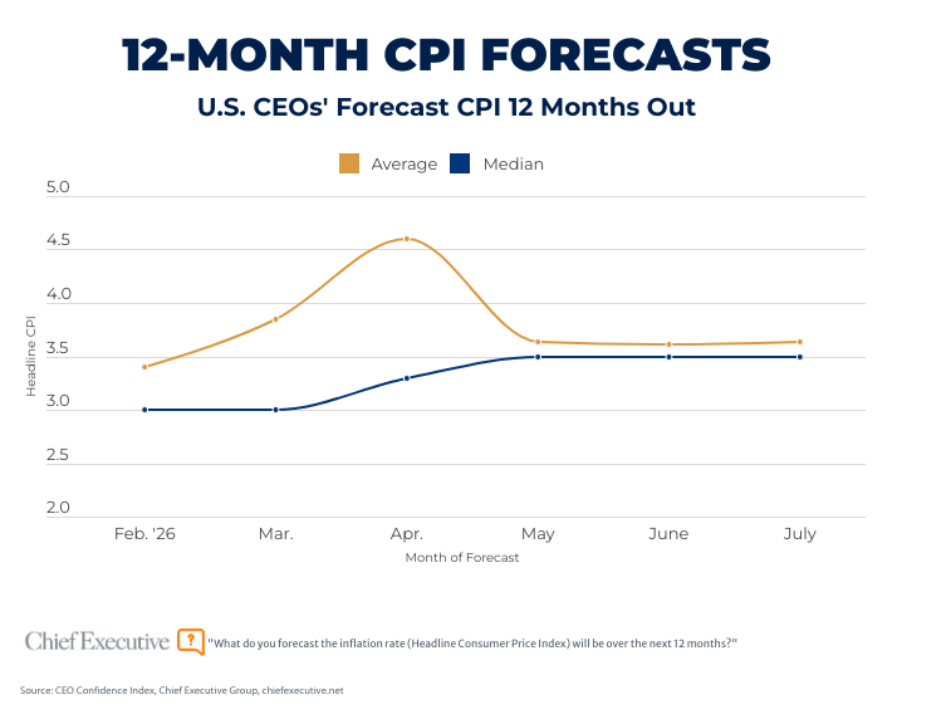
Inflation expectations, however, remain elevated. For the fourth consecutive month, CEOs forecast an average inflation rate of 3.6 percent over the next 12 months, keeping pricing and cost pressures top of mind.
Corporate Forecasts
Stronger revenue expectations are not translating into more aggressive hiring or investment.
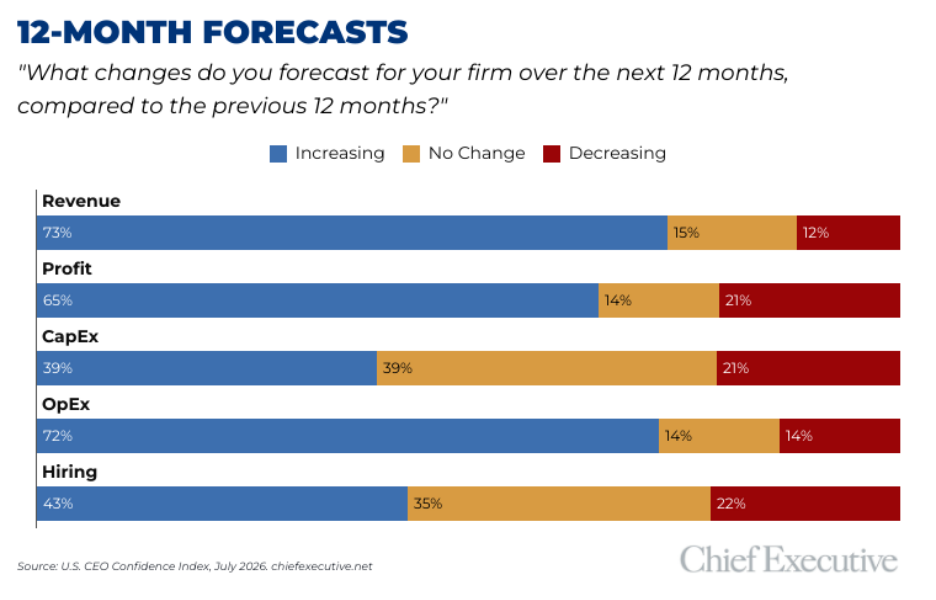
Seventy-three percent of CEOs polled expect revenue to be higher in 2026 than in 2025, and 65 percent expect profits to increase. But the share forecasting reductions in headcount rose to 22 percent from 17 percent in June, while the share planning to decrease capital expenditures climbed to 21 percent from 17 percent.
“It is not possible to make clear investment and growth decisions in this environment,” said one CEO, “Until the world settles down, many in our supply chain will be buckling down.”
John S. Ondik, the founder of The Ondik Group, a management consulting firm in Pennsylvania, says the current environment is forcing some companies to slow investment decisions. “Macro challenges (domestic and global) are driving uncertainty, which impacts planning, hiring, investment—and morale,” he said.
Neil Shah, president and CEO of the Construction Financial Management Association (CFMA), agrees: “The uncertainty in policy leading to fluctuations in workforce and inflation are the biggest risk to our business.”
The Conflict in the Middle East
A similar increase in the proportion of CEOs planning reductions in capex and hiring surfaced in the data earlier in the year, when the U.S. first launched attacks on Iran. The conflict resumed during the July survey fielding period, and President Trump’s announcement on the end of the Iran cease-fire showed up in the data once again.
Geopolitics registered more clearly on CEOs’ radar, but responses received after the announcement did not turn more negative. Rather, CEOs’ year-ahead forecast ticked up slightly, from 5.9 among those who responded prior to the announcement to 6.0 among those responding after it.
What changed was the language CEOs used to explain their outlook. War and geopolitical concerns appeared in 38 percent of responses received post-announcement, up from 24 percent pre-announcement, even if it did not derail CEOs’ broader forecast.
Exposure may help explain the split. Among CEOs operating only in the U.S., the year-ahead outlook improved from 5.9 to 6.2 after the announcement. Among those with international exposure, the outlook ticked down slightly, from 5.9 to 5.8.
But even among internationally exposed CEOs, the shift is not dramatic. Their outlook remains close to neutral/slightly positive, and the share expecting conditions to worsen ticked up modestly, from 23 percent to 30 percent.
One CEO says domestic companies should pay closer attention: “Watch global economics,” he said, “because they impact SMB and midsized companies a lot more then you think it does.”