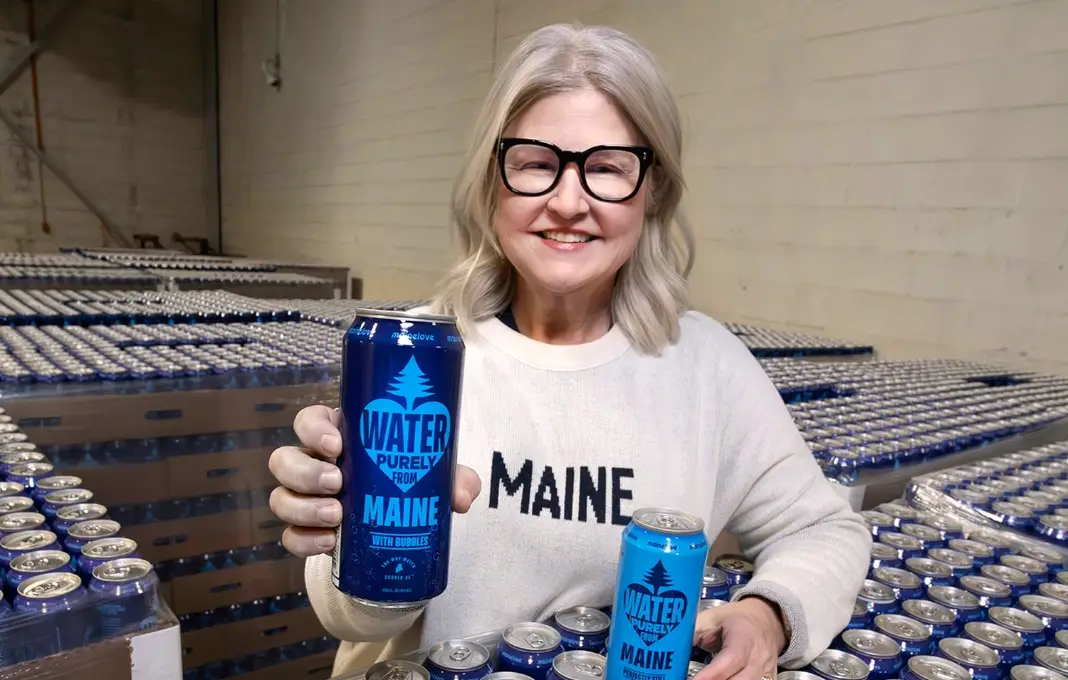
Jen Millard found a creative way to start her canned water company, mainelove, without having to invest in significant capital outlays—using the facilities of local brewers when they are not making beer.
It’s an all-around win, for the brewers and mainelove—the company now distributes in five states and more than 600 stores—but also the state of Maine. Maine has exported its water for generations, but now mainelove is creating more economic value that stays local. In an interview Millard shares how she founded and grew the company, and where it’s headed next.
Tell us about the decision to partner with local brewers to create mainelove, and how that benefits the business.
As a 12th-generation Mainer, I had always dreamed of starting a business in my home state, but never found the right opportunity. That changed in early 2024 when I was back in Maine visiting my cousin, Frank Grondin, at his brewery, Brickyard Hollow.
During that visit, I noticed the brewing facilities were sitting idle. Frank explained they had already produced all of their beer for the week, and I later found the same was true at many breweries across Maine. With alcohol consumption declining, a lot of brewing capacity was going unused for days at a time. As part of my research, I walked through more than 40 breweries in Maine and heard the same story everywhere.
At the same time, I knew that one of the reasons Maine beer is so great is its access to Sebago Lake water. That led to the aha moment: Why don’t we can Maine’s great water to help breweries diversify their revenue?
Maine has more brewers per capita connected to this same water source, so we started thinking of them as a network of potential water producers. That became the foundation of our asset-light business model: We partner with brewers to make water when they are not making beer. Today, we work with three brewery partners to produce our mainelove line, including still water, sparkling water and three flavored seltzers.
This model benefits our brewery partners by bringing them into the water economy and creating an additional revenue stream. More importantly, it helps keep more of the economic value of Maine water in Maine.
Throughout this process, I kept asking myself: How do I build something meaningful in Maine? That question led me to this brewer model. We have 65 brewers pulling from Sebago Lake, and even more if you include the broader watershed. The water quality is incredible, thanks to Sebago Lake and the forests that surround it, which act as natural filters.
As I met with brewers, I found they were all facing similar challenges. We are not pretending to save the beer industry, but we can create a new opportunity for them.
One of the most important parts of building this business was figuring out how to keep as much of the value chain in Maine as possible. Maine has been exporting water for generations, but the economic benefit has not always stayed in the state.
What does your operating model look like?
Our model is designed differently. We provide the drink formulas, purchase the aluminum cans and ship them to our three brewery partners. They produce and can the water, then deliver the finished product to our warehouse. All of our production partners meet GMP standards required for food-grade manufacturing. Since water is classified as a food product by the FDA, those standards are essential.
In many ways, we are helping brewers evolve into co-packers. We pay them a co-pack-style rate, similar in spirit to Maine’s cooperative models in industries like lobster and oysters. They complete production, send the product for testing and we sell it under one master brand.
The economics are compelling. It takes less water to produce canned water than it does to produce beer, since we are not boiling off excess liquid. That means the model is efficient, cost-effective and supportive of Maine jobs. Our goal is to help breweries keep people employed, respect the source of their water and support the long-term protection of the watershed.
We also strongly believe in giving back to land trusts because if we do not protect the forests, we will not protect the lake. Taken together, it is a beautiful model: community-driven, job-creating, environmentally aware—and asset-light.
From an investor’s perspective, what makes this model appealing?
I own almost no equipment besides a forklift. We rent warehouse space in Westbrook, Maine.
That asset-light structure is highly attractive to investors because the capital that would normally be tied up in a manufacturing facility can instead be used to drive growth. Rather than sinking money into heavy operating costs, we can direct more cash flow into promotions, sales and marketing, which is critical in the beverage business.
What does scalability look like for mainelove with the business model you have created?
Scalability is fast and furious! Year one was focused on building distribution in Maine, where we are now available in more than 600 stores. We are currently distributing in five states: Maine, New Hampshire, Massachusetts, Vermont and Connecticut, to be followed by a major expansion into Florida this fall.
Florida is a particularly attractive opportunity. Maine has a strong reputation there, especially among snowbirds who travel back and forth seasonally. Florida also faces significant water quality challenges across many areas, making Maine-sourced water an especially compelling proposition. We were licensed in Florida in just one day, and we are excited about what that market could mean for the brand.