For entrepreneurs who have spent years building a business, handing over responsibility to a professional management team can be a major transition. It can also require a change in how they think about executive compensation.
A founder who’s kept their own salary relatively low may discover that hiring an experienced president, CFO or COO requires a compensation package substantially higher than they’re accustomed to paying—or even taking home themselves. Even a professional CEO, who has a significant equity incentive, may have reason to pay more to bring in an executive with needed capabilities.
New research from Chief Executive Group illustrates just how much private companies pay for senior leadership, and how sharply those numbers rise as companies grow.
According to the 2026–2027 CEO & Senior Executive Compensation Report, median total compensation for presidents of U.S. private companies reached $354,608 in 2025. COOs earned a median of $282,940, while CFOs earned $272,434.
But those national medians tell only part of the story.
What It Costs to Bring In Leadership
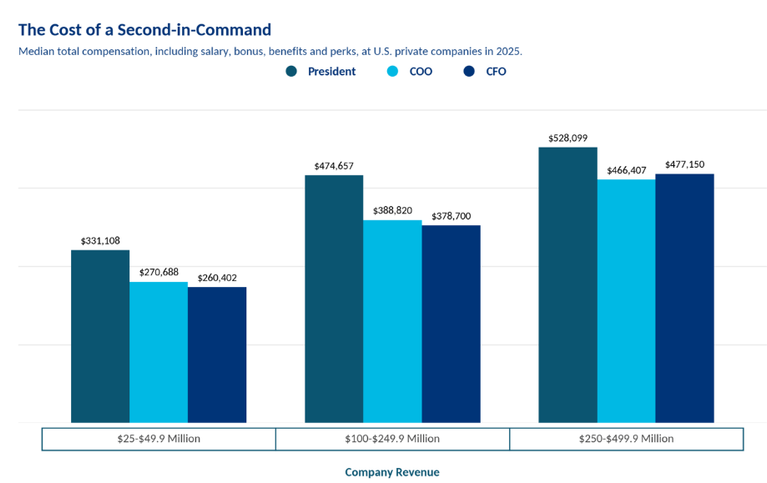
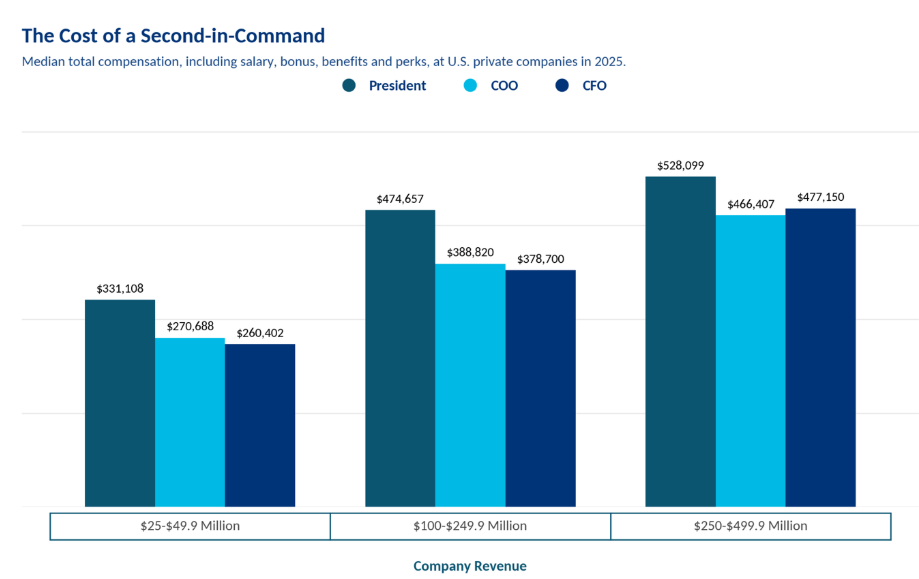
At private companies generating $25 million to $49.9 million in annual revenue, median total compensation for presidents was $331,108 in 2025. For COOs, it was $270,688, and for CFOs, $260,402.
At companies with $100 million to $249.9 million in revenue, the figures climb considerably: $474,657 for presidents, $388,820 for COOs and $378,700 for CFOs.
And for companies generating $250 million to $499.9 million, median compensation reaches $528,099 for presidents, $466,407 for COOs and $477,150 for CFOs.
Those figures include salary, bonuses, equity, benefits and perks. They also represent medians—not necessarily the compensation required to recruit an executive with particularly strong experience or specialized capabilities.
Among CFOs at companies with $100 million to $249.9 million in revenue, for instance, top-quartile total compensation reaches $596,198, well above the $378,700 median.
Owners planning a hire should budget against the range, not the midpoint. Half the market is already above it.
The Cost of Taking the Next Step
The challenge isn’t simply whether an owner or CEO can afford to pay a new executive more in cash compensation than their own package. It’s determining what capabilities the business needs—and what those capabilities are worth. And often, it is prudent to hire a key executive who comes from a larger company (where compensation tends to be higher) to bring capabilities to enable the company to grow.
A company expanding into new markets may need a president with experience managing a larger, more complex organization. A founder preparing for an eventual sale or outside investment may need a CFO with expertise in financing, reporting, transactions and raising capital. A rapidly growing manufacturer may need an operations leader capable of bringing greater discipline to production and supply chains.
Each role presents a different compensation challenge.
The research also shows that compensation varies materially by industry, ownership structure and profitability. Private equity-backed companies, for example, tend to offer more competitive compensation packages than many other privately held businesses, particularly through bonuses and equity incentives.
For founders competing for the same talent, that can mean looking beyond base salary to consider performance bonuses, long-term incentives or other ways to reward executives for building enterprise value.
Think Beyond Your Own Paycheck
CEOs often have something that hired executives don’t: a meaningful ownership stake in the business.
That distinction matters when comparing compensation packages. The salary and other short-term compensation elements a CEO takes home may represent only one part of the financial return from building the company. A hired senior executive, without equivalent ownership, may evaluate an opportunity very differently.
There is no universal formula for determining what a second-in-command should earn, and paying more doesn’t automatically guarantee better leadership.
But as chief executives plan the next phase of growth for their company, their own compensation may be the wrong benchmark for deciding what to offer the executives they need.
The more useful question is what comparable companies pay for those capabilities—and how to structure compensation around the results the business expects.
Chief Executive Group’s 2026–2027 CEO & Senior Executive Compensation Report provides detailed benchmarks for presidents, COOs, CFOs and other senior executives by company size, industry, ownership structure and performance.