This summer, the United States turns 250. At the same moment, the most disruptive technology in a generation is rewriting what work means. Boards are asking which jobs survive. Employees are asking whether theirs do. Politicians are asking whom to blame.
The right question for CEOs is different: What comes next?
The honest answer is that we have already lived through this story—not once but a half-dozen times. The American economy at its founding looked nothing like the one we run today; and the one we hand to our successors will look nothing like ours. Every transition has cost jobs that mattered. Every transition has built more than it broke. That is not luck. It is the operating system of free enterprise running, generation after generation, on the most adaptive workforce in the world.
The 250th anniversary is a useful moment to remind ourselves—and our boards and our teams—of what that operating system actually does. And how we can all prosper from it.
1776: A NATION OF FARMERS
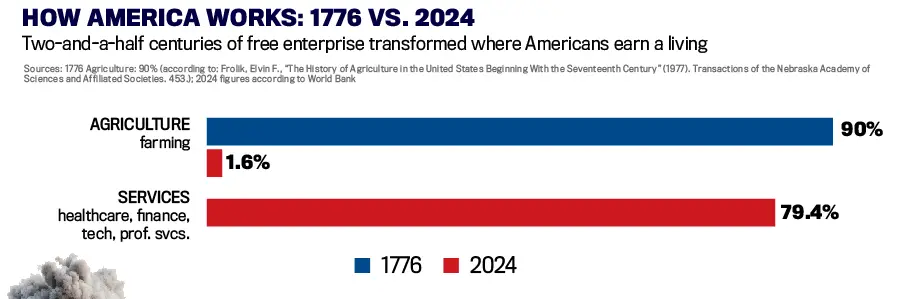
When the founders signed the Declaration of Independence, roughly nine in 10 working Americans worked the land. The colonial economy was a patchwork of regional agricultures—tobacco and rice in the South, wheat and corn in the middle colonies, fish and timber in New England—stitched together by a small merchant class and a few thousand artisans. There was no Treasury, no continental currency, no factories worth the name. The national balance sheet, on July 4, 1776, was a few million pounds of crops, some ships and an idea.
The idea, it turned out, was the asset that mattered.
Compare that starting point to the workforce we report on today. The U.S. Bureau of Labor Statistics counts roughly 170 million Americans at work. Less than two percent of them farm. Roughly 19 percent build, manufacture, mine or move physical things. The remaining 79 percent—nearly four out of every five working Americans—produce something that did not meaningfully exist as a category in 1776: services. Healthcare. Software. Finance. Education. Logistics. Entertainment. Professional advice. The work that fills our calendars.
If you had told a Pennsylvania farmer in 1776 that his great-great-great-grandchildren would earn a living writing code, treating cancer or managing pension funds for retired auto workers, he would have asked you what an auto was. The categories did not exist because the productivity to support them did not exist.
Then it did. And the entire structure of American work bent around the new possibilities.
THREE ERAS, ONE PATTERN
The shift from the blue bars to red bars in the How America Works chart above did not happen by accident, and it did not happen smoothly. It happened in waves, each one driven by entrepreneurs who saw an inefficiency the rest of the country had learned to live with and refused to accept it.
Carnegie and the Age of Steel
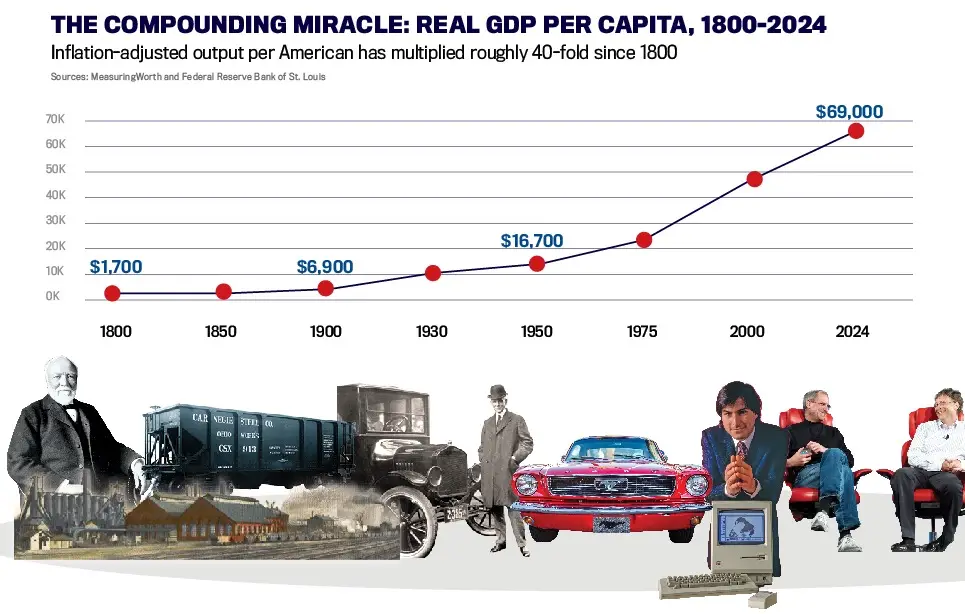
When Andrew Carnegie opened his first steel mill in 1875, the United States imported most of its rails from Britain. Within 25 years, American mills were the cheapest and most productive in the world, and steel was the substrate on which skyscrapers, railroads, bridges and an entire industrial workforce got built. Carnegie did not just sell steel; he created the conditions for cities to rise vertically and for a continental economy to knit itself together. The agricultural workers displaced by mechanized farming—and there were millions—found work in the mills, the railyards, the construction crews and the supply chains that fed them. The country did not become poorer. It became unrecognizable.
Ford’s Democratization of the Middle Class
Henry Ford did not invent the car. He invented the proposition that a working man should be able to afford one. The moving assembly line cut the time to build a Model T from 12 hours to 90 minutes, and the price from over $800 to under $300. Ford then doubled his workers’ wages to $5 a day so they could buy what they built. Critics called him reckless. He created the American middle class. The blacksmiths, livery stables and harness makers who lost work in the transition had children who became machinists, mechanics, dealers, road builders and—a generation later—suburban homeowners. Whole industries that did not exist in 1908, from auto insurance to motels to fast food, owe their existence to one factory in Highland Park.
Jobs, Gates and the Knowledge Economy
By 1976, when Steve Jobs and Steve Wozniak built the Apple I in a garage and Bill Gates was writing the operating system that would define the personal computer, the heavy industrial economy Carnegie and Ford built was already shedding jobs to automation and global competition. The hand-wringing of that era will sound familiar: factories closing, communities hollowed out, an entire generation worried they would never match their parents’ standard of living. What followed instead was the largest expansion of high-skill, high-wage work in human history. Software, biotech, financial services, telecommunications and the ecosystem of professional services that supports them now employ more Americans, at higher real wages, than the manufacturing economy ever did at its peak.
Three names, three industries, three centuries—and one through-line. Each of these eras began with a productivity breakthrough that destroyed established work, was met with sincere predictions of mass unemployment and ended in an economy materially larger and more diverse than the one before it. The cumulative effect is not subtle.
The Compounding Miracle chart above tells the story in a single line. Inflation-adjusted output per American sat at roughly $1,600 in 1800. It crossed $8,000 around the turn of the 20th century, $18,000 by mid-century, and now sits near $70,000—a roughly 40-fold increase. Every doubling required a wave of disruption. Every wave required a generation of CEOs and entrepreneurs willing to bet on what came next.
THE AI MOMENT, IN CONTEXT
Which brings us to the technology on every CEO’s desk.
Artificial intelligence is, by any honest measure, the most consequential general-purpose technology since electricity. It will eliminate categories of work. It already has. The question is not whether we will lose jobs to AI—we will, just as we lost jobs to the cotton gin, the steam engine, the assembly line, the container ship and the personal computer. The question is whether we will let fear of that transition rob us of the vastly larger opportunity on the other side.
History is unambiguous on this point. Every previous technology that destroyed jobs created more jobs than it destroyed, at higher wages, in categories the doomsayers of the era could not have imagined. The Bureau of Labor Statistics now projects 5.2 million net new American jobs over the next decade, with the fastest growth in healthcare, professional and technical services, and—notably—occupations directly enabled by AI itself. That projection assumes we get out of our own way.
Pessimism is always more credible than optimism. It always has been. In 1900, the great anxiety was that immigrant labor would never assimilate; in 1950, it was that automation would create permanent unemployment; in 1980, it was that Japan would eat American manufacturing; in 2000, it was that the internet was a bubble with no real economy behind it. Every one of those fears was rational. Every one of them was wrong about the destination, even when it was right about the disruption. The American economy has lost specific jobs in nearly every decade of its existence. It has not lost the ability to create them.
WHAT THIS ASKS OF CEOs
The 250th anniversary is not just a moment to celebrate. It is a moment to take inventory of what we owe the system that made us. Three commitments are worth making out loud.
First, build with the technology, not around it. Companies that treat AI as a cost-reduction exercise will harvest a one-time efficiency gain and then be flattened by competitors who used the same tools to build something new. The 19th-century textile mills that bought the most efficient looms were not the winners; the winners were the ones that asked what an industrial economy could now produce that had never existed before. Apply that question to your business this quarter, not next year.
Second, invest in the workforce you have, not just the one you will hire. The American worker has out-adapted every prior technological wave. That has not been an accident of national character; it has been the product of employers willing to retrain, reskill and trust people to grow into roles that did not exist when they were hired. AI gives every CEO the chance to be that kind of employer at a scale and speed never previously possible. Take it.
Third, defend the conditions that made the miracle possible. Free markets, the rule of law, property rights, open capital, immigration of talent and a culture that celebrates entrepreneurs rather than resenting them—these are not the natural state of the world. They are an inheritance, and inheritances can be squandered. CEOs are among the few voices in American life with the standing to defend them. Use that standing.
THE NEXT 250
The Pennsylvania farmer of 1776 could not picture our world. We cannot picture the world our great-grandchildren will run. What we can know, because 250 years of evidence say so, is that it will be richer, more productive, more dynamic and full of work we have not yet imagined—if we keep faith with the system that delivered the first 250.
America’s business miracle was never inevitable. It was built, decision by decision, by people who chose to bet on the future when it would have been easier to flinch. That is the job description of the American CEO. It always has been. It still is.