For years, private equity has been associated with the promise of substantial rewards for executives capable of creating value.
The proposition is straightforward: take on ambitious performance targets, help build a more valuable enterprise and participate financially in the results. For a CEO willing to accept the demands of private equity ownership, the potential upside can be a powerful attraction.
But new historical compensation data suggests something has changed.
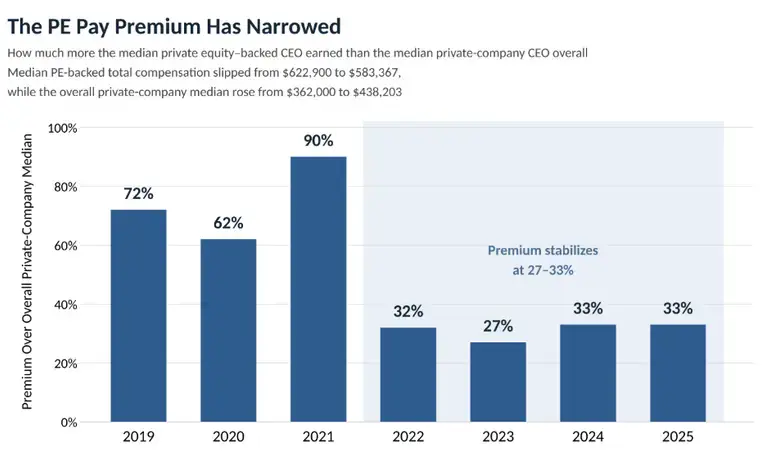
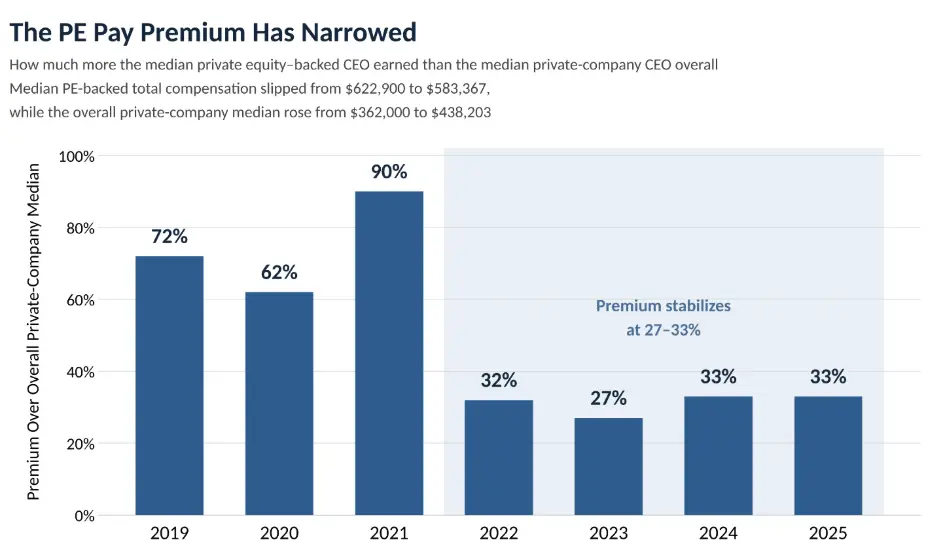
In 2019, the median CEO of a private equity-backed company earned 72 percent more than the median private-company CEO overall. By 2025, that premium had narrowed to just 33 percent.
The findings raise an intriguing question: Has the financial advantage associated with PE-backed leadership diminished—or has the way executives are rewarded changed?
Chief Executive Group Research analyzed seven years of CEO compensation data, from 2019 through 2025, using its annual surveys of U.S. private companies, to find out.
In 2019, the median PE-backed CEO earned $622,900 in total compensation, compared with $362,000 across the overall private-company sample. The premium remained substantial in 2020, at 62 percent, before reaching nearly 90 percent in 2021. That year, median PE-backed CEO compensation climbed to $844,500, against $445,000 for the overall sample.
Then, the gap narrowed sharply.
In 2022, median PE-backed CEO compensation fell to $546,000, leaving a premium of 32 percent. Since then, the premium has remained relatively stable: 27 percent in 2023, 33 percent in 2024 and 33 percent again in 2025.
That’s a very different picture from the period preceding the pandemic. And although PE-backed executives continue to earn substantially more than the overall private-company median, their advantage is considerably smaller than it once was.
What Changed?
The simplest explanation would be that PE firms have become less generous. But the data doesn’t support that conclusion—nor does it deny it.
The facts are that total compensation includes base salary, bonuses, benefits, perks, equity grants and equity appreciation, and these components can behave very differently from year to year.
Equity appreciation is especially important. The value of executive ownership stakes can increase dramatically when business valuations rise, then retreat when market conditions change. That makes total compensation more volatile among executives whose packages include substantial equity participation.
The unusual conditions of 2021 are particularly relevant. The period featured strong business recoveries, elevated transaction activity and significant increases in valuations across parts of the private market. Those conditions may have influenced the reported value of executive equity.
But that is only one possible factor. There can be several factors at play here and even when controlling for equity gains, the premium has fallen.
No matter the cause, the findings raise a critical question for PE firms: If the annual compensation premium over other private companies has narrowed, is the potential for long-term wealth creation still sufficiently clear and compelling to attract the leadership talent required?
That doesn’t necessarily mean increasing compensation. It may mean communicating incentive value more effectively—or ensuring that executive rewards are closely aligned with achievable business outcomes.
For CEOs and investors alike, the relevant question may no longer be simply how much more PE-backed executives can earn, but how much value they have the opportunity to create—and how much of that value they stand to receive.
For more benchmarks by company size, industry and ownership structure, explore Chief Executive Group Research’s latest CEO & Senior Executive Compensation Report.