A profitable year can mean bigger bonuses for your leadership team. But does that mean your incentive program is working?
Not necessarily.
A CFO can strengthen cash flow while revenue declines. A COO can improve efficiency even as margins come under pressure. A CHRO can reduce costly turnover without producing an immediate improvement in earnings.
And a company can deliver outstanding financial results for reasons that have little to do with any one executive’s performance.
For CEOs, this creates a challenge: how to reward senior leaders for helping the company succeed without losing sight of their individual contributions.
Chief Executive Group Research’s latest compensation study, based on data from 1,551 U.S. companies, shows that annual bonuses tend to rise significantly with profitability across the executive team. But the findings also raise questions about what companies are actually rewarding—and whether those incentives are designed to drive future performance or simply recognize results after the fact.
Profits Pay
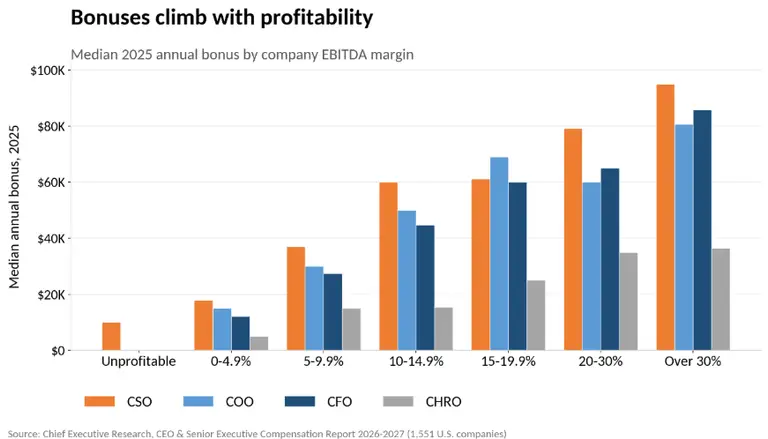
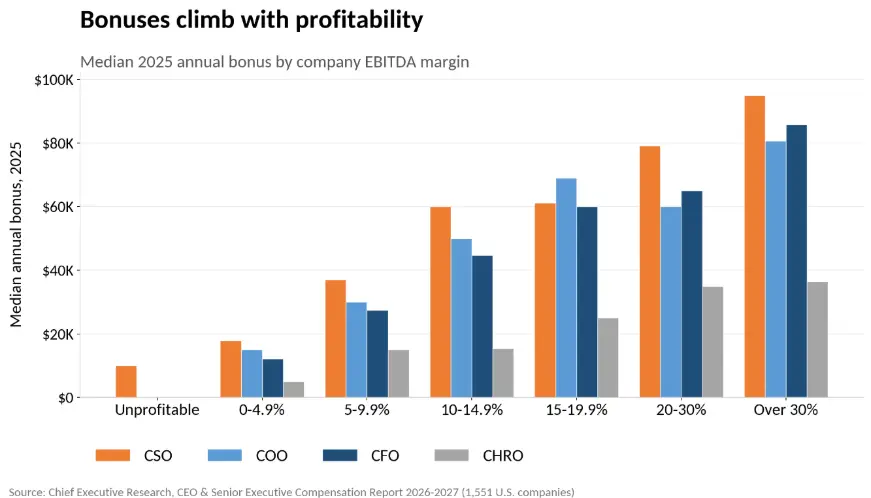
Across the C-Suite, the relationship between profitability and annual bonuses is striking.
At companies that were unprofitable in 2025, the median CFO, COO and CHRO received no bonus. At companies reporting EBITDA margins above 30 percent, the median CFO bonus reached $85,842, the COO bonus $80,625 and the CHRO bonus $36,503.
The pattern is evident in sales leadership, too. Chief sales officers at unprofitable companies received a median bonus of $10,103, compared with $95,000 at businesses with EBITDA margins above 30 percent.
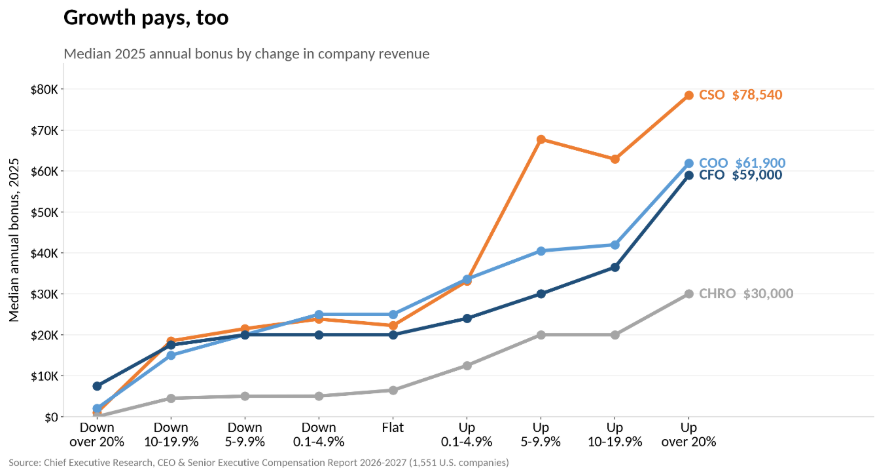
Revenue growth produces a similar pattern: At companies reporting flat revenue in 2025, the median CFO earned a $20,000 bonus. That climbed to $36,500 at companies growing between 10 and 19.9 percent and $59,000 at businesses growing 20 percent or more.
For CHROs, the median bonus increased from $6,450 at companies with flat revenue to $20,000 at those growing between 10 and 19.9 percent and $30,000 at companies growing at least 20 percent.
Different Jobs, Different Measures
The findings clearly show that private companies distinguish between stronger and weaker financial performance when determining variable compensation. Linking bonuses to company profitability makes intuitive sense. Senior executives share responsibility for results, and tying compensation to financial performance helps reinforce a common goal.
But relying too heavily on companywide metrics can obscure the contribution of individual leaders.
Consider a COO who successfully reduces production costs, improves quality and shortens delivery times during a year when customer demand weakens. Or a CFO who strengthens liquidity and refinances debt on favorable terms despite disappointing revenue. Both may have delivered exactly what the business needed. Yet if their bonuses depend primarily on hitting an EBITDA target, their compensation may not reflect those accomplishments.
The reverse can also happen. A company may exceed its profit target because of favorable market conditions, even when some executives fall short of their own objectives. “Fair and equitable pay” doesn’t mean every executive’s incentives should be structured the same way.
A CFO’s performance might be evaluated partly through working capital improvements, capital allocation, financing costs or the effectiveness of financial controls. A COO’s objectives could include productivity, operating efficiency, quality and execution of major initiatives.
For a CHRO, priorities might include retaining critical talent, strengthening leadership succession, improving workforce productivity or closing capability gaps. Sales leaders, meanwhile, may be accountable for revenue growth, customer retention, pricing discipline and the profitability of the business they bring in.
While growth creates financial capacity to reward executives, it also reflects the success of decisions made across the company, not each individual contribution.
For CEOs, the question is whether the compensation program recognizes these contributions or leaves them dependent on broader company performance. The appropriate measures will depend on the company’s strategy.
Don’t Reward This Year at the Expense of Next Year
Annual bonuses are well suited to rewarding near-term accomplishments. But some of the decisions that create the most value require executives to look beyond the current year’s results. Investments in technology, leadership development, operational capacity or new markets may reduce near-term earnings while strengthening the business for years to come.
An incentive program focused almost exclusively on annual profit targets may give executives little financial reason to prioritize those investments.
That’s where longer-term incentives can play a role.
Equity-based awards, long-term cash incentives and multiyear performance plans can help connect executive compensation to outcomes that take longer to achieve.
But the structure matters as much as the potential reward. Executives need to understand what they’re working toward, how success will be measured and what they stand to gain if the company delivers. A long-term incentive with unclear targets or an uncertain payoff may do little to influence the decisions made today.
Is Your Compensation Plan Doing Its Job?
For CEOs reviewing executive compensation, the most useful question may not be whether bonuses are increasing with profitability. Our research suggests they generally are. The bigger question is whether those bonuses reward the individual and collective contributions necessary to sustain performance. That means looking beyond the size of the payout.
Some considerations:
- Are your executives being measured against objectives they can meaningfully influence?
- Do those objectives reflect the company’s strategic priorities?
- Are you recognizing valuable contributions even when broader financial results disappoint?
- Are you rewarding decisions that will strengthen the business beyond the current year?
There’s no single compensation formula that works for every executive or every company. But there is an important distinction between paying executives more because the company performed well and paying them in ways that encourage the company to perform better.
For more benchmarks by company size, industry and ownership structure, explore Chief Executive Group Research’s latest CEO & Senior Executive Compensation Report.