For a growing private company, few decisions are more consequential than hiring the right people.
The CFO who can secure financing for an expansion. The COO who can turn a founder-led operation into a scalable business. The sales executive who can open new markets and build a team capable of serving them.
These are the hires that can help a company reach its next stage of growth. They’re also among the most difficult decisions for CEOs and business owners, particularly when the compensation required to attract an experienced executive stretches beyond what the company has historically paid.
The instinct to protect margins and control overhead is understandable. But at what point does holding the line on executive compensation become an obstacle to growth?
The Compensation Gap
Our latest compensation research, based on responses from 1,551 U.S. companies, reveals substantial differences in how businesses approach executive incentives.
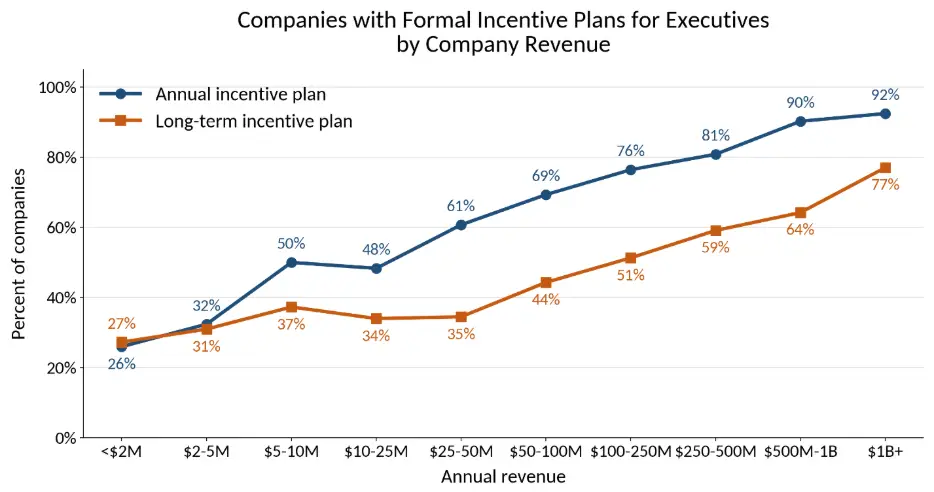
Among companies with less than $2 million in annual revenue, just 26 percent report having formal annual incentive plans for executives. That proportion rises to 61 percent among companies generating $25 million to $49.9 million and 92 percent among those with revenues of $1 billion or more.
The divide extends to long-term compensation. Only 27 percent of companies with less than $2 million in annual revenue offer formal long-term incentive plans, compared with 44 percent of companies generating $50 million to $99.9 million and 77 percent among those with revenues exceeding $1 billion.
Sophisticated incentive programs don’t necessarily cause companies to grow. And larger organizations generally have more resources, more complex management structures and greater capacity to formalize compensation practices.
But the data does raise a question for smaller businesses looking to compete with larger peers: Is your compensation program equipped to attract the leadership talent required for your company’s next stage of growth?
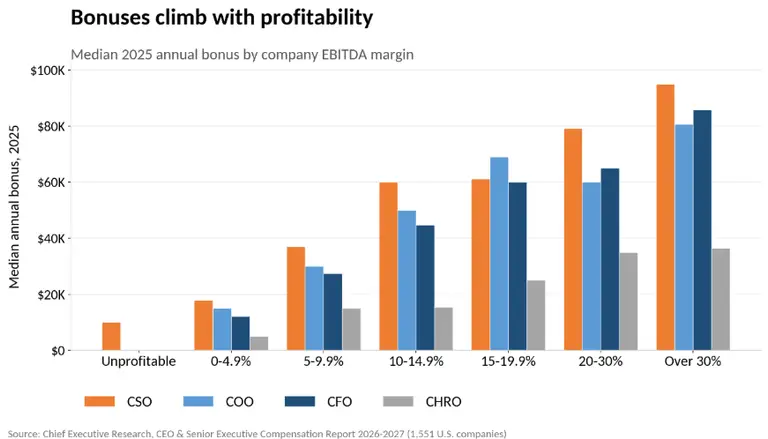
Competing for executives isn’t always about matching the highest salary in the market. A talented CFO or COO evaluating an opportunity will consider the responsibilities of the role, the company’s prospects, the chance to make a meaningful impact and the potential financial rewards.
Those rewards don’t always come from the attractiveness of the base salary. In fact, our research finds that compensation becomes increasingly weighted toward variable pay as company size increases. Among companies generating $10 million to $24.9 million in annual revenue, the median COO bonus represents approximately 9 percent of base salary, with no median equity component. For companies with $100 million to $249.9 million in revenue, the median bonus represents 27 percent of salary.
At companies generating $1 billion to $9.9 billion, the median COO bonus reaches approximately 64 percent of base salary, with equity representing another 13 percent. While at the top quartile, equity represents anywhere from 4 to 34 percent of a COO’s final compensation package.
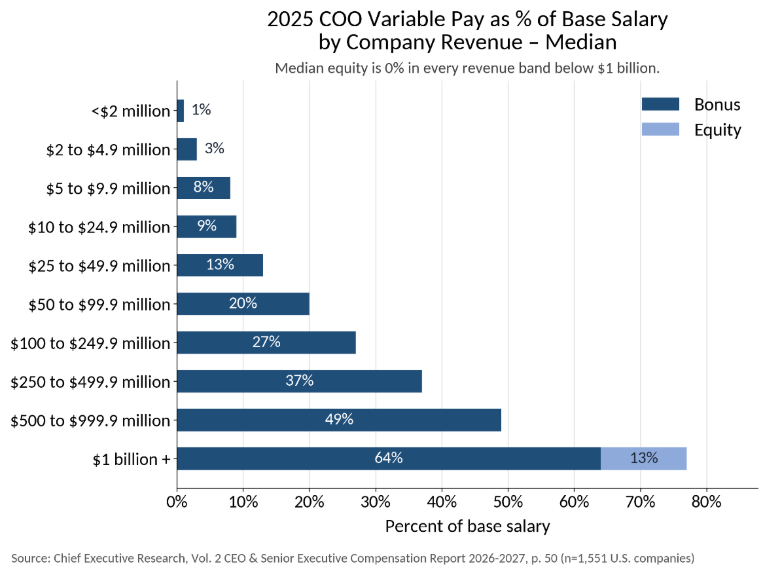
These are very different compensation structures—and they illustrate how larger organizations use incentives to create opportunities for executives to participate financially in company performance.
For smaller businesses unable to offer comparable guaranteed salaries, thoughtfully designed variable pay can provide an alternative: the possibility of significant rewards tied to achieving meaningful business objectives.
The Cost of Thinking Too Small
One risk for scaling companies is continuing to make compensation decisions based on what worked when the company was smaller.
An owner who has built a successful $20 million business may hesitate to offer a prospective executive compensation significantly above existing management salaries—or even their own. Yet the skills needed to run a $20 million business aren’t necessarily those required to scale it to $100 million.
Hiring an executive capable of managing a larger operation may require competing with employers already paying for that level of experience. That doesn’t mean every company should increase executive pay. Nor does offering more money guarantee better leadership. But it does mean that compensation decisions should reflect the responsibilities and strategic importance of the role, the market for the talent being recruited and the value the executive could help create.
A strong candidate may cost more than the organization is accustomed to paying. The relevant question is whether that investment makes sense relative to what the company is trying to accomplish.
Long-Term Incentives: An Underused Opportunity
Long-term incentives offer another way to bridge the gap between what a business can afford today and the value an executive may help create tomorrow. Yet 57 percent of companies in our survey reported having no formal long-term incentive plan. That represents a potential missed opportunity, particularly for companies seeking to build stronger leadership teams without significantly increasing fixed compensation costs.
Equity, phantom equity and performance-based cash awards can create financial incentives tied to future results, though each carries different costs, risks and implications for owners.
The structure also matters. An incentive that executives don’t understand—or whose potential value is never clearly communicated—may do little to influence their decisions.
And compensation cannot compensate for everything. A weak culture, unclear strategy or lack of trust in leadership may undermine even a generous package.
Investing in the Next Stage
The lesson isn’t that smaller companies should copy the compensation practices of billion-dollar enterprises. Their economics, ownership structures and priorities are often fundamentally different.
It’s that executive compensation should evolve alongside the business.
As organizations grow, they depend on leaders who can take on responsibilities their founders once managed themselves. Attracting and retaining those people may require new approaches to how performance, contribution and long-term value are rewarded.
For CEOs and owners evaluating their next phase of growth, the question is worth considering: Is the current compensation strategy designed for the company they have today—or the company they’re trying to become?
For more benchmarks by company size, industry and ownership structure, explore Chief Executive Group Research’s latest CEO & Senior Executive Compensation Report.