Market Pulse
Global freight spot rates moved sharply higher in the second quarter of 2026 and remained elevated through September, following a comparatively subdued period in late 2025 and early 2026. At the same time, industrial margins remained relatively stable, while industrial production growth improved toward the end of the period.
The data points to a market in which freight costs have moved sharply higher while broader operating indicators have remained relatively stable. For middle-market companies, the key question is whether recent rate increases represent temporary volatility or the beginning of a more sustained shift in transportation costs. While freight is particularly relevant for industrial companies, the broader M&A takeaway applies across sectors: Buyers and capital providers place a premium on businesses that can demonstrate resilient margins, pricing power and the ability to manage volatile input costs.
Freight Rates Resurged While Industrial Margins Remained Stable
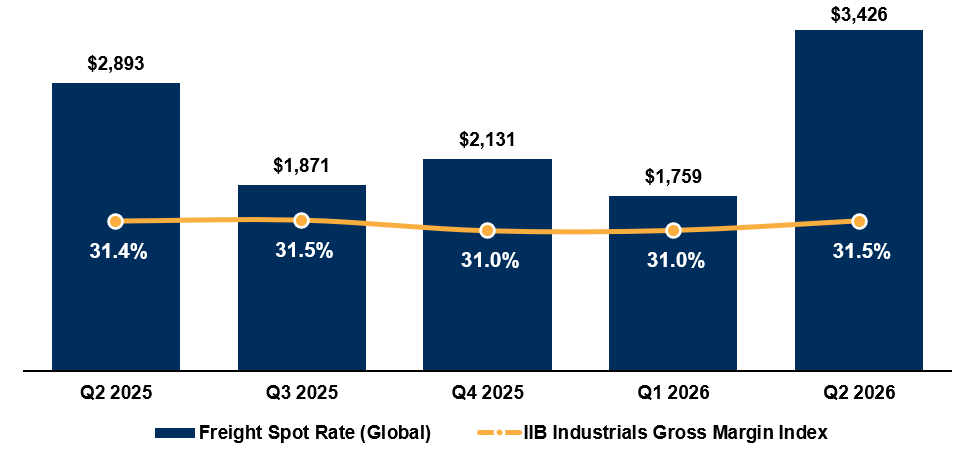
Global freight spot rates rose from $1,759 in Q1 2026 to $3,426 in Q2 2026, while Intrepid’s industrial margins index, which tracks gross margin across 150 publicly traded companies spanning all stages of the value chain, showed limited signs of change.
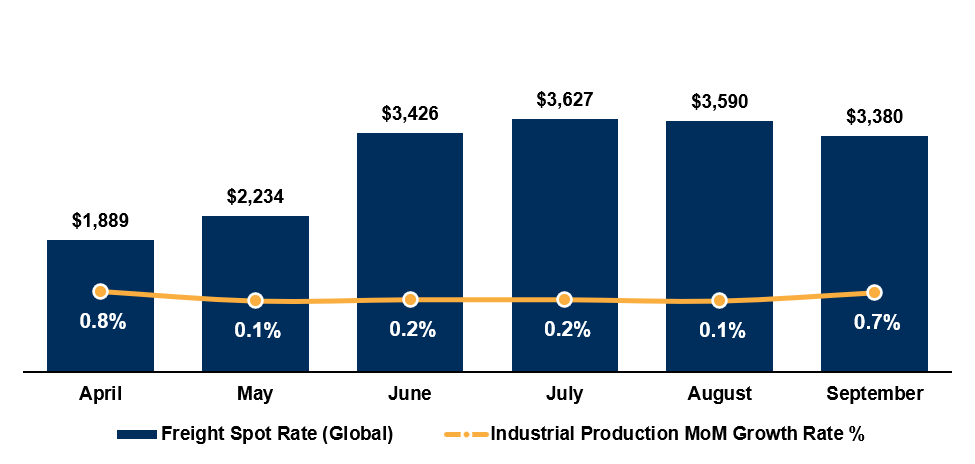
Freight spot rates remained elevated through September as industrial production growth improved.
Global freight spot rates increased from $1,889 in April to a peak of $3,627 in July, before easing to $3,380 in September. Industrial production growth remained modest but improved to 0.7 percent in September, up from 0.1 percent in August.
Freight Rates Remained Elevated as Industrial Production Growth Improved
M&A Market Snapshot
Despite fluctuations in freight spot rates, industrial margins remained relatively stable. From Q2 2025 through Q2 2026, the margin index stayed within a narrow range of 31.0 percent to 31.5 percent.
More recent monthly data shows freight rates accelerating through the summer before moderating in August and September. Industrial production growth also remained positive, increasing to 0.7 percent in September. While these indicators do not establish a direct relationship, they suggest that transportation costs may remain elevated without a corresponding decline in broader industrial activity.
For buyers and investors, periods of cost volatility place greater emphasis on understanding how effectively a business can protect margins. While the specific pressures vary by industry, companies with demonstrated pricing power, flexible cost structures and diversified supplier or vendor relationships may be better positioned to navigate volatility and support a more durable earnings profile.
What does this mean for owners and acquirers?
Valuation. Buyers will look closely at whether recent margin performance can be sustained if key input costs remain volatile. Companies that can demonstrate effective cost recovery, disciplined pricing and resilient margins may be better positioned in a transaction.
Positioning. Operational flexibility is becoming an increasingly important point of differentiation. Businesses that can demonstrate pricing power, a flexible cost structure and limited concentration across key suppliers or vendors may be better positioned to manage volatility.
Timing. Owners considering a transaction should be prepared to explain how changing costs affect profitability and working capital, and clearly distinguish temporary impacts from underlying operating performance. This will help buyers and capital providers evaluate normalized earnings and the durability of margins.
About Intrepid Investment Bankers
Intrepid Investment Bankers is a leading middle-market investment bank providing M&A, capital raising and strategic advisory services. As part of MUFG, one of the world’s largest financial institutions, Intrepid combines deep industry expertise, senior-level execution and global resources to help clients achieve their strategic objectives.
Connect with Intrepid
Questions about market conditions, valuations, capital raising or transaction activity? Intrepid’s team is available to discuss the trends shaping today’s M&A environment and what they may mean for your business.