Giving senior executives a stake in the business is supposed to accomplish two things: keep them invested in the company’s future and encourage them to make decisions that build long-term value.
But what happens when executives don’t know what that stake is actually worth?
New research from Chief Executive Group suggests this may be an overlooked weakness in private-company compensation programs.
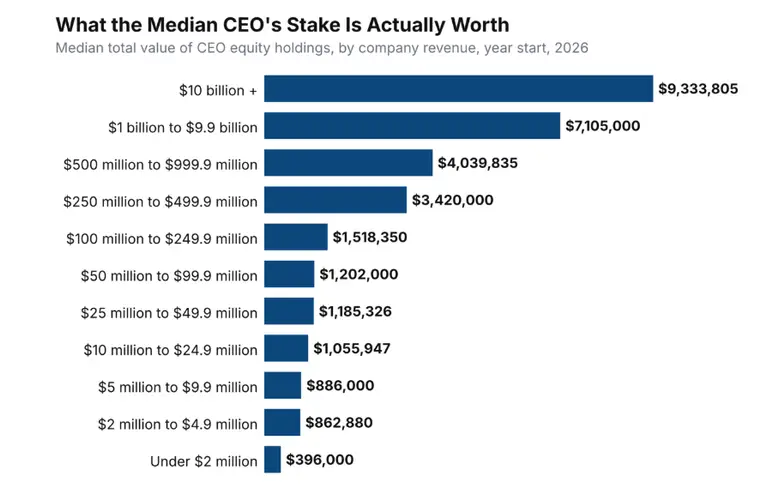
While many businesses offer equity or phantom equity incentives to senior leaders, relatively few regularly measure and communicate the gains in those awards, potentially diminishing one of their most important motivational tools. The range in value of the equity stake for CEOs is large—and largely dependent on company size, varying from a median stake valued at $396,000 for companies with revenue under $2 million all the way to a median stake of $7.1 million at companies with revenue of $1 billion to $9.9 billion.
The Value Nobody Sees
Unlike executives at publicly traded companies, where share prices provide a readily available measure of ownership value, executives at private companies may have little visibility into what their equity awards are worth from one year to the next.
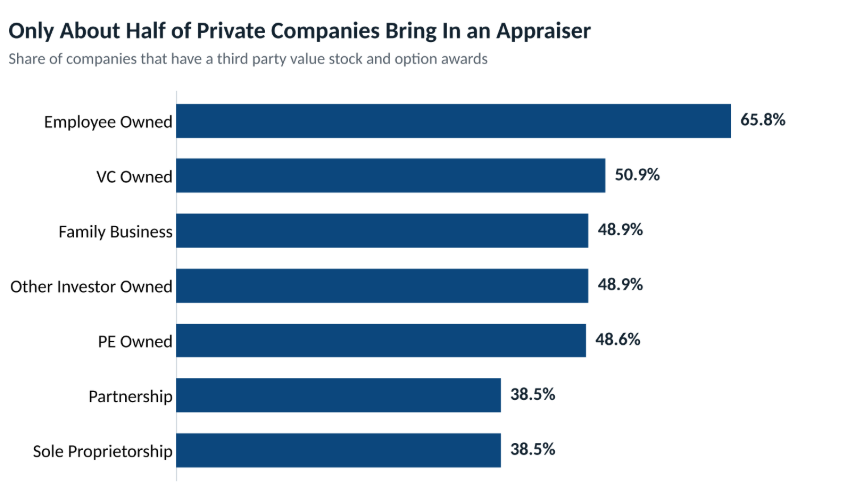
Only about half of private companies bring in an outside party to value stock and option awards. Employee-owned companies are the most likely to, at 66 percent. Sole proprietorships and partnerships are the least likely, at 39 percent. The rest rely on an internal estimate from the CFO or other staff, or on a formula tied to profits, sales or other metrics.
The report finds that private equity- and venture capital-backed companies generally do a better job of regularly valuing and communicating equity gains than other privately held businesses, although on the narrower question of who hires an independent appraiser, they sit in the middle of the pack.
The distinction matters because the value of an equity incentive isn’t simply what an executive might eventually receive. It’s also the financial stake they understand themselves to be building along the way. Without regular valuations and communication, executives may struggle to recognize how their decisions and the company’s performance affect their potential rewards.
The result: A compensation program designed to encourage long-term commitment may be delivering less motivational value than intended.
What Regular Valuation Looks Like
Pete Ensch, CEO of private equity-backed manufacturing firm Sani-Matic, works with a sponsor that tracks value quarterly and commissions a formal valuation once a year. This year the company began sending each equity holder a personalized statement showing what their stake is worth at the new valuation, along with a range of outcomes if the business were sold today.
“Everybody was doing the same thing, just doing their own math,” Ensch said. He is candid that transparency cuts both ways. At an earlier, more difficult business, he said, valuations brought disappointment rather than enthusiasm. “It comes down to the numbers.”
Parr Instrument Company, a 127-year-old manufacturer in Moline, Illinois, has stayed independent and is organized with a unique ownership structure. President and CEO Jim Nelson says an independent appraiser values the business every year, and that the company periodically offers key employees shares at roughly a 40 percent discount to that appraised value. The discount is what makes the annual number necessary: The gap between what an employee pays and fair market value becomes taxable income in the year of purchase.
Both companies also require executives to put up their own money. Research shows that’s not common, with just 22 percent of companies requiring employees to invest their own funds to acquire equity incentives, even though doing so gives executives a share of the downside as well as the upside.
More Than an Ownership Stake
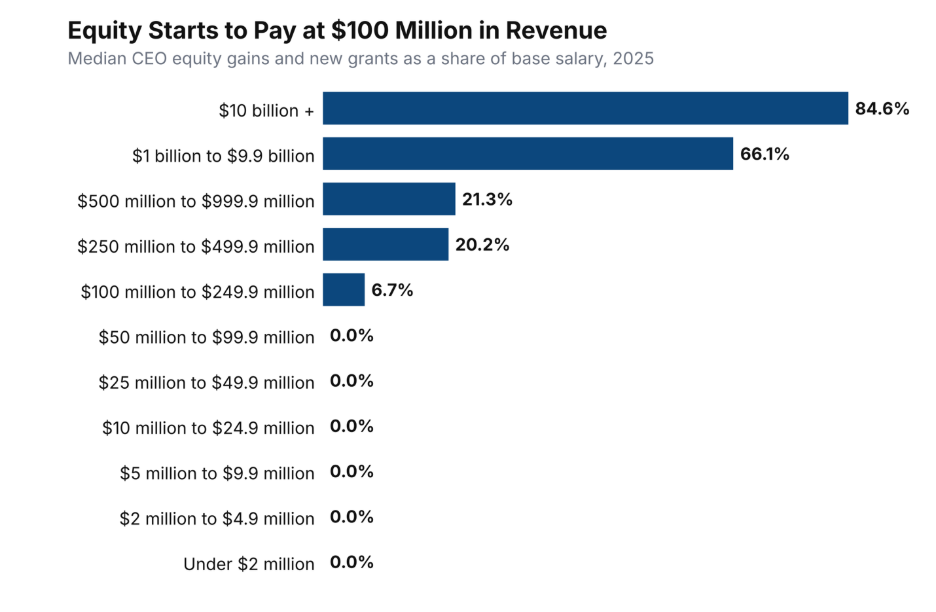
Equity incentives are increasingly important as private companies grow.
According to the report, the median CEO at companies generating $100 million to $249.9 million in annual revenue recorded equity gains and new grants equivalent to roughly 7 percent of base salary in 2025. At companies with $250 million to $499.9 million in revenue, that figure climbed to 20 percent. At companies generating $1 billion to $9.9 billion, it reached 66 percent.
Below $100 million in revenue, the median CEO recorded no equity gains or new grants at all.
And how equity shares are vested is another split decision for many companies. Time-based vesting depends only on the calendar. Performance-based vesting needs a number, and someone prepared to stand behind it. Most private companies seem to favor time-based vesting: nearly half vest equity on time alone, 19 percent on performance alone and 34 percent on both.
So, a stake can sit on the books for years with no figure attached to it, even though the median CEO’s holding is worth at least twice base salary at every company size in the survey.
The question for owners isn’t only whether an award rewards the right things. It’s whether anyone in the business could say, today, what it is worth.
Making Incentives Count
For private-company CEOs reviewing their executive compensation programs ahead of 2027, the research points to several practical steps.
- Establish a regular process for valuing equity awards and communicating those values to participating executives. An annual review can help make the financial benefits of ownership more tangible, even when there is no public market for the company’s shares.
- Make sure executives understand how their awards work—including vesting requirements, performance conditions and how improvements in enterprise value might affect their eventual payout.
- Assess whether the overall compensation package remains competitive. Salary and annual bonuses are only part of the equation. Equity incentives can represent substantial value, particularly at larger companies, and should be considered when benchmarking executive compensation against relevant peers.
The goal isn’t necessarily to grant more equity or increase compensation costs. It’s to ensure that the incentives already in place are understood and aligned with the company’s longer-term ambitions.
For private-company owners, that’s an important distinction. A potentially valuable reward that executives can’t readily evaluate may be less effective than one whose value, and connection to performance, is clear.
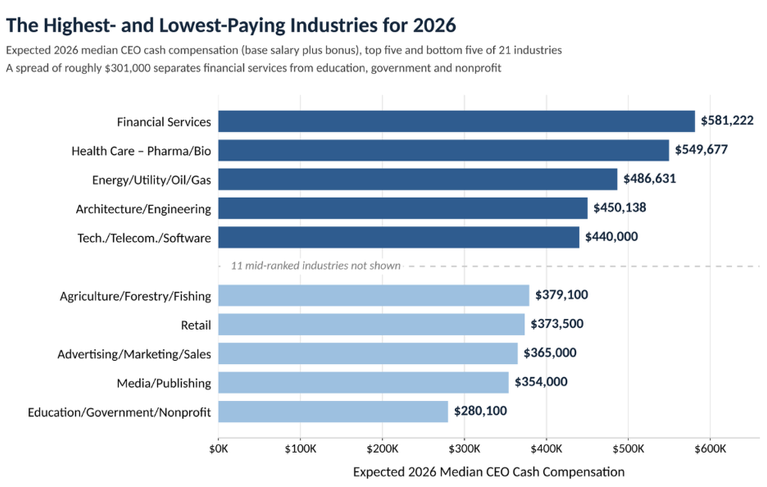
Chief Executive Group’s 2026–2027 CEO & Senior Executive Compensation Report provides detailed benchmarks for CEO and senior executive compensation, including equity incentives, pay practices and differences by company size, industry and ownership structure.