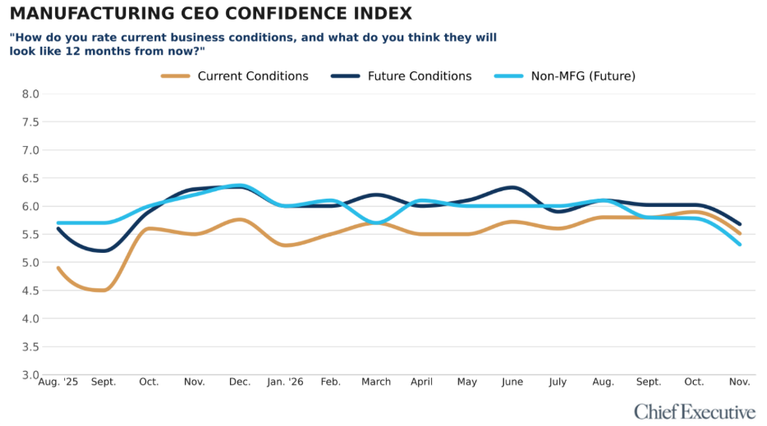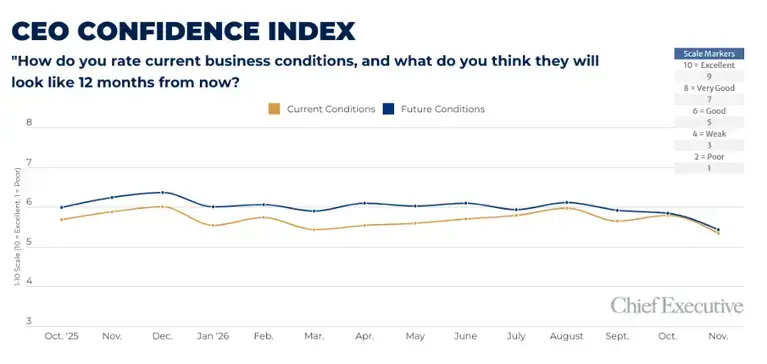
Manufacturing CEOs grew more cautious in November, with their outlook for the year ahead falling to its lowest point of 2026. Most of that drop came from CEOs who answered before the midterm results were known. Manufacturers who responded afterward were nearly as optimistic as they were in October.
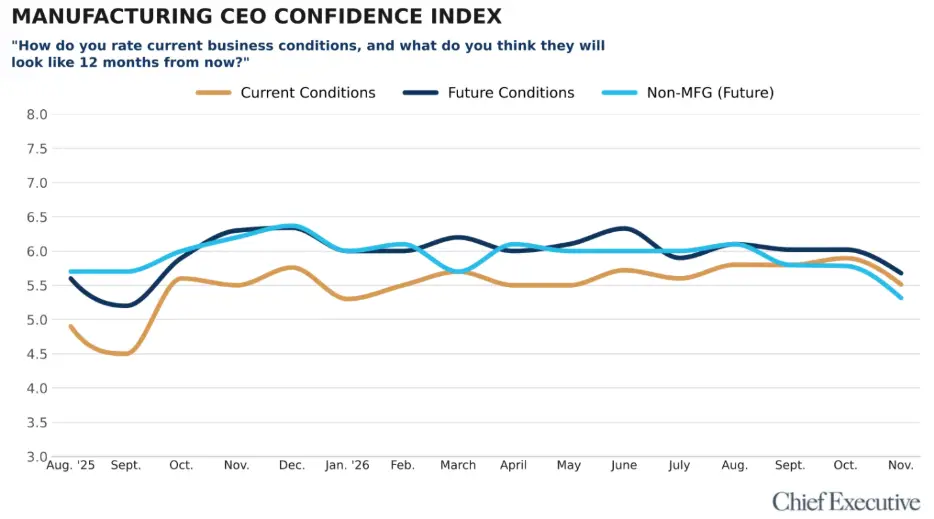
Chief Executive’s latest CEO Confidence Index, fielded November 3–5 among 435 U.S. CEOs, finds manufacturers rate current business conditions 5.5 out of 10, on a scale where 1 is Poor and 10 is Excellent—down 7 percent from 5.9 in October and the sector’s lowest reading since May. Their 12-month forecast fell 6 percent, to 5.7 from 6.0, well under the 6.1 they have averaged in 2026.
Non-manufacturing CEOs fell further, down 8 percent on both measures to 5.3 from 5.8. That keeps manufacturing ahead for a third straight month.
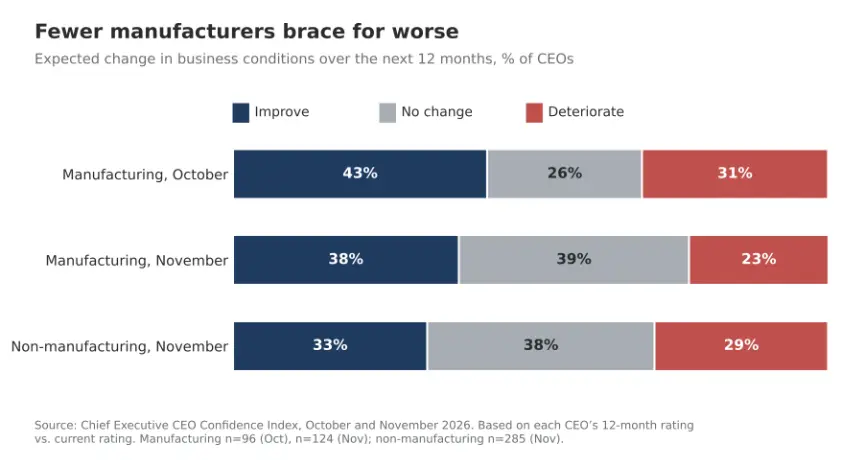
Fewer manufacturers expect conditions to improve over the next 12 months, 38 percent against 43 percent in October, but the share bracing for deterioration fell faster, to 23 percent from 31. The rest moved to the middle: 39 percent now expect no change, up from 26 percent. Non-manufacturers are gloomier on both counts.
Demand remains the leading driver of manufacturers’ outlook, and on the industrial side it is concentrated in a handful of markets: data centers, power and utility work, semiconductors, aerospace and defense. “Aerospace, defense and space all up,” says Scott Wood of LISI Aerospace Fasteners North America, a maker of aerospace fasteners, who rates current conditions a 10.
Although not the leading driver, the midterm elections played a role as well. The CEO of a mid-size industrial manufacturer credits a brighter outlook to “automotive industry recovery and election results,” while another expects conditions to slip, citing the “continuing impact of tariffs” and the “uncertainty the midterm results will create for the business climate”.
Similar to the analysis of results from CEOs across all industries, the election results seem to have helped boost outlook for manufacturers. Those who completed the survey during the day on November 3, before results were known, rated conditions 12 months out at 5.5. Those who responded afterward put them at 5.9, while their view of current conditions barely differed. Additionally, of those responding after the results, 43 percent expect conditions to improve, against 34 percent of earlier respondents, with no rise in those expecting deterioration.
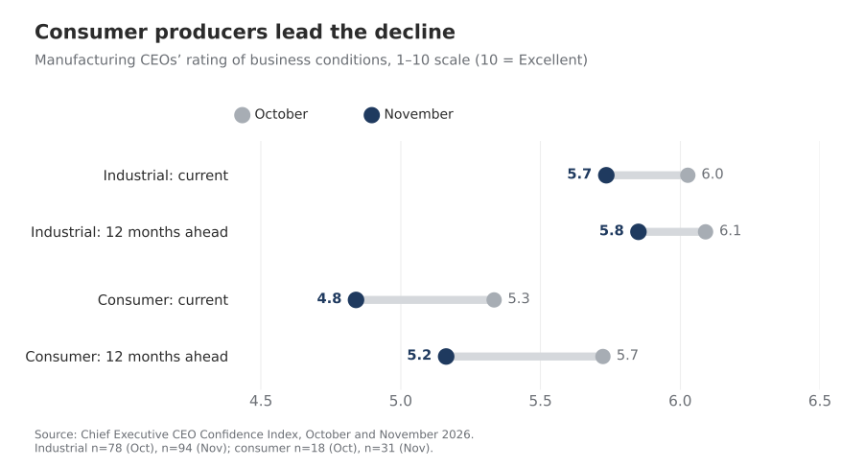
Within manufacturing, the pressure is uneven. Consumer goods producers are carrying more of the decline: Their rating of current conditions fell 9 percent, to 4.8, and their year-ahead forecast dropped 10 percent, to 5.2. Industrial manufacturers slipped less, to 5.7 and 5.8, widening the gap between the two on current conditions to 0.9 points from 0.7.
“Consumers may still be spending money, but they are becoming increasingly selective about where and how they spend it,” says the CEO of a small consumer goods manufacturer.
ECONOMIC OUTLOOK
Manufacturers’ view of the broader economy spread toward both ends. Sixty-four percent forecast some kind of growth over the next six months, up from 60 percent in October, while the share expecting flat conditions fell to 19 percent from 26. The share forecasting a recession rose to 17 percent from 14.
Non-manufacturers also shifted toward growth, to 58 percent from 50, but their recession forecasts fell, to 14 percent from 19. That leaves manufacturers both more bullish on growth than non-manufacturers and more likely to forecast a recession, with fewer on the fence: 19 percent expect flat conditions, against 28 percent of non-manufacturers.
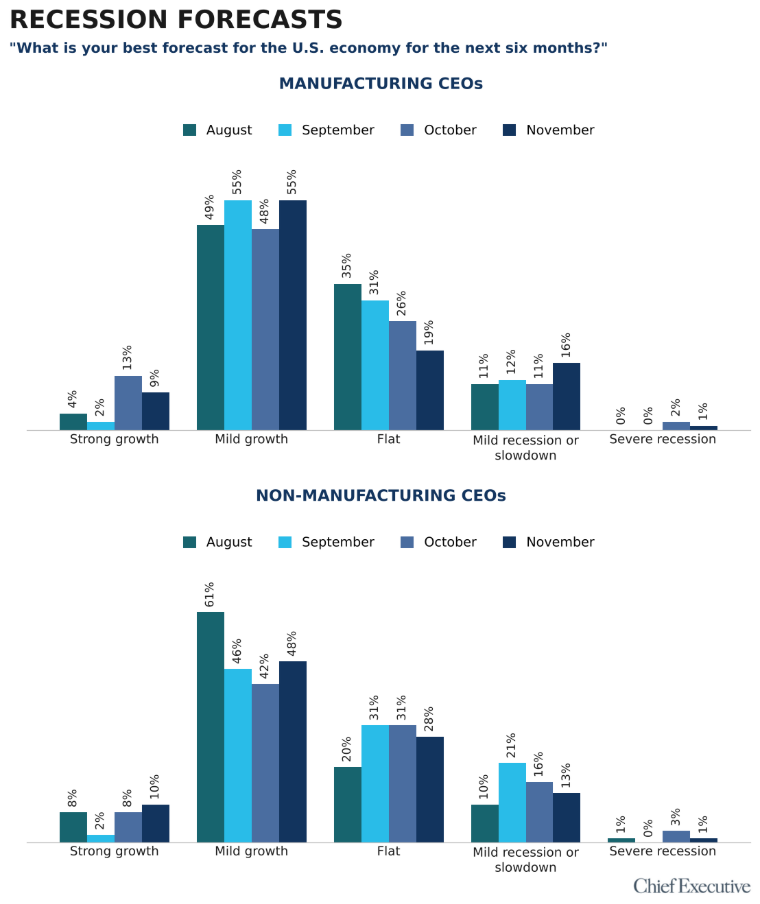
Consumer goods manufacturers are the more pessimistic of the two groups: 29 percent forecast a recession, against 13 percent of industrial manufacturers.
Costs remain the other drag. Across all respondents who explained their outlook, about one in five cite inflation or input costs, from steel to fuel, and one in 10 point to interest rates. “Rising interest rates will slow the economy in 2027,” says Jim Nelson, CEO of Parr Instrument Company, a maker of laboratory pressure reactors and calorimeters.
SOFTER OUTLOOK, STEADY PLANS
Manufacturers’ forecasts for their own companies held up better than their view of the greater business climate. Seventy-five percent expect to finish 2026 with higher revenues than in 2025, and 67 percent expect higher profits, up from 71 percent and 62 percent in October, respectively. Non-manufacturers trail on both, at 65 percent and 61 percent.
Looking to 2027, compared with 2026:
- 86 percent expect revenues to increase (89 percent in October)
- 83 percent expect profits to increase (vs 85 percent)
- 62 percent expect to raise capital expenditures (compared to 55 percent)
- 55 percent expect to add headcount (vs 57 percent)
- 82 percent foresee higher operating expenses (vs 65 percent)
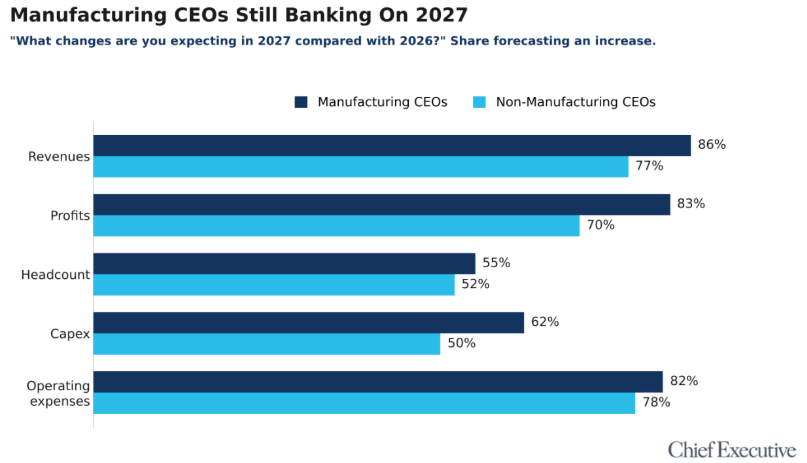
Manufacturers are more likely than non-manufacturers to expect increases on all five measures. Capital spending is the one where the two groups moved in opposite directions: A higher proportion of manufacturers plan to raise capex, up 13 percent from October, while the proportion of non-manufacturers who say the same fell 6 percent, to 50 percent. Manufacturers’ hiring expectations slipped 4 percent, extending last month’s pattern of investment going into equipment rather than payroll.
Cost expectations moved most. Eighty-two percent now expect operating expenses to rise in 2027, up from 65 percent who were targeting increases in October. Non-manufacturers’ cost expectations climbed too, to 78 percent from 68.
For some, the answer is to plan ahead of the data. “Experience, judgment and the willingness to trust your gut still matter,” says the CEO of a mid-size, family-owned industrial manufacturer. “Sometimes leadership means making a decision before the numbers can fully justify it.”
About the CEO Confidence Index
Since 2002, Chief Executive Group has been polling hundreds of U.S. CEOs at organizations of all types and sizes, to compile our CEO Confidence Index data. The Index tracks confidence in current and future business environments, based on CEOs’ observations of various economic and business components. For additional information about the Index and prior months data, visit ChiefExecutive.net/category/CEO-Confidence-Index/