The road between Provo and Seattle, which crosses the Blue Mountains in Oregon, is one of the most treacherous drives in the region. I drove it many times as a college student—steep grades, tight turns, and in winter, weather that’s completely unpredictable. There have been times when dozens of cars have been stranded overnight.
I never knew what I’d find at the summit. But what I did know, and could control, was that I had good tread on my tires, and that my car was serviced and it would start even in a deep freeze. It was also smart to have a gallon of water in the trunk.
This is where most CEOs sit right now with artificial intelligence. The road ahead is likely to be challenging and some cars are going to stall or spin out. We know the weather is not under our control. But the tires and the battery? If we think of these as organizational capabilities—the strength and agility of our leaders, the level of trust we’ve built, our capacity for execution—then they are fully within our control.
CEOs doubt their leadership teams can execute the vision
I’m fascinated by what is happening in organizations right now. Executive teams seem to be clear about their most important strategic priorities. In a new Bain & Company survey of chief executives, 83 percent said their investments and strategic decisions are focused on the future and what matters most, and 87 percent said their executive leadership team is aligned around that ambition. But only 46 percent believe they have the right people in the right roles to deliver it. Bain’s David Michels put it this way: The ambition gap is small, but the execution gap is large.
I would go one step further. With new models coming out constantly that push the frontiers of what is possible, no organization on earth has yet completed a successful AI transformation. So, I would, respectfully, challenge the 46 percent who believe their people and roles are positioned correctly. How could anyone know? On a hard day I count myself among the other 54 percent. Every CEO responding to the survey is guessing based on limited understanding and few, if any, comparables.
With more than half of CEOs lacking confidence in their organizations’ ability to execute their strategic agendas, think of the risk! Pursuing AI transformation without the leadership capability to execute it can put the core business at risk before the new one has time to hit its stride. It may well be worse than clinging to the status quo. You can lose the company you have while building the one you want.
And of course, maintaining the status quo isn’t really an option for most organizations, is it?
Two very different promises
AI offers two payoffs, and boards are beginning to insist on knowing which one to expect.
The first is a one-time reset of the cost structure that results in new efficiencies and margin growth. Every significant technology deployment has delivered some version of this.
The second is transformation—new products, new business lines, new growth vectors, new categories of customer value.
Eli Lilly reinvented its business model by turning its most guarded asset—the performance data from hundreds of thousands of molecules, built at a cost of more than $1 billion—into a platform. About a year ago, Lilly launched TuneLab, giving biotech companies access to AI models trained on that data. In return, these firms contribute their own results, which improve the models for everyone while keeping each side’s proprietary information private. More than 1,300 biotech firms now have access. A century-old pharmaceutical company still sells medicines but now also sells intelligence—and gathers more with every partner that signs on.
Efficiency is important. But efficiency alone will not justify the AI investments most organizations are making. If the outcome is only a slightly leaner version of the same company, the investment case won’t hold up. The greater benefit will accrue to organizations attempting something larger than doing the same work with fewer people.
Experienced CEOs understand that the two AI outcomes draw on different organizational muscles, and that they can compete with each other. The road to efficiency is easier to picture, easier to model, and easier to sell internally. The road to transformation asks whether you can turn the business on its side, imagine what it becomes and survive the journey from here to there.
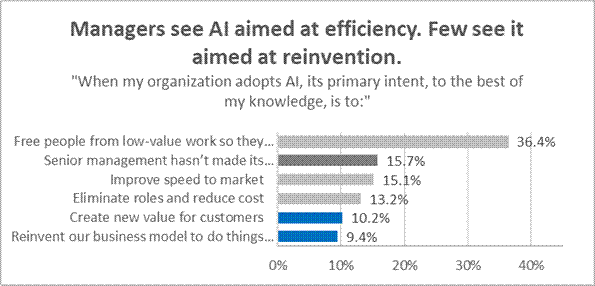
FranklinCovey’s own survey of 1,480 professionals this summer suggests leaders are leaning on efficiency rather than imagination. When we asked managers about their organization’s primary intent with AI, their top response, nearly double the next highest response, was freeing people from low value work. But, just under one in ten said reinventing the business model.
This is not an ERP installation
Earlier waves of technology change came with a known roadmap. When a company installed an ERP or a CRM system, someone could describe the timeline, the cost, the training effort and the outcome.
But no one has that map for AI, including the frontier labs, whose own leaders revise their forecasts monthly.
And just because it’s AI doesn’t mean it is not subject to the same inertia and headwinds that every strategic initiative encounters. Our research on execution consistently finds that leaders underestimate the pull of the day-to-day whirlwind—the customers who need serving today, the numbers due this quarter. That whirlwind sits in direct conflict with any breakthrough effort, and it wins more often than leaders expect or care to admit.
What is within your control
The fundamentals of organizational readiness are well within our control as leaders. We control the nature and resilience of our culture. We control how safe people feel proposing something that might fail. We control the level of trust between the executive team and the front line, and among the executives themselves. We control whether the organization has a system for turning a decision into execution, or whether new initiatives dissipate once exposed to the day-to-day.
These things are like good tires on slippery roads. They don’t stop the snow from falling, but they do substantially improve the odds of arriving.
Resist getting too far ahead
One more discipline belongs on the list of things we can control—directing the organization toward the right outcomes, toward what matters most to its future.
Six months ago, the consensus held that AI would eliminate large swaths of white-collar employment by 2028. Today, the same voices describe a far gentler transition, while significant safety risks are gaining more attention. The internet mattered enormously, but almost nothing anyone predicted in 1999 described how it would play out. We imagined connected refrigerators, not ridesharing apps.
So, there’s a healthy tension here. We can’t freeze up in fear or be satisfied with incrementalism. And we need the self-awareness to know we likely don’t know what we don’t know and cannot yet see. Driving your organization down a path that turns out to be wrong is an always-present existential risk. Part of leadership is not driving your team into a ditch.
What I can say with some confidence: There is no version of the future in which high trust is not a competitive asset. No CEO will look back in three years, and regret having built more capability, more trust and more execution capacity into their organization before heading up over the mountain pass.