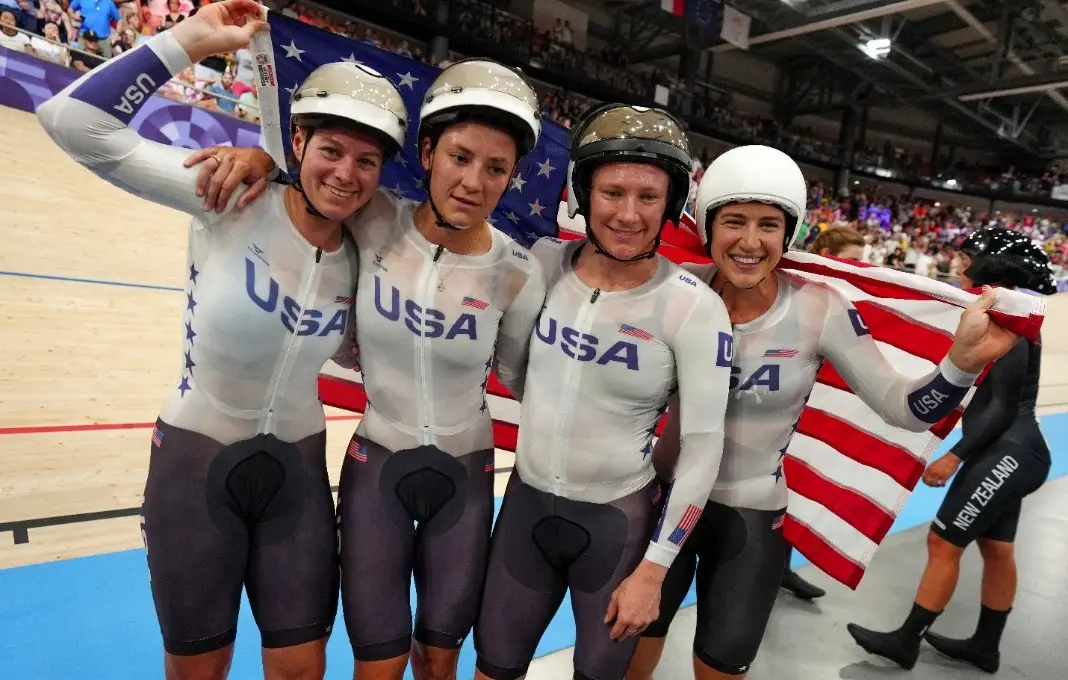
I recently had a chat with Kristen Faulkner, and she isn’t your typical athlete. She’s a two-time Olympic gold medallist across road and track cycling. Harvard graduate. Venture capital career. Didn’t even start cycling until her mid-20s. Then, within a few years, she’s standing on the podium at the 2024 Paris Olympics, winning gold in both the individual road race and the team pursuit.
That kind of trajectory doesn’t happen by accident. It’s built on intentional choices, resilience and a very different way of thinking about team performance. And as I listened to her talk, I couldn’t help but think about how much business leaders could learn from team cycling.
Teamwork under pressure is built on brutal honesty.
One of the first things Kristen mentioned about team pursuit racing struck a chord with me. She said, “There’s basically two important things. The first is communication, like over-communicate with the entire time. You cannot sit there and feel something is wrong and not say it out loud.”
When you watch cycling, it looks deadly silent and composed. But behind the scenes, it’s constant, raw communication. No filters. No hesitation.
In business, we often do the opposite. We hold back. We wait. We assume people should know and things get dropped.
Kristen pushed it further.“If the person in front of you is starting to slow down, you have to tell them to get off the front. You can’t hold anything back in the moment.”
There’s something incredibly powerful in that level of transparency with your teammates. It requires trust, but it also builds it. It removes ambiguity in moments where precision matters most. Simon Sinek calls communication the “lubricant” of teamwork. It breaks down silos, reduces assumptions and creates the safety people need to admit mistakes, ask for help, and perform under pressure.
The second insight was even harder hitting: “There can be no ego at all.” In the cycling world, if you feel strong, you don’t speed up. You go longer. If you feel weak, you don’t try to prove something. You step off the front earlier. The goal is not individual performance. It’s collective output.
In business we reward individual heroics, even when they redline the system. Cycling flips that. It rewards self-awareness and sacrifice for the team.
The business lesson: Create environments where people are expected to speak up in real time and where rotating back is seen as strength, not weakness.
Team trust is earned through self-awareness, not hierarchy.
Kristen made trust very tangible. “If someone is always going to the point where they’re slowing down in a race it can erode trust.” Trust, in her world, isn’t built through titles or intent. It’s built through consistent, observable behavior.
On the flip side, she said, “If someone always hits their numbers I start to feel like, wow, this person is really self-aware.”
High-performing teams aren’t made up of perfect individuals. They’re made up of people who understand their limits and act accordingly. “I have a teammate who goes so hard that the people behind her actually get dropped,” she says, “and I don’t always trust that she doesn’t want to show how strong she is.”
We’ve all seen that in business. The high performer who unintentionally creates headwinds for everyone else. The issue isn’t excellence. It’s misalignment. James Clear makes a similar point in his book, Atomic Habits: High performance isn’t about endless willpower, but about designing habits and routines that allow you to show up consistently, without breaking the system around you. Positive Intelligence frames this as mutual accountability, where team members hold each other responsible not just for results, but for how those results are achieved. In the best teams, accountability doesn’t sit with the leader alone.
The business lesson: Trust is built when people consistently act in the best interest of the team, not when they individually perform at a high level.
Feedback needs to be direct, objective and constant.
Kristen was incredibly clear on this. “The best way to give feedback is to never make assumptions about intent.” Instead of questioning motives, she focuses on observable facts. What happened. What was experienced. What needs to change. Fearless Culture makes a similar point: clarifying questions turn raw feedback into actionable insight.
Kirsten also emphasizes clarity: “I think if you beat around the bush, then things can get a little confusing… the clearest ‘this is what happened’ is the best.”
Furthermore, Kirsten explains how feedback happens constantly. After every training effort, they review what happened. Often with data and video. It’s immediate. It’s specific. It’s usable. According to an article in Medium, constructive feedback is not just about correction. Done well and done often, it strengthens performance, engagement, growth and trust across the team.
Kristen shares, “There’s a lot of accountability for the decisions that we make in real time and there’s a constant feedback loop.” Furthermore, over time, something interesting happens. “The more common feedback is, the more numb people get to the emotional effects of it.” In other words, feedback becomes normal. It loses its sting and becomes a tool for improvement.
The business lesson: Build fast feedback loops. Make feedback objective, frequent and safe. The goal is learning speed, not perfection.
High performance teaming depends on micro-awareness.
In cycling, there are no dashboards, no real-time metrics. You read cadence, body movement, subtle shifts in pace. Kristen shares that “If the cadence is starting to slow down, it means the person on the front is going too slow.” Or “If the person in front of you is wobbling, maybe they need to get off sooner.” It’s constant sensing and adjusting.
The same applies in business. Micro-signals, such as a shift in posture, a delayed response, a fleeting expression of hesitation often reveal what people are not saying. Mindful Insights describes these cues as “unspoken truths” because they can surface frustration, doubt or disengagement before they become bigger issues.
In business, we wait for reports, metrics or escalations. By then, it’s usually too late. What Kristen described is a form of situational awareness that allows teams to course-correct in the moment.
The business lesson: Train teams to pick up subtle signals early. Encourage observation, not just analysis.
Final reflections for business leaders
As I think back on the conversation, what stood out isn’t how elite athletes perform. It’s how deliberately they build teams around six essential elements.
- Over-communicate, especially when it’s uncomfortable
- Remove ego and optimize for the system
- Build trust through consistent, self-aware actions
- Create fast, objective feedback loops
- Stay hyper-attuned to real-time signals
- Reflect with discipline and intent
None of this is theoretical for Kristen. It’s practiced. Every day. Under pressure where milliseconds matter.
In business, the stakes may look different, but the principles are remarkably similar. The best teams don’t just work together. They know when to take the front, when to rotate back and when to help someone else carry the load. They operate like a single system, adapting in real time, holding each other accountable and constantly improving. High performance isn’t about individual brilliance. It’s about the power of the pull, and how well the team shares it.