
The path to value creation is rarely linear. It becomes even more complex when companies pursue growth through acquisitions. Organizations may build deep internal capabilities, conduct extensive market diligence and develop cohesive strategies—yet many deals still fail to deliver the expected returns. It is widely reported that more than half of M&A transactions fail to achieve their intended financial outcomes. The challenge is even greater when a public company acquires a privately held, family-run enterprise with a deeply rooted culture and operating philosophy.
Over the course of our careers, we have led numerous acquisitions and divestitures across industries and geographies. One lesson stands out: There is no universal formula for success in value creation through M&A. However, certain principles consistently improve the odds. Effective acquirers begin with a rigorous strategic assessment of how the target strengthens the core business. They involve industry experts, test assumptions thoroughly and make deliberate strategic bets, while ensuring that no single transaction can materially jeopardize the enterprise. Leaders must demonstrate patience as integration unfolds, while remaining agile enough to adjust strategy as markets, technologies and competitive dynamics evolve.
Qnity Electronics illustrates how value creation through acquisitions often follows a winding road rather than a straight path. The company traces its origins to assets spun out of DuPont and built through a series of acquisitions under Rohm and Haas (ROH) in the mid-1990s, including Rodel, Shipley and LeaRonal. While the combined investment across these acquisitions was approximately $1 billion, the enterprise value of the resulting company has grown significantly, reaching roughly $30 billion today. This article examines the evolution of this transformation—alongside related lessons from Tyco and DuPont—and highlights the strategic choices, leadership discipline, and integration practices that enabled sustained value creation for shareholders.
The Twists and Turns of the Strategic Direction: Value Creation is Never Linear
Boards make deliberate choices when appointing CEOs to drive transformational change. These decisions are rarely about continuity; they are about redefining a company’s trajectory toward sustained growth and value creation. In the case of ROH, the board appointed Raj Gupta in 1998 to realign the portfolio toward higher-growth, technology-driven segments. Similarly, Tyco selected Ed Breen in 2002 to not only refocus the company’s portfolio and fix the balance sheet but also to rebuild a culture grounded in compliance, discipline and integrity. A common thread in both transformations was the selection of the leaders. The board’s intent was explicit: challenge assumptions, make difficult choices and reposition the enterprise for long-term value creation. A growth mindset and a focus on portfolio optimization at the CEO level fundamentally reshape how strategy is approached. It removes the notion of “sacred assets” and replaces it with a willingness to question every aspect of the business—portfolio composition, capital allocation, organizational structure and even the company’s identity. It also recognizes a central truth: strategy is not straightforward. It develops through cycles, guided by market responses, competitive actions and the results of bolder choices.
“The path to value creation is rarely a straight line. Markets shift, competitive dynamics evolve, and leaders must make difficult choices along the way. It requires disciplined capital allocation and a willingness to use M&A, not simply to get bigger, but as a strategic tool to reshape the portfolio and position the company for the future.”
Raj Gupta, Former Chairman and CEO, Rohm and Haas.
In theory, strategy formulation is straightforward. Leaders assess external market dynamics, evaluate internal capabilities and allocate capital to maximize returns. In practice, however, strategy is anything but linear. Markets evolve, competitors respond unpredictably and technological disruption continuously reshapes the playing field. The result is a constant tension between long-term intent and near-term adaptation and resource allocations.
This is where a growth mindset becomes essential. Leaders must remain aware of shifts in industry structure and be willing to pivot when required. At ROH, Raj Gupta quickly recognized the need to shift the portfolio from slower-growing commodity segments to faster-growing innovation-driven markets. This led to a series of deliberate actions—divesting underperforming, commodity-oriented businesses and reallocating capital toward technology-driven platforms. These decisions were not made in isolation; they followed rigorous internal debate, scenario testing and a willingness to challenge well-established views.
At Tyco, the leadership team reached a similarly significant conclusion: The company’s collection of businesses lacked sufficient strategic coherence. Rather than forcing synergies where none existed, Ed Breen and his leadership team determined that greater value could be unlocked by separating the portfolio. With focused leadership and dedicated capital, businesses could operate with greater agility and achieve higher growth. Under Ed Breen’s leadership, Tyco executed a series of bold moves—divestitures, spin-offs and mergers—that fundamentally reshaped the enterprise, resulting in a 703 percent return to shareholders. Tyco shareholders ultimately became majority owners of a fourth company through a strategic merger, further amplifying value creation.
Reflecting on these journeys, several lessons stand out beyond the importance of a growth mindset. First, while the need for change was clear, the precise end state was not always fully defined. Leaders must act with conviction even amid ambiguity. Second, success required building leadership teams that not only embraced change intellectually but were also willing to execute difficult decisions and guide their organizations through disruption. Third, alignment with the board was critical—ensuring governance, oversight and strategic direction remained tightly coupled throughout the transformation. Finally, decisive leadership mattered. Both Raj and Ed remained laser-focused on making bold, at times uncomfortable choices, recognizing that inaction posed the greatest risk to long-term value. For leaders, the implication is clear: Strategy must be treated as a dynamic process rather than a static plan. It requires continuous reassessment of both external conditions and internal capabilities, coupled with the discipline to question long-held assumptions. When M&A becomes a central lever for transformation, organizations must build the capabilities to source, diligence, integrate and scale acquisitions effectively. This is inherently riskier than organic growth, but when executed well, it can significantly accelerate value creation.
Family-owned businesses account for approximately 70 percent of companies worldwide and employ nearly 60 percent of the global workforce. A significant share faces ownership transitions by the third generation. In recent years, private equity ownership of family-run businesses has grown substantially, yet exits have become increasingly challenging. With more than $1.2 trillion in private equity-backed assets awaiting exit, representing thousands of companies, large corporations have a significant opportunity to accelerate growth through strategic acquisitions.
In our experience, some of the most rewarding and yet challenging work involved acquiring and integrating family-run businesses. These transactions required not only strategic clarity but also cultural sensitivity and disciplined execution. In the following section, we explore how Qnity Electronics (See Appendix below) created substantial shareholder value through such acquisitions, illustrating once again that the path to value creation is rarely straight.
From the Acquirer’s Lens: What Large Corporations Must Get Right When Acquiring Family-Run Businesses
“Our journey has been about bringing together great businesses, preserving what made them successful, and then building on those strengths as part of a larger enterprise. That approach has helped create the diversified portfolio we have today, and it will continue to guide us. We will be thoughtful about where we invest, how we innovate, and how we position Qnity for the next generation of growth.”
Jon Kemp, CEO, Qnity
In the mid-1990s, it became clear to us at Rohm and Haas that organic growth and innovation alone would not deliver the scale and speed required to compete in the changing marketplace we played in. We needed to shift from organic to acquisitive growth to close critical product and technology gaps. Rather than relying solely on internal development, we made a deliberate decision to pursue acquisitions that could accelerate our entry into new markets and capabilities and exit small and commodity businesses.
Through our strategic assessment, we identified three companies—Shipley, Rodel and LeaRonal—as high-priority targets to build a critical-size business in the fast-growing semiconductor and circuit board markets. Each enjoyed strong market positions, differentiated technologies and deeply embedded entrepreneurial cultures. However, we also recognized the inherent challenge: convincing these businesses to partner with a large multinational organization with established processes, governance structures and a distinct corporate culture. Continued engagement from leadership is essential to building a strong operational culture. From 1999 to 2022, under Dow and DuPont ownership, the Electronic Materials business was led globally by ROH alums until Jon Kemp’s appointment.
Before we began discussions, we obtained internal alignment on how to manage both acquisition and integration. For a public company, especially one of our size with a longstanding history and deeply ingrained operating norms, the bigger challenge was not just acquiring the business but adapting enough to preserve what initially made the target attractive as an acquisition target.
As we progressed, several principles proved critical to successful acquisition and integration:
Stepped Ownership Structure
In a couple of cases, we did not insist on acquiring 100 percent ownership on day one. A phased or stepped ownership approach allowed founders and family owners to retain economic participation, align incentives and capture upside as value creation unfolded. This structure also helped build trust and ease the transition for the sellers. Both at ROH and Tyco, we embraced the stepped ownership structure to successfully acquire and grow family-run companies.
Preserving Entrepreneurial Spirit
We acquired these companies for their agility, customer intimacy and innovative capabilities. Over-integration would have risked eroding these strengths. Instead, we maintained a degree of operational independence, enabling the businesses to continue operating with speed while selectively leveraging ROH’s scale, resources and global reach.
“When you acquire a family-run business, you don’t want to lose what made it successful in the first place. Keep the entrepreneurial spirit alive, add the right operational discipline without changing the culture overnight, and focus on earning trust and respect. Get the people side right, and the deal economics will usually follow.”
Ed Breen, Chairman, DuPont
Creating a Blended Culture:
ROH’s culture was shaped by decades of leadership across Europe and the United States and was well established. However, we recognized that imposing this culture across the acquired entities would have destroyed the value. Successful integration required a “best-of-both” approach: preserving the entrepreneurial DNA of the acquired companies while introducing the discipline and governance of a public enterprise. Minimizing bureaucracy, maintaining direct access to senior leadership and fostering open communication were essential to achieving this balance.
Approach to Operational Discipline
While ROH had robust operating systems and performance expectations, we introduced these progressively. Imposing full public-company rigor too quickly can disrupt momentum and destroy innovation and growth. Instead, we sequenced integration by prioritizing areas such as financial reporting, compliance and safety, while allowing commercial and innovation processes to evolve more gradually. Transparency around “non-negotiables” helped avoid friction and built credibility with the acquired leadership teams.
A similar approach proved effective at Tyco. After the company paused all M&A activity to address compliance and strategic challenges, Tyco re-entered the acquisition market with a disciplined approach. Tyco identified a highly sought-after, family-owned industrial business in the Middle East, an asset pursued by multiple global competitors. Tyco ultimately secured the acquisition not by outbidding competitors, but by out-building trust with the sellers. The sellers engaged not only with the divisional leadership team but also with key board members in the relationship-building phase of the transaction. The success of the transaction was rooted in two factors—trust established at the early stage of the acquisition process and a willingness to tailor the pace and degree of integration without destroying the company’s entrepreneurial spirit.
For large multinational corporations, the lesson is clear: Value creation in acquiring family-run businesses is not achieved through control alone, but through balance—between discipline and flexibility, scale and autonomy, and structure and entrepreneurship.
From the Seller’s Lens: What Family-Owned Businesses Should Consider When Selling to Large Corporations
“In 1982, Rohm and Haas made the decision to acquire a 30% stake in Shipley. Patience, trust, disciplined risk management, and mutual compromise ultimately led to full ownership in 1992—followed by seven more years of entrepreneurial family leadership. Looking back, the real innovation wasn’t the transaction; it was the willingness of both sides to build trust before seeking control.”
Richard Shipley, Chairman and CEO, Shipley Company
Acquisitions of family-owned businesses require a level of sensitivity and discipline that goes well beyond financial considerations. These companies often have deeply rooted customer relationships, entrepreneurial decision-making and long-standing employee loyalty—intangible assets that can quickly erode if integration is mishandled. While much has been written about what acquirers should do, the seller’s perspective, particularly that of a family-run business, is equally critical to ensuring long-term value creation.
Successful acquirers therefore prioritize cultural assessment alongside financial and operational diligence. They respect the founders’ legacy, maintain continuity in key leadership roles where appropriate, and communicate a clear vision for how the combined organization will grow. Equally important is establishing governance structures, performance metrics and professional management systems that enable the acquired business to scale in line with public-company expectations.
The leadership teams of several family-run companies that became part of ROH in the 1980s and 1990s faced precisely such a decision. Selling was not merely a financial transaction; it was a defining moment that required them to weigh legacy, people and long-term leadership against immediate value realization. Decades later, many reflect that they made the right choice but only because they approached the decision with clarity, discipline and a focus on long-term outcomes. From their perspective, several considerations were critical:
Trust and Mutual Respect
The foundation of any successful transaction is trust and mutual respect. Early interactions, where meetings are held, who participates, how commitments are honored and the tone of communication signal the acquirer’s intent and cultural orientation. Sellers should assess whether the acquiring organization demonstrates consistency, transparency and respect. These early signals are often the most reliable indicators of how the partnership will unfold post-close.
Preserving Legacy and Entrepreneurial DNA
Entrepreneurial private companies have their own long histories and legacies; they reflect years, often generations of effort, reputation and identity. Sellers should seek alignment on how the business’s legacy will be maintained, including brand equity, customer relationships and entrepreneurial decision-making. The most successful transactions are those where the acquirer enhances rather than diminishes the founding culture while providing the scale and resources to accelerate growth.
Blended Culture and Integration Discipline
Cultural misalignment remains a leading cause of integration failure. Both parties should agree on decision-making speed, risk tolerance, organizational hierarchy and operating rhythm. Integration is not about absorbing the target company’s culture into the acquirer’s dominant culture but about blending strengths. Both parties must understand that successful integration requires compromise, and it is a deliberate effort to create a “best-of-both” culture.
“From its beginning, our primary objective for Rodel was to build it into a great company. Profit was an important enabler but never the objective. Similarly, when it became time to sell, price was not top of the list. Of the many offers we had, ROH was far from the highest. But they were the only suitor who took the trouble to understand us, to understand why culture and identity were so important, and to credibly assure us those things would be preserved after the sale. Time proved we made the right decision.”
Bill Budinger, Founder, Chairman and CEO Rodel Inc.
Leadership Continuity and Organizational Clarity
Clarity around leadership roles post-transaction is essential and should be mutually agreed upon between the parties. Sellers should evaluate how the acquired business will be positioned within the parent organization, who will lead it, and what authority retained leaders will have. Retaining key talent, particularly those with customer relationships and institutional knowledge, is often a critical determinant of success. A successful integration is one in which the acquired company’s leadership remains with the firm years after the transaction, and Qnity is a good example of that.
Governance and Decision Rights
Transitioning from an entrepreneurial private enterprise to a public company introduces new governance, reporting requirements and decision-making processes. Sellers should seek clarity on where autonomy will be preserved versus where standardization will be required. Clearly defined decision rights, particularly around capital allocation, hiring and customer engagement, help avoid unnecessary friction and enable faster integration. Every transaction has elements that are non-negotiable for both parties, whether related to people, brand, location, or operating philosophy and this should be understood and agreed upon early in the process.
Finally, the decision to sell a family-owned business to a large multinational corporation goes beyond the valuation expectations. The most successful outcomes occur when sellers choose partners who not only offer financial upside but also demonstrate a genuine commitment to preserving what made the business valuable in the first place: its people, culture and entrepreneurial spirit.
In Closing
The journey of a thousand miles begins with the first step. In the context of enterprise transformation, that step is not a strategy—it is a mindset. Leaders must begin with a growth mindset. A growth mindset is not a willingness to take reckless risks but a discipline to continuously learn, challenge assumptions and expand one’s thinking. It requires leaders to surround themselves with diverse perspectives, avoid the trap of groupthink and develop a clear mental model of the desired end state—even when the path to get there remains uncertain.
In transforming the companies we led, we operated in environments defined by constant change. We continually pressure-tested scenarios around growth, execution and talent, using them to refine our strategic direction. These mental models guided decision-making, but they were never static. As markets evolved, disruptions emerged, and competition intensified, we adapted. Strategy is not fixed; it is iterative. The path to value creation is therefore not straight, but inherently non-linear.
“There was an emotional attachment that many of us at LeaRonal underestimated after the sale to Rohm and Haas and during the early stages of integration. What we learned is that successful integration takes more than a good process. Having senior leaders personally involved, including the CEO (Raj Gupta), being willing to adapt along the way, and respecting the heritage of the acquired company made a real difference.”
David Schram, Senior Executive, Lea Ronal.
Value creation at scale requires more than vision. It demanded alignment with the board, with the external environment and across the leadership team. Together, we deployed a full range of strategic levers, including acquisitions, divestitures and spin-offs, to reposition the enterprise for long-term growth. Along the way, we made mistakes, an inevitable consequence of bold decision-making. What mattered was not avoiding risk but managing it with discipline and learning quickly from outcomes.
Equally important was the caliber of our leadership team. As Andrew Carnegie once observed, enduring success comes from building organizations of individuals who challenge and elevate one another. Leaders who embrace this philosophy create institutions capable of navigating complexity and sustaining growth.
For multinational corporations pursuing acquisitions, particularly of entrepreneurial, family-run businesses, the lesson is clear: These transactions are not merely financial transactions. When approached as such, they often fail to realize their full potential. Cultural alignment, trust and respect for legacy are not soft considerations; they are central to value creation. Neglecting them can erode the very strengths that made the acquisition attractive in the first place.
More than three decades on, the leaders who joined Rohm and Haas, navigated the Dow–DuPont merger, and now operate within an independent entity, Qnity, stand as evidence of what is possible when acquisitions are executed with strategic clarity and cultural discipline. Their journey underscores a simple but powerful truth: When done right, one plus one does not equal two; it equals three.
Appendix: The Qnity Journey
Qnity Electronics, Inc. (NYSE: Q), HQ in Delaware and employing 10,000 people globally, is a leading pure-play technology company serving the semiconductor and advanced electronics industries.
Jon Kemp was appointed chief executive officer in connection with the spin-off and previously served as President at DuPont. Spin-off allows Qnity to operate as a focused, pure play across the semiconductor value chain serving AI, high-performance computing, and advanced connectivity. Qnity reported revenues of $4.7B in FY 2025 with a Market Cap debut of ~$20B. Its stock began trading at $95/share and has reached $169/share within ~6 months. The company has added ~$15B in Enterprise Value in the six months since the spin-off and has a current Market Cap of $28 B.
The Long Journey of Value Creation at Qnity
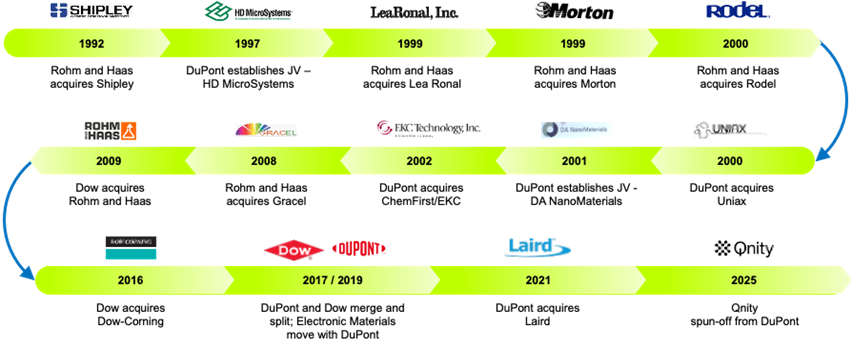
Acquisition History
Qnity was shaped in large part by the acquisition of family-owned businesses, among them Shipley Company, Rodel, and LeaRonal. Founded and managed by families advancing specialized materials for the electronics industry, these companies brought deep technical expertise and strong customer relationships. These acquisitions constitute the majority of the company’s revenues today. For their founders, the decision to sell rested on more than financial terms. In joining the enterprise that would become Qnity, they found an acquirer that shared their values and a lasting home for the business they had built.
Qnity Approach to Value Creation
Targeting 6-7 percent organic growth, 7-9 percent Adj. EBITDA, Solid Free Cashflow <3x Net Debt Leverage, disciplined capital allocation
Qnity has embarked on a three-pronged multiyear transformational plan to support long term growth and profitability.
- Commercial and Innovation Excellence—enhance sales speed and effectiveness; invest in R&D advancement
- Productivity & Quality Improvement—upgrade automation, quality standards and invest in AI
- Enhance local-for-local operating model—stream lining supply chain and optimize footprint
Leadership Values that have Transformed the Company
- Partnering of Choice—Understanding customers’ needs and solving challenges together
- Innovation Edge—Continuously learn and innovate to power next generation of technology solutions
- Speed—Act with urgency and speed and be intentional, focused and efficient in everything we do
- Our People—We win through exceptional talent who inspire change, collaboration and growth