America’s CEOs turned more cautious in September, downgrading their assessment of current business conditions for the first time since the Iran war began in March.
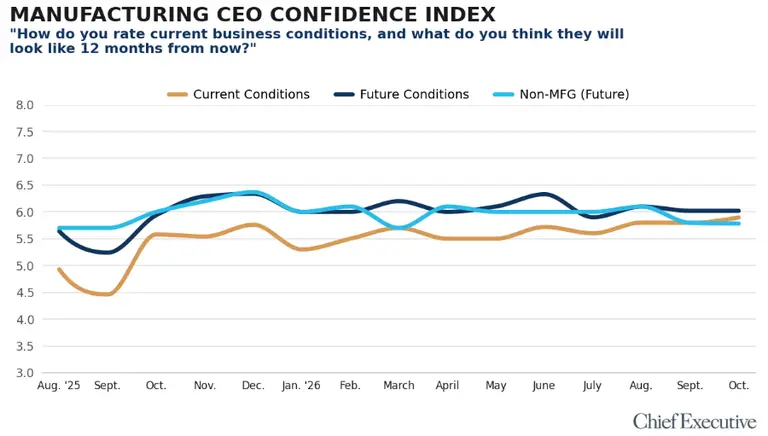
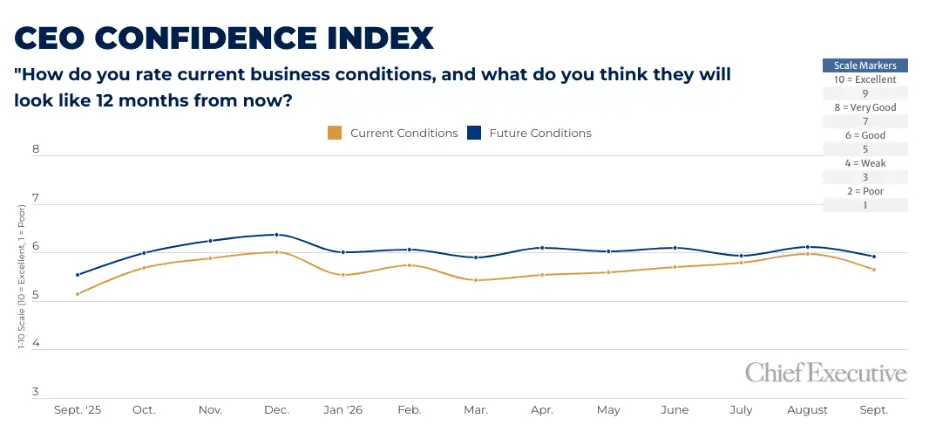
Chief Executive’s latest CEO Confidence Index, fielded September 1-3 among more than 150 U.S. CEOs, finds leaders rating current business conditions 5.6 out of 10, down roughly 6 percent from 6.0 in August.
It is the largest one-month decline since January, when confidence dropped sharply (-8 percent) amid uncertainty over Washington policy.
Still, even after this September retreat, the Index remains 2 percent above where it began the year and roughly in line with its 2026 average of 5.7.
“It seems to have gotten worse in a hurry,” said the CEO of a large manufacturing company, adding the war in the Middle East is “impacting consumer spending in USA more than the headlines appear to show.”
CEOs also lowered their expectations for the year ahead, though less sharply. Their 12-month forecast declined 3 percent, to 5.9 from 6.1 in August.
That still puts expected conditions about 5 percent above today’s assessment. But the wider gap doesn’t reflect a surge in optimism about 2027. Rather, the data indicates that CEOs’ view of present conditions has deteriorated faster than their outlook for what comes next. As one CEO wrote, “Things can’t get much worse from a disruption standpoint.”
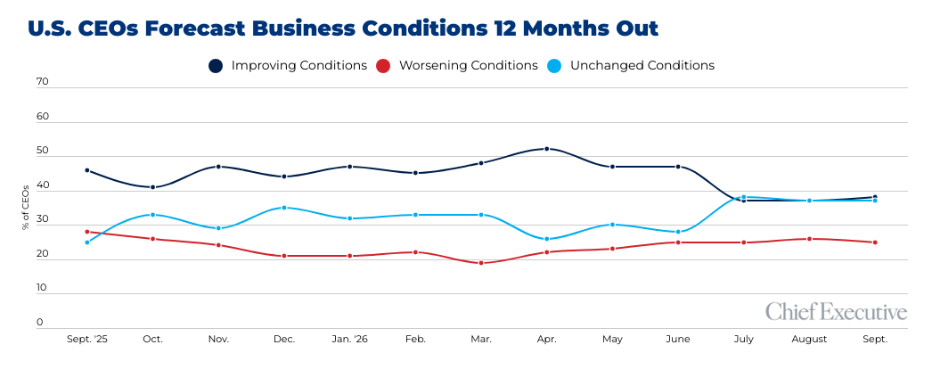
The proportions expecting business conditions to improve, remain unchanged or deteriorate were virtually identical to August: 38 percent expect improvement over the next 12 months, 37 percent expect little change and 25 percent expect conditions to worsen.
There are signs of caution farther down the middle market as well. Among CEOs running companies with $10 million to $24.9 million in annual revenue, 36 percent expect business conditions to deteriorate over the next year, compared with 25 percent of CEOs overall. That suggests caution is more pronounced at the smaller end of the middle market.
ECONOMIC OUTLOOK COOLS
The more notable shift in the September data is showing up in CEOs’ expectations for the U.S. economy over the next six months.
Half now forecast economic growth, down sharply from 64 percent in August. Another 32 percent expect the economy to remain flat, while 18 percent foresee a slowdown—up from 11 percent last month and the highest share since May.
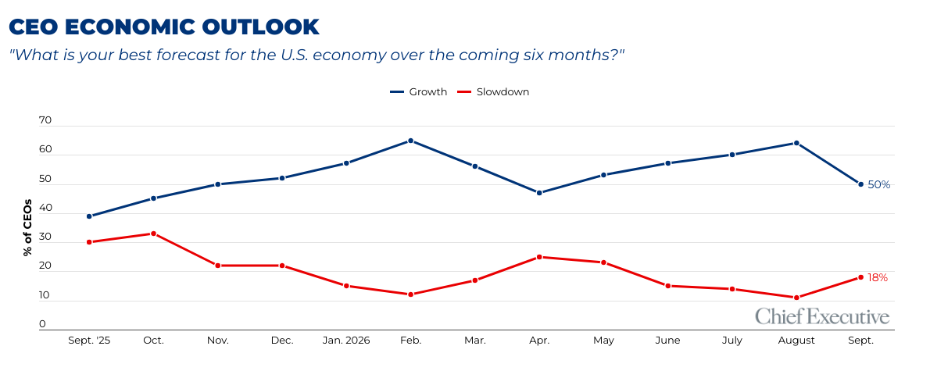
That leaves CEOs considerably less confident about near-term economic momentum than they were just a month ago.
Their comments suggest no single culprit, though demand remains a major dividing line. Some CEOs continue to report strong pipelines and healthy spending in their markets. Others say customers are delaying purchases or pulling back.
“Demand remains strong, particularly across data centers, electrification, energy storage and critical power infrastructure,” said one industrial manufacturing CEO, whose overall outlook is nevertheless tempered by supply-chain constraints, longer lead times and tariff uncertainty.
Justin Moore, CEO of Mile Marker Industries, a small Florida-based manufacturer in the automotive industry, sees it as a bifurcated reality. “Premium buyers are still spending, lower-end buyers are increasing, but the hardest negative sales impact has been that middle-class buyer. They are saving more, spending less and shifting down or up depending on their economics at home.”
Costs, tariffs, government policy and geopolitics also appear repeatedly in CEOs’ explanations for their tempered outlook, adding to inflation concerns.
“Pricing power is eroding and labor costs continue to increase well beyond headline inflation,” said the CEO of a Texas-based construction business.
One professional services CEO summed it up this way: “Uncertainty and trade relationships continue to be crucial. Real costs being passed to consumers, hurting the economy overall. If we didn’t have some of this, the economy would be booming. The fundamentals are strong, the noise on top is a mess/wrench in the works for products and manufacturers. Full stop.”
PROFITS LOSE GROUND
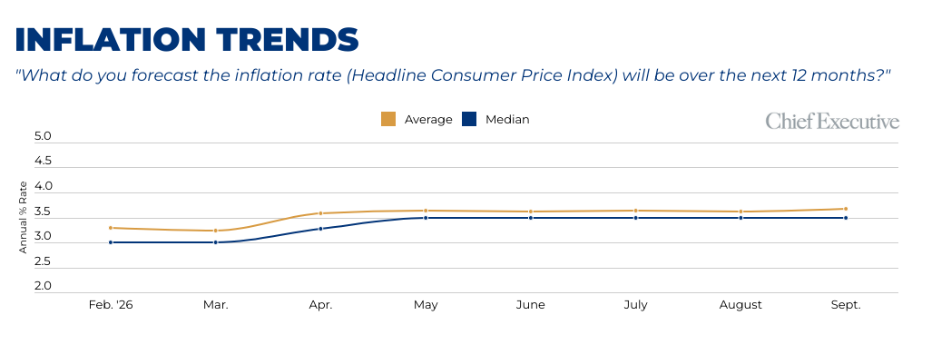
Inflation expectations have changed little in recent months. CEOs’ median forecast for headline CPI over the next 12 months is 3.5 percent, while the average forecast is 3.7 percent, vs. August’s 3.6 percent.
Still, cost pressures are highly visible in CEOs’ forecasts for their respective companies: 61 percent of those polled in September expect to close 2026 with higher profits than in 2025, down from 69 percent in August and 67 percent in January.
Rising operating expenses are part of the pressure and becoming harder to ignore. Nearly eight in 10 CEOs—78 percent—expect operating expenses to continue rising this year, up from 73 percent in August and 62 percent at the start of 2026.
“Inflationary pressure on labor and material continues to challenge gross margins,” said Innovance CEO Merritt Becker. “Accelerating demand offers some pricing opportunities, but timing lags inflation’s rate of increase.”
Michael McQueeney, president and owner of home improvement and hardware company KR Johnson, which operates on the input side of the economy and typically leads the broader economy by 8-12 months, warns: “Manufacturers are bleeding down inventory and ordering lower quantities. Price Increases are coming from every direction which will lead to overall inflation increases over the next 8-12 months.”
CONTINUED CAPEX
Despite those pressures, CEOs are not broadly pulling back on investment. Half expect to increase capital expenditures in the months ahead, compared with 45 percent who said the same at the beginning of the year.
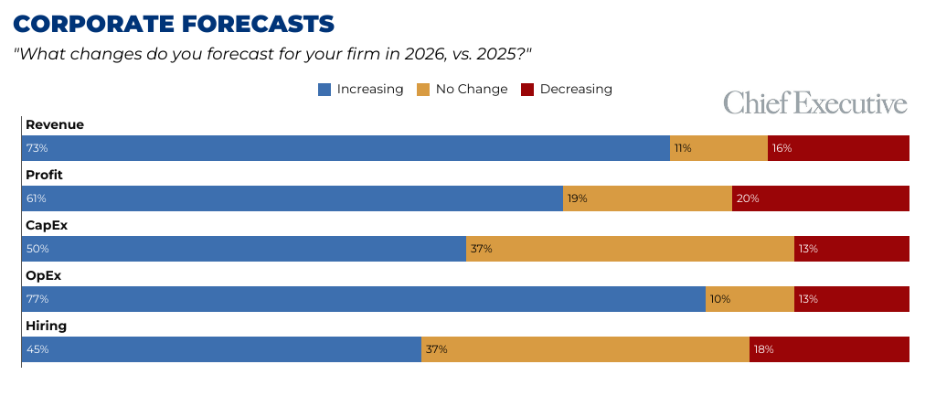
Hiring is more restrained: 45 percent expect to increase headcount, down from 53 percent in January.
For many CEOs, this means increasing investment in capacity and productivity to continue supporting top-line growth.
“We are trying to navigate an environment where investment is clearly necessary to generate growth but capital to do so is virtually non-existent,” said one PE-backed CEO.
As Allen Krueger Jr., president of Krueger Communications, a managed IT and cybersecurity company based in Southeast Wisconsin, explained, “Unpredictable forecasts means unpredictable results with unknown solutions to overcome. Relentless effort is all we have.”
This perhaps explains why revenue forecasts have held up better: 73 percent of CEOs expect their companies to generate higher revenue in 2026 than in 2025—though that share is slightly down from 75 percent in August and 76 percent at the beginning of the year.