
The pace at which AI frontier labs introduce their latest and greatest models is unrelenting. As I write this, Kimi K3, Claude Fable 5.1 and GPT-6 Astra are among the models drawing attention. By the time you read this, the list will almost certainly have changed.
What one lab introduces today is quickly matched or surpassed by another as they all vie for the holy grail of the race: Artificial General Intelligence, the thus-far mythical “superintelligence” that will come to fully dominate all other AI. Meanwhile, those of us trying to build businesses using these exciting new tools are left wondering what to do. Swap? Adapt? Keep with what we have?
Welcome to what I call “leapfrog parity”—a feverish market condition in which frontier AI developers repeatedly trade temporary leads, follow with competitive responses, and leave business leaders wondering whether the cost of switching is worth the gains.
Consider the recent battle for AI-assisted coding. For a period, Anthropic’s Claude Code was widely viewed as the tool to beat, earning praise for its ability to reason across large codebases and tackle complex software engineering tasks. Developers who had standardized on OpenAI began experimenting with Claude, and some switched entirely.
OpenAI responded with a rapidly evolving Codex platform, improved coding models, autonomous agents and development workflows. With this new wave of capabilities, many developers viewed the two platforms as largely comparable, with each excelling in different scenarios. Anthropic, no doubt will soon attack once again.
In this leapfrog parity moment, where no lab is establishing a durable advantage, buyers are left to decide whether a temporary technical edge is large enough to justify switching. When does switching from one model to another create enough practical value to justify the disruption? How do you know? It is one of the great, underdiscussed issues facing AI use and adoption in business today.
When does a better model create real value?
With the latest AI models advancing so rapidly, two fundamental questions should be considered. First, does the most advanced (and most costly) model justify the investment (and value)? Or can a less expensive, less cutting-edge model address the business requirement? After all, progressive CIOs know there is a deliberate effort to incorporate “model routing” into their AI workflows, which allows for simpler queries to be routed to less expensive models.
Second, while there is a high correlation and growth trajectory between the evolution and interest in the latest AI models, does the practical use of these models operate at a different pace? If I could illustrate what the current market looks when it comes to leapfrog parity vs. practical AI adoption and usage, it would look something like this:
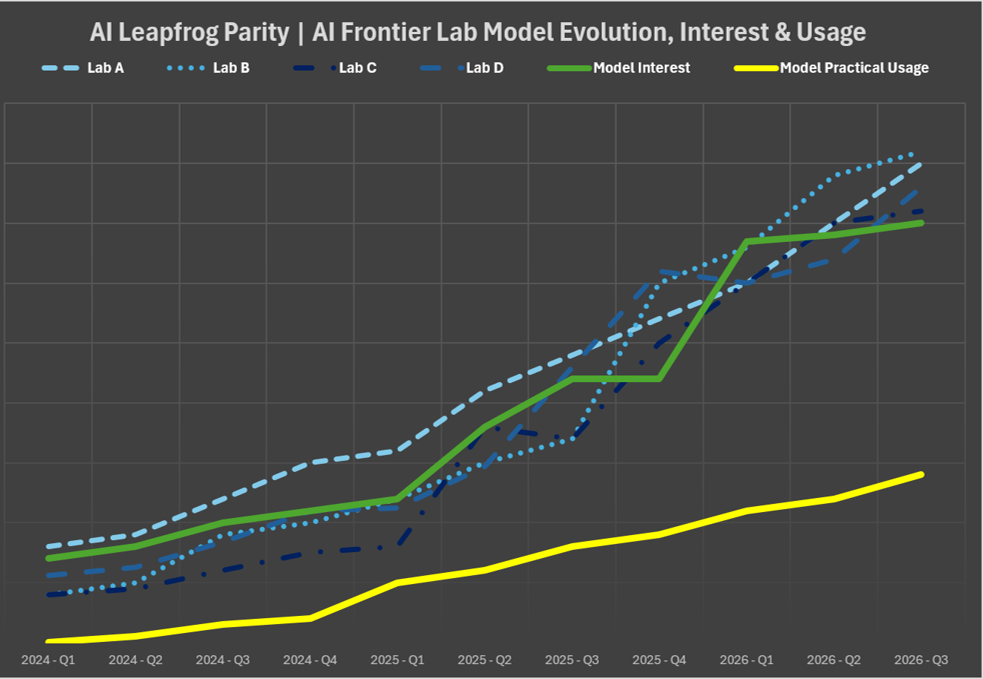
The business cost of switching providers
Faced with this rate of change, we need to examine the practical costs of switching model providers. Is swapping horses mid-race really the best way to achieve your desired outcomes? In my experience, there are three considerations worthy of highlighting as one considers the switch to a new model:
- What practical value will my organization derive from the switch?
- What is the cost of switching and do I have any obligations with my current LLM(s)?
- What type of change management process is needed for adoption?
To put it more directly: Is your organization well prepared to establish a new vendor business relationship with the new AI model vendor? Moving from OpenAI to Anthropic requires a recasting of the business relationship, the data protection strategy, contractual and term-based obligations and the learning curve for the new company’s models.
That doesn’t mean the investment isn’t worthy of consideration. It is simply that the switch, based upon the actual usage of the advanced AI models, may not justify the associated overhead, at least not at that moment.
The operational cost of migrating to a new model provider
If a switch is inevitable and you’ve worked through the value and business impact, the next bridge to cross is operational logistics. These should not be taken lightly. For organizations and their employees that have standardized on a frontier AI provider, the operational logistics can be substantial.
Human usage, such as AI agents, and, more broadly, the AI prompt knowledge cultivated by employees require change. Beyond the human usage tools such as agents and prompting, there are likely numerous other agents and models connected to business systems, tools and data via MCP servers or other connectors. These integrations will most likely need to be rebuilt.
If the switch takes place, is there a way to measure the productivity gains introduced with the new models? If so, what does that modeling look like? And will the more advanced model provide a material productivity gain? Governance policies, training, change management processes and user documentation (in some capacity) often need to be updated, as is the case with security compliance documents.
I completely agree with Jeetu Patel, Cisco’s president and chief product officer: “In the agentic era,” he said, “the question is not which model is ahead this week. It is whether the enterprise has the infrastructure, security and observability to use AI safely at scale. Temporary model advantage matters far less than operational readiness.”
Leapfrog parity beyond AI
Leapfrog parity is a notion that has applicability well beyond AI. It translates into many different product and service categories that we are exposed to in our respective businesses. Today we buy Dell computers. Tomorrow, Lenovo. But when Dell advances again, do we switch again? Another example may be with a SaaS-based CRM system. Today Salesforce leads. Tomorrow it’s HubSpot. The next day a newcomer to the CRM marketplace. The same principles apply across so many technology categories and purchasing decisions.
Your business use cases may fully justify the temporary lead afforded by the frontier lab whose model is currently garnering the most attention and delivering the most value at that time. And maybe it makes sense to continually switch to the next lab with the greatest model. But I believe it only makes sense to switch when the measurable business advantage exceeds the cost, complexity and risk of migration, not merely when a new model wins the latest benchmark.
Of course, you can always build your business, risk and logistical processes around the need to stay ever current with the most advanced labs and their models. However, I think you need to ask the following questions:
- Does the new model truly improve a priority use case?
- Does that improvement exceed the migration, integration and retraining costs?
- Are prompts, agents, data connections and governance controls portable?
- Can a controlled pilot prove the gain before a broader migration?
As Ken Corriveau, co-founder of Evolvium and former global CIO of Omnicom Media Group said recently, “Switching models to catch a temporary lead is like changing lanes in traffic. It may feel faster for a moment, until everyone merges. It is not about the fast lane; it is about the map that gets you where you are going.”
When you do the math, I’d bet that staying with a model provider who aligns with your long-term business requirements will prove to be a good move. Even while the leapfrogging continues around you.