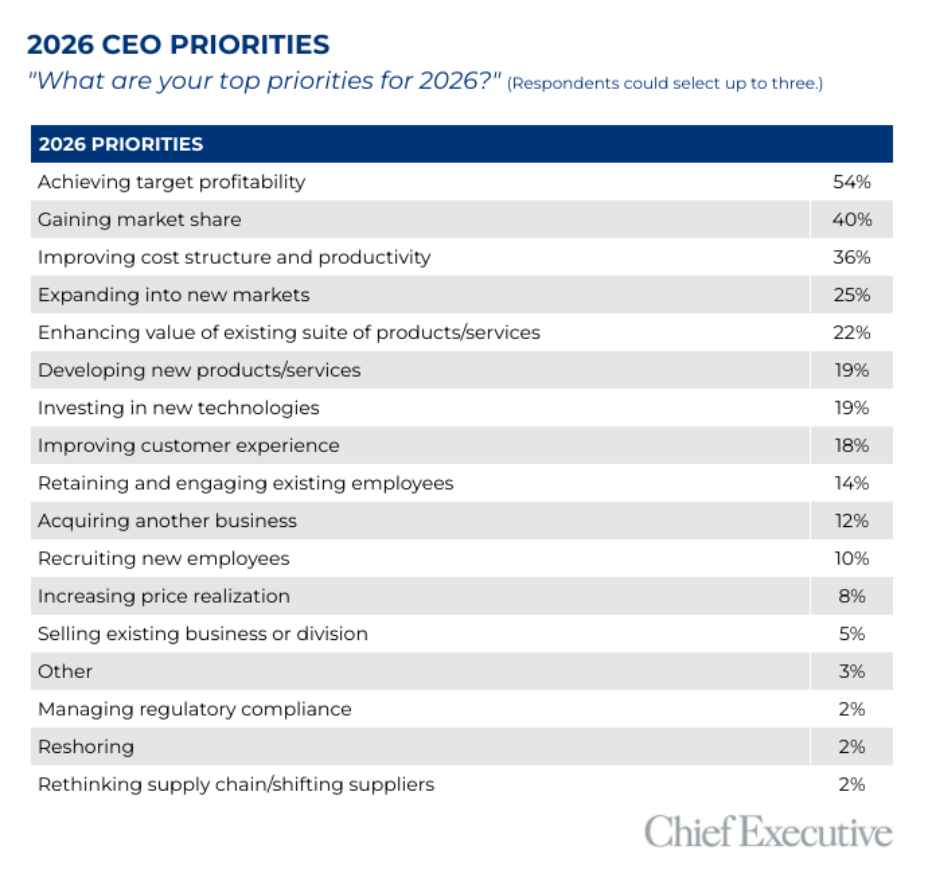
At the beginning of 2026, Chief Executive surveyed CEOs and found agendas brimming with ambition: Entering new markets, developing products, improving existing offerings, investing in technology, improving customer experience and driving productivity.
Eight months of geopolitical and policy surprises later, when Chief Executive asked where CEOs planned to focus their efforts for remainder of the year, the answers are a bit more focused.
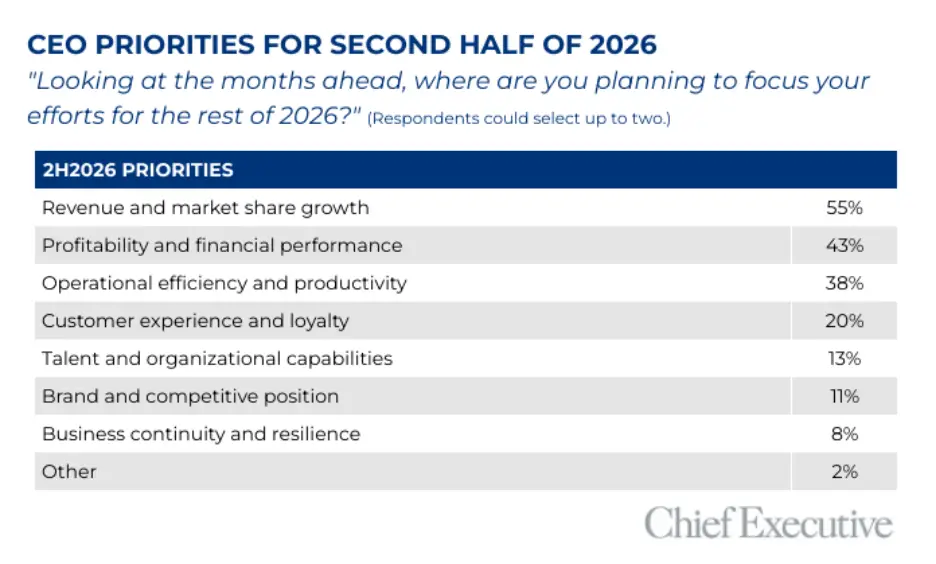
Revenue and market-share growth now top the list, selected by 55 percent of the 285 CEOs responding to our August CEO Confidence Index on August 4-5. Profitability and financial performance follow at 43 percent, with operational efficiency and productivity at 38 percent. Everything else falls well behind.
Leaning into AI
To be sure, the January and August surveys aren’t directly comparable. January’s survey let CEOs pick up to three priorities from a longer list mixing broad goals with specific initiatives, while August asked for just two broader areas of focus. Still, taken together, the results suggest CEOs are converting January’s groundwork into results—with AI emerging as a prominent tool in that push.
Several CEOs commented on the need for organizational work to support the growth push. One CEO described the issue as managing “growth pace against operational structures and consistencies.”
For a number of CEOs, AI is part of that effort.
As one CEO focused on revenue growth and operational efficiency in the second part of 2026 explained, the challenge now is to “spin up new business lines in AI to make up for legacy product stagnation.”
Bill Estes, president of Geokon, a manufacturer of geotechnical and structural instrumentation, has seen it firsthand: “Adoption of AI is significantly improving efficiency and data intelligence,” he said.
At Honesdale, PA-based Wayne Bank, CEO Jim Donnelly said he’s working to “make the business more efficient” through the implementation and scaling of new technology to help minimize operational constraints.
The AI push builds on the priorities CEOs flagged at the start of the year: entering new markets, enhancing existing products and services, developing new offerings, investing in new technologies, and improving customer experience.
Paul Riedl, Jr., CEO of River Run, a managed IT and cybersecurity services firm based in Glendale, Wisconsin, says companies must learn to use AI judiciously to accelerate growth. “Our business is affected by AI,” he said, warning other leaders that the pressure will only continue to rise. His focus for the months ahead: “AI Implementation and getting people to use it as a tool to leap forward,” he said.
The Priorities That Aren’t Priorities
The bottom of the list may be just as revealing as the top.
Only 13 percent of CEOs polled said talent and organizational capabilities are among their top two areas of focus for the rest of 2026—despite the fact that workforce issues remain highly visible elsewhere in the survey.
Twenty-seven percent identify talent shortages or workforce constraints as one of the biggest challenges to achieving their goals. Another 26 percent say workforce strength and productivity is one of their biggest drivers, while 22 percent identify workforce availability and labor costs as a major external risk.
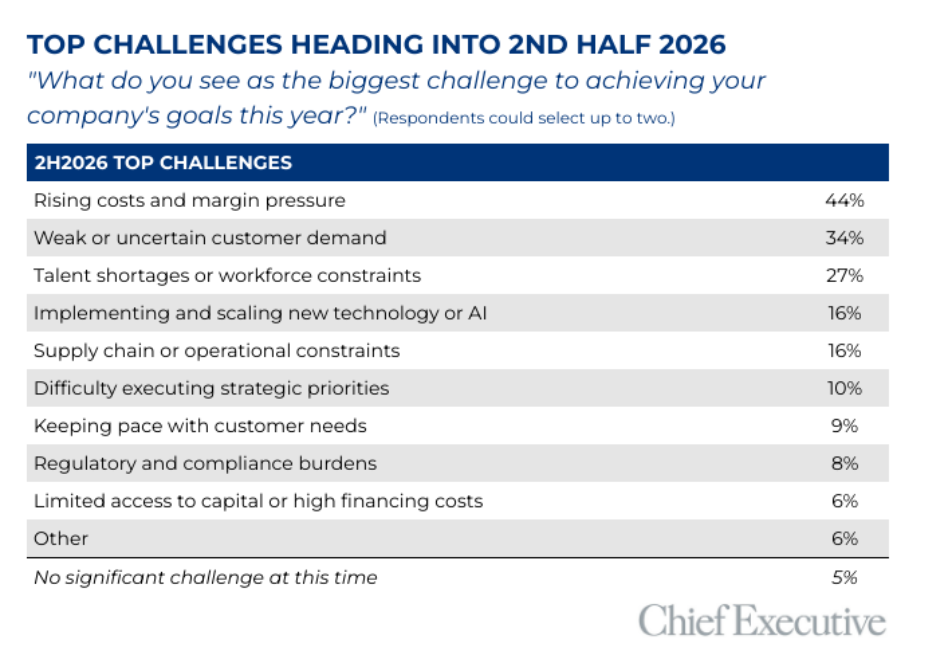
The disconnect is even more striking when CEOs are allowed to answer in their own words. Asked separately what issue, internal or external, is currently top of mind, workforce, talent and leadership were the most frequently cited themes, appearing in 19 percent of responses.
Gladiola Unzueta, founder and CEO of MultiGla Strategies, a provider of integrated financial services and business consulting, pointed to talent as a key differentiator to future success. “The companies that will lead in the coming years will not simply adopt new technology, they will build strong cultures, invest in their people and remain adaptable,” she said. “AI is transforming business, but trust, leadership and execution will continue to be the true competitive advantages.”
Chris Burkhard, president and founder of Placers Staffing & Recruitment, sees an acceleration in the pace of hiring and firing. “There is a normalization to the market churn that is just beginning,” he said, adding that labor shortages and skill gaps are making workforce strategy relevant again. “AI falls short in replacing humans.”
The CEOs who are explicitly prioritizing talent also tend to be those expecting more growth. Nearly 90 percent expect revenue to increase this year, versus 73 percent among CEOs who did not select talent as a top priority. Sixty-three percent expect to add headcount, compared with 44 percent among the rest.
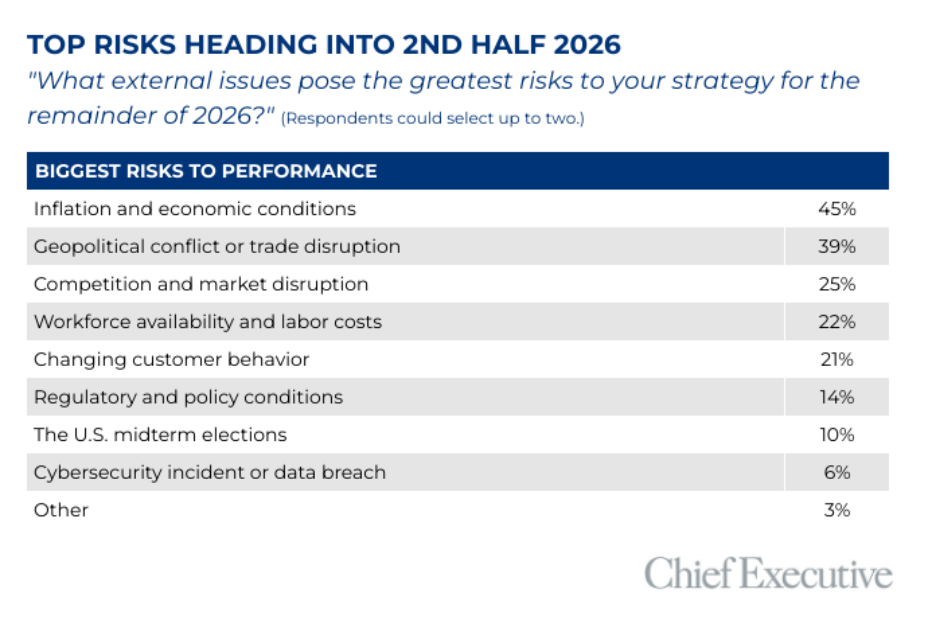
Business continuity and resilience raises a similar question: Just 8 percent of CEOs put it among their top areas of focus, even as 45 percent identify inflation and economic conditions as a major external risk and 39 percent cite geopolitical conflict or trade disruption.
Another tension in the survey: competitive positioning.
Only 11 percent selected brand and competitive position as a top focus. Yet 25 percent identify competition and market disruption as a major external risk. And when CEOs were asked what issue is currently top of mind, without being given answer choices, 12 percent independently raised AI or technology. Their comments point to concerns about AI disruption, changing business models and the need to adapt quickly.
What Could Still Get in the Way
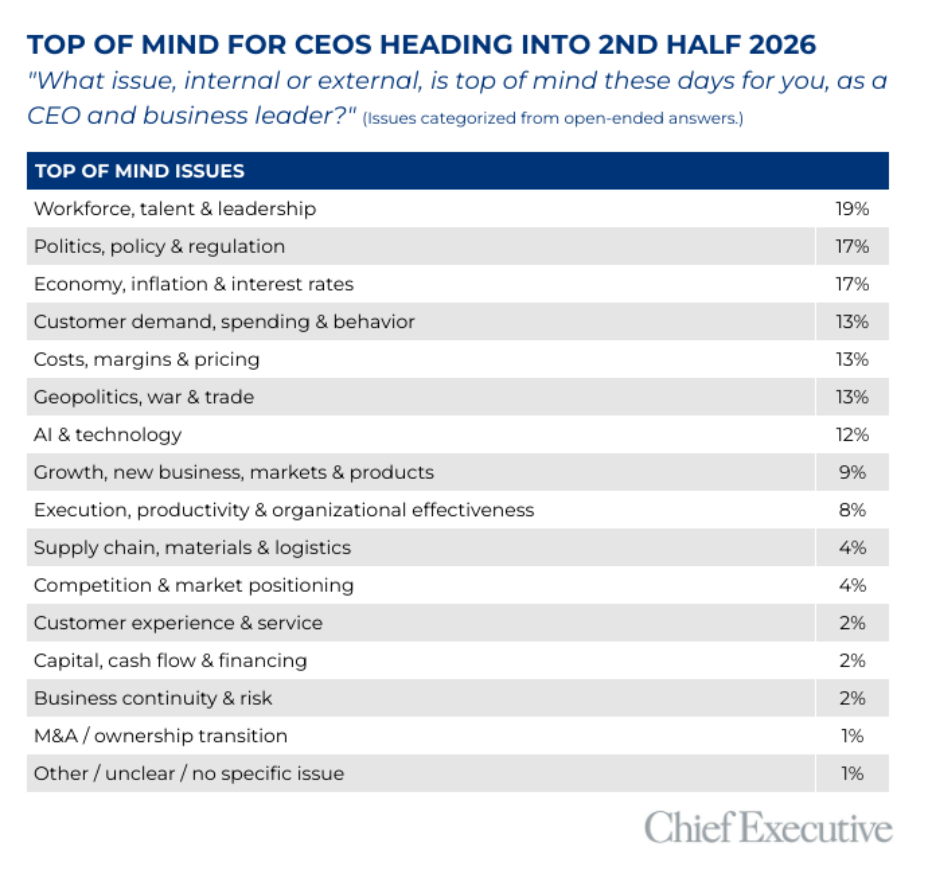
Despite those potential hurdles, rising costs and margin pressure remain the most common challenge to achieving company goals, selected by 44 percent of CEOs. Weak or uncertain customer demand follows at 34 percent, while 27 percent cite talent shortages or workforce constraints.
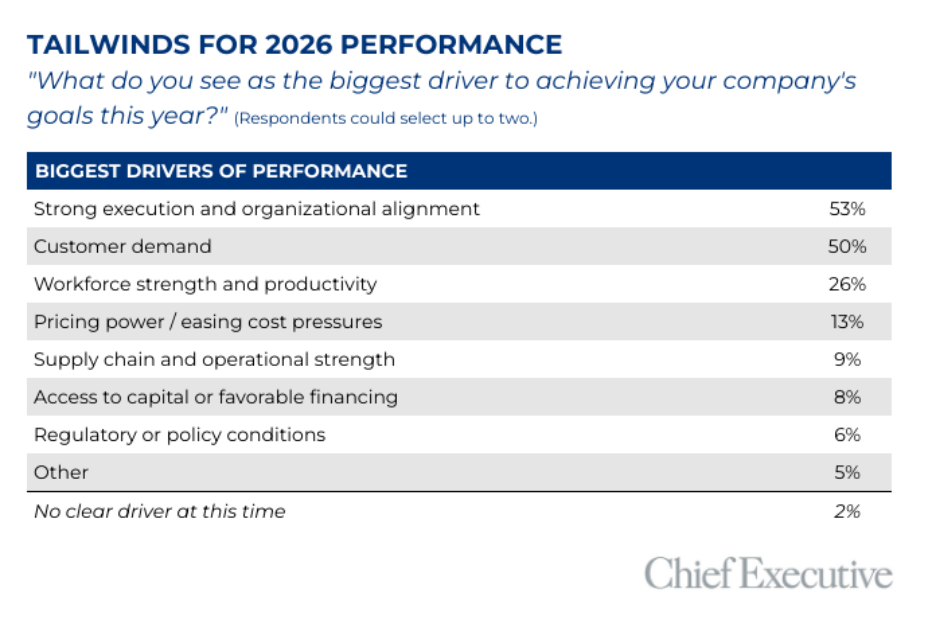
Not everyone agrees on the strength of customer demand. Half of the polled CEOs identified it as a major tailwind, while roughly a third see weak or uncertain demand as a challenge. For some businesses, demand is supporting the growth push. “Demand is accelerating,” one CEO said, while another noted that “the market has remained stronger than expected for longer than expected.”
For others, the picture is very different. One respondent said that “high costs/inflation is finally shrinking consumer demand.”
External risks remain substantial as well. Inflation and economic conditions top the list, followed by geopolitical conflict or trade disruption, competition and market disruption, workforce availability and labor costs, and changing customer behavior.
Even with those concerns, 55 percent of CEOs say revenue and market-share growth is where they plan to focus the most effort through year-end, while 53 percent cite strong execution and organizational alignment as one of the biggest drivers helping them achieve their goals.