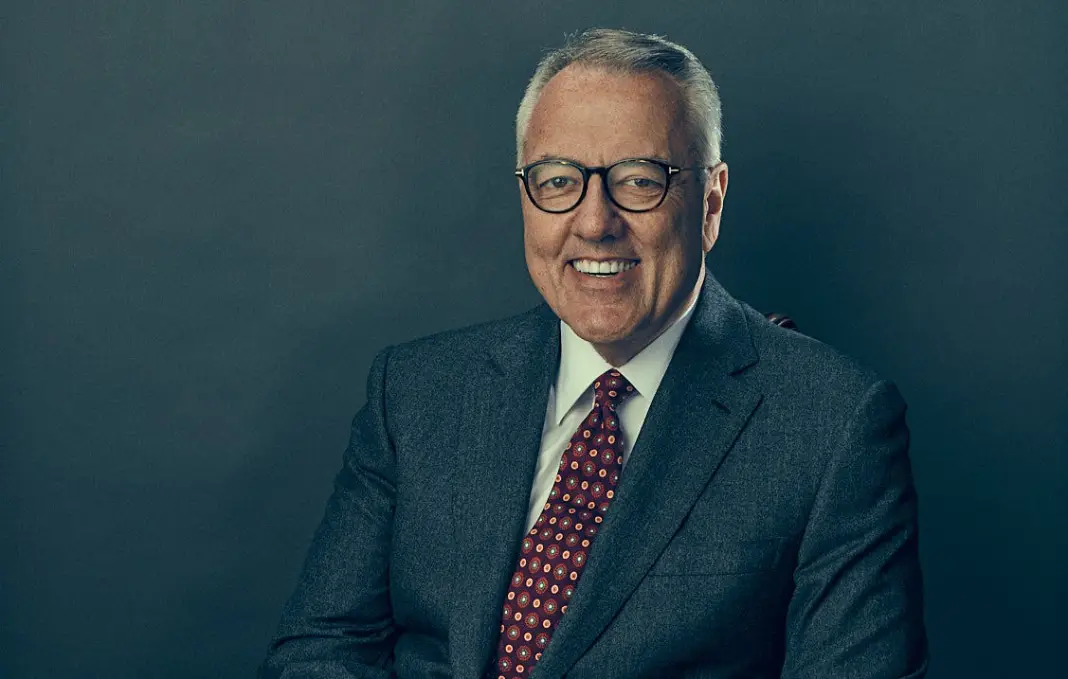
Sometime in 2008—he’s not certain of the exact night, only that it was around 3 a.m—Greg Brown was walking the floors of his home outside Chicago, unable to sleep, when his wife Anna found him.
He had lost 40 pounds since taking the CEO job at Motorola. He had cut more than 15,000 jobs, frozen the pension and done a reverse stock split. The handset business that made Motorola a household name after publicly introducing the cell phone in 1973, making it commercially available in 1983 and building the iconic Razr, was losing more than $1 billion a year, a once-beautiful, now-dying appendage he couldn’t lop off because no one would take it. Activist investor Carl Icahn, who’d taken a large position at the top of the market, was unhappy and had Brown in his sights. The board was restless. Brown wasn’t sure the company would make it. He wasn’t sure he was going to make it.
“You have no idea how bad this is,” he told Anna.
“You’re right,” he recalls her saying. “And I don’t care. But while you’re walking around the house with your shoulders slumped, consumed in self-doubt and self-pity, there are 75,000 people working for you waiting for you to lead. So, Greg, you gotta get your shit together. Eat the elephant one bite at a time and get going.”
Brown didn’t fly to the office in a cape the next morning and fix everything. Here in reality, that’s not how leadership works. But he did, he admits, turn a corner. He went back to doing what he knew: being ruthlessly honest about the situation, identifying critical decisions that mattered and acting—without flinching, sometimes without the board’s full buy-in. He hired a co-CEO to run the handset business he couldn’t fix himself, a Qualcomm executive named Sanjay Jha who had been quietly working on something called Android. He settled with Icahn, over the board’s objection, and—in a counterintuitive move that still generates admiration in corporate governance circles—found the activist’s presence accelerated decision-making rather than derailing it. Most importantly, he pressed forward with spinning off the consumer mobile business, the crown jewel that was also the millstone, and bet Motorola’s future on what had been an afterthought inside the company—its mission-critical communications business serving first responders, the military and governments around the world.
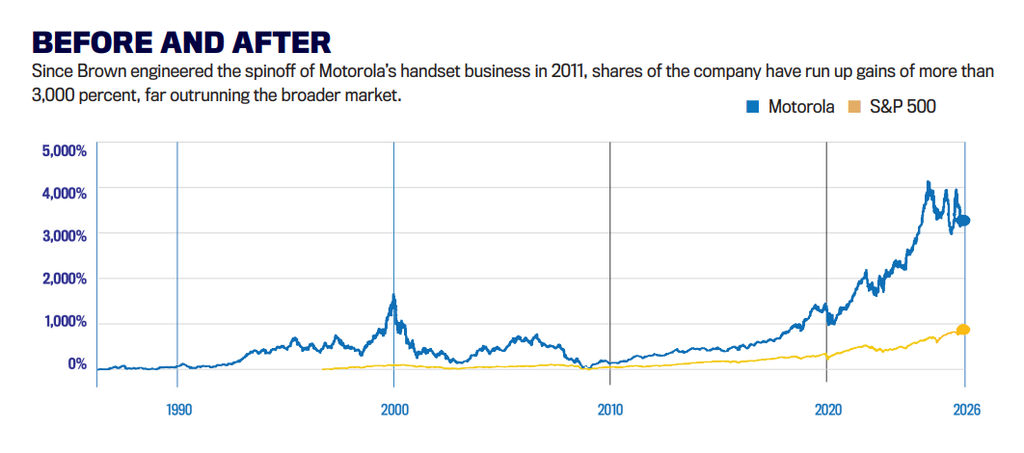
In January 2011, Motorola Mobility was spun out. Eight months later, Google bought it for $12.5 billion. The company left behind, with Brown at the helm, was Motorola Solutions, trading as MSI on the NYSE. And it began building one of the most quietly extraordinary track records in modern American business.
Motorola Solutions today has $11.7 billion in annual revenue, focused with near-monastic discipline on public safety and enterprise security: the networks that run 911 call centers, the body cameras worn by police officers, the communications systems used by first responders in every major city in the country and in more than 100 countries around the world. Under Brown’s leadership, the company completed more than 60 acquisitions—all logically adjacent to the core mission—and generated total shareholder return of more than 1,500 percent since the spin, compared to roughly 400 percent for the S&P 500 over the same period. It is a performance that makes MSI—market cap $66.5 billion—one of the great compounders of the past decade and a half, a fact that tends to surprise people who still think of Motorola as a cell phone company.
It is for this achievement—and the depth of the leadership thinking behind it—that our selection committee named Greg Brown Chief Executive’s 2026 CEO of the Year.
“Greg’s an exceptional leader who has navigated a challenging and complex environment to transform Motorola into a highly valued technology partner for public safety entities around the world,” says Marillyn Hewson, former chair and CEO of Lockheed Martin, a member of the selection committee and our 2018 CEO of the Year.
Tamara Lundgren, former chair and CEO of Radius Recycling and a longtime selection committee member, agrees: “His courageous transformation of an iconic company toward mission-critical communications, software growth and rigorous operational excellence has redefined its trajectory and built a powerful launchpad for Motorola’s next century.”
“Greg Brown has led his company from challenged to winning with his willingness to make a bold strategic bet and a relentless focus on execution,” says Dave Ricks, chair and CEO of Eli Lilly, a member of our selection committee and our 2025 CEO of the Year. “The fact that Motorola now sits at the core of public safety communications—protecting communities across the U.S. and around the world—is a testament to his vision and discipline. As a long-serving CEO, Greg has earned the respect of investors, his customers and fellow CEOs alike. He is an outstanding choice for CEO of the Year.”
‘I’m Going to Surprise You.’
Brown was born in 1960 and grew up in Highland Park, New Jersey, the youngest of five children. He attended Highland Park High School and then Rutgers University on a path that, he’ll tell you, had no particular design. He graduated in 1982 with a bachelor’s in economics—not an engineer, a software guy, anyone you’d necessarily peg as the future savior of one of America’s most storied technology companies.
He was offered a job at IBM out of college. His older brother Dick—13 years his senior, who would go on to be CEO of EDS and Cable & Wireless—told him to try telecom instead. Brown joined AT&T in Detroit and, by 29, was president of Ameritech’s equipment business, part of Wisconsin Bell Communications. He caught the eye of Ameritech CEO Dick Notebaert and rose through the company to lead Ameritech New Media, building a cable TV operation nearly from scratch that Notebaert had asked him to create inside the telecom giant. That business was eventually sold for roughly $1 billion.
In 1999, Brown left for something riskier: Micromuse, a publicly traded San Francisco software company, where as chair and CEO he grew annual revenue from $28 million to more than $200 million before Motorola came calling. He joined in 2003 to run what was then a $4.5 billion slice of a $22 billion conglomerate nobody was paying much attention to. It was called, unglamorously, the commercial, government and industrial solutions sector—CGISS. Brown thought it was the best business in the building.
None of it, he’ll tell you, happened by accident—or by pedigree. The youngest of five, Brown grew up in a household where his father’s philosophy was simple: When you’re in a tough spot, don’t be an excuse guy. Look in the mirror, and mow your own lawn. “When you play for a coach and you’re not playing, when you’re getting a C in a course, no matter what situation you’re in that’s tough, it’s your fault,” Brown recalls his father, Harris Brown, saying (again and again). “So, don’t even come to me. Tell me what you’ve done. When you’ve done everything you can do, then we’ll have a conversation.”
His mother, Winifred Brown, provided the counterweight—the eternal optimist who told him he could do anything he wanted to do. Brown describes himself as a blend of both.
The competitive fuel also had a more immediate source: his brother Dick. “I remember my father saying, ‘Look at your brother, he’s a CEO,’” Brown recalls. The bar was visible. It was also, crucially, achievable—someone in the family had already cleared it.
The day they drove out to Detroit in a U-Haul for Brown’s first job, he and his dad stopped at a truck stop outside Pittsburgh. Brown turned to his father and said: “By the way, Dad, I really appreciate you driving me out, and I just want to tell you one thing—you ain’t seen nothin’ yet. I’m gonna surprise you.” He didn’t mean it arrogantly, he says. But he did mean it.
The Blessing of the Obvious
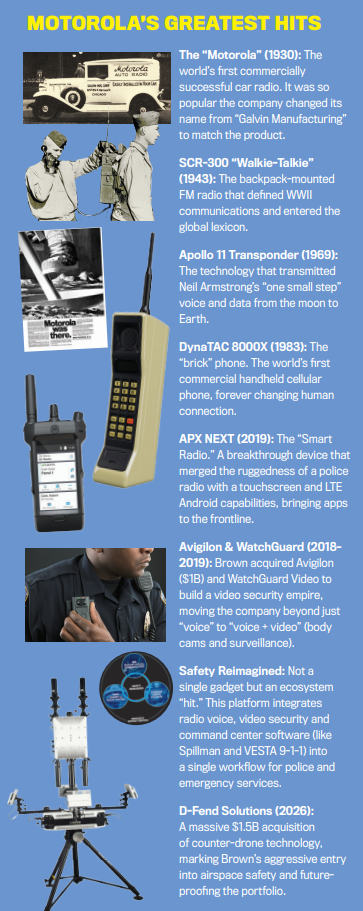
Brown describes the Motorola he inherited as CEO in January 2008 as a combination of Bell Labs and the federal government—deep technical expertise, a culture of invention, a tradition of patents and Six Sigma and achievement that stretched back to the car radio. (The name Motorola itself is a contraction of “motor” for motorcar and “ola,” a suffix for sound, together implying sound in motion.) The company had invented the portable TV, the pager, the portable cellular telephone and system, the transponders that told Neil Armstrong he’d touched down on the moon. It had, at its peak in 2006, reached $42.9 billion in revenue.
It had also, for most of its history, demonstrated a consistent inability to hold onto the businesses it created once the competition caught up. Again and again, Motorola would invent something, lead for a decade, then cede ground to Asian manufacturers who scaled faster and built at lower unit costs with more margin to play with. The cell phone was supposed to be different—Motorola debuted the portable cell phone commercially—but by the time the Razr craze faded and the iPhone arrived in 2007, the handset unit was burning more than $300 million a quarter. The company had missed 3G. It was a mess.
“If we didn’t get out of the cell phone business, there would be no interview today,” Brown says flatly, sitting at the dining room table in his New York apartment. “We wouldn’t be here.”
What Brown saw—and what took real conviction to act on, given that the handset business still largely defined Motorola—was that the most valuable thing inside the conglomerate wasn’t the glamorous part. It was CGISS, which claimed maybe 10 percent of revenue at the height of the Razr years. The business was built around mission-critical networks—custom-engineered, city by city, agency by agency. NYPD had its own configuration. LAPD had its own. The Pentagon had its own. You don’t switch your 911 network or combat radios the way you switch cell carriers.
“These networks were built and curated and customized around each customer,” Brown says. “Very high switching costs. Significant barriers to entry.” In other words, deep competitive moats he could defend. An afterthought inside Motorola—and, as Brown diagnosed it almost from the day he walked in the door in 2003, the one really, really good business in the building.
What followed his arrival as CEO was beyond rough. In his first board meeting in January 2008 he pushed for a statement that the company was evaluating strategic alternatives. By the second board meeting in March 2008, they were evaluating spinning out the handset business. Four months in, over the board’s explicit objection, he settled with Icahn. “I’m a practical guy from New Jersey,” he told anyone who’d listen. “I want him inside the tent pissing out, not outside pissing in.” He hired Sanjay Jha—paying him five times his own salary—to stabilize a handset portfolio he had no personal expertise to fix. He cut costs that needed cutting, froze pensions that needed freezing and held on long enough to spin a dying asset into something an acquirer might want.
“I thought the strategy was right,” Brown says. “I just wasn’t sure we could pull it off. I wasn’t sure there was enough tarmac in the runway to get the plane in the air.”
Less Is More
The years that followed the spin were not without turbulence. Growth stalled in 2013 and 2014. Internal skepticism about the strategy—and about Brown himself—ran deeper than he’d understood. It surfaced in a leadership meeting in 2014 that has since become something of a legend inside the company. Brown opened it by projecting quotes collected from social media and press coverage: Greg Brown only knows how to cut costs. Greg Brown breaks things up, he doesn’t know how to grow it. Then he put onscreen the company’s historical total shareholder return against its peer group, going back years before his tenure.
“You sucked,” he says he told the room. “You’re terrible. I don’t even think you should be here. So, I’m sure I’m part of the problem, but I ain’t the biggest one. You are.”
Then he made them an offer. Anyone who wanted out—right then, right there—would get the best severance package in Motorola’s history. “Commit or quit.” He meant it. About 15 percent took him up on it. “This bullshit’s stopping today,” he said. “This is our North Star.”
The North Star was total shareholder return—a concept, it turned out, that was genuinely new to significant portions of an organization steeped in a culture of patents and full employment rather than shareholder accountability. Brown had discovered, to his surprise, that there was an unwritten rule at Motorola: If you’d worked there for 10 years or more, you could only be fired by the chair. He hadn’t known that when he walked in. “That’s not policy,” he was told. “That’s the culture.”
Since that meeting, Motorola Solutions has not stalled. The company executed wave after wave of acquisitions, some tuck-ins and some bolt-ons, and some truly transformative. Avigilon, an AI-driven video security company. Airwave, the UK national emergency network managed services. Silvus Technologies, a global leader in mission-critical mobile ad-hoc networks. And the pending D-Fend, which builds counter-drone systems. Each one extending the company’s competitive moat in a direction its existing customers were already pulling it, none of them simply about bulking up revenue.
“I’d much rather be a $15 billion firm that’s the leader in the markets it serves than a $50 billion firm, even if the $50 billion firm is growing faster,” Brown says. “The elite compounders generate top line, expand margins, grow operating cash flow, have a strong balance sheet and reinvest in the firm.”
The Road Ahead
The opportunity in front of Motorola, as he describes it, is not incremental. Its exponential. Unmanned drones deployed automatically as first responders before a human officer can reach a scene. Counter-drone detection systems protecting Super Bowls, World Cups, the Pentagon. AI that translates a Spanish-language 911 call in real time, flags the word “weapon” and bridges a supervisor onto the line without the operator touching a button. The technology, Brown says, is not theoretical. It’s in the field now, and it’s saving lives. Shave 60 seconds off every 911 response, he points out, and you save 10,000 lives a year in the U.S.
“I have never been more excited about the future of the company than now,” he says. “And it’s not CEO speak or hyperbole.”
THE POWER OF ’EVENT DRIVERS’
Everyone knows the old saw about “never letting a crisis go to waste.” Greg Brown agrees, but he takes it a step—ok, a few steps—further. He’s not even willing to wait for a crisis.
For Brown, the everyday interactions involved with running a company are also precious opportunities to keep big ideas in focus, whether it’s board of director meetings, earnings calls, ops reviews, one-on-ones, annual leadership meetings, town halls, the company’s yearly supplier summit, executive committee meetings or routine skip-level calls and meetings.
He looks at those events as not only the platform to carry out everyday business but as mechanisms and use cases to reinforce alignment priorities, key messages, critical milestones, reinforcing connection, clarity and communication, “vertically and horizontally,” he says, “so there is a clarity—everybody knows what we’re doing, why we’re doing it, and we have alignment.
“If a board member meets with one of my senior management team members, they know the messages to reinforce,” he says. “They know the priorities of their function or of that person. I may be in a town hall and reference similar priorities and messages.”
He also likes to bring in outside perspectives, including investors and analysts covering the company to give his management team a look at how they’re perceived. Last year he invited an analyst with a “hold” on Motorola shares to explain his thinking about the company. The only ground rule: no self-censoring, no hedging.
“It’s just reinforcement, commitment, clarity, because every single interaction,” says Brown, “every ‘event’ in this context is an event driver, a catalyst for galvanizing, clarifying and having a crystal-clear call to action on what we’re doing and why we’re doing it.
At 66 and 19 years into the job—longer than any Motorola CEO except the founder and his son, and almost four times the tenure of the average F500 CEO—Brown still seems to authentically get a kick out of it. He still has roughly 1,000 people’s cell phone numbers and takes their texts. He loves roaming the company peppering everyone—from front-line employees to the C-Suite—with questions. He still describes himself, without any apparent performance of modesty, as not being an expert at anything. When AI erupted as a business imperative, he asked his head of products to teach him from scratch—“like I’m in second grade”—asked dumb questions without embarrassment and kept going until he understood it well enough to act on it. Alongside his house-a-fire intensity, there’s palpable joy to Brown, and it is infectious. He believes. He really does.
“I love the mission. I love our team. I love what we focus on,” he says. “I never work because it isn’t work for me. If you said, ‘Would you rather go to the Amalfi Coast or work at Motorola?’—Motorola every time.”
The following conversation was edited for length and clarity.
What was your assessment of the company when you took over as CEO?
I joined Motorola in ’03. I was a sector president for four years before becoming COO for nine months. But coming into the firm in ’03, it was a disparate group. It was a conglomerate like a Danaher, GE, Honeywell. It had a variety of disparate businesses.
Motorola has a phenomenal tradition of invention but had historically a wildly inconsistent performance for shareholder return and commercialized sustainable success. The reason I joined Motorola in the division that I joined, which is the essence and the nucleus of Motorola Solutions, is I thought the public safety business was the most successful. It served business customers and government customers, and it had an end-to-end system orientation. These networks were built, curated and customized around each customer. NYPD had a unique configuration. LAPD, unique. The Secret Service, unique.
Easy to switch cell phone carriers, tough to switch your 911 network.
Exactly. And these networks were built and curated and customized around each customer. Very high switching costs. Significant barriers to entry or competitive moats in a good way. And I said, “This sector is an afterthought in Motorola.” At the height in ’06, Motorola reached $40 billion in revenue. This sector was 4.5 percent. So, it was never getting the capital, the glamour or the recognition. I remember saying early on to two board members, “There’s one really, really good business in Motorola. And it’s called CGISS, the commercial government industrial solutions sector,” which was and now is the nucleus of what we’ve built.
Do you think there’s a broader lesson for other CEOs about bright shiny objects?
I believe less is more. I’d much rather be a $15 billion firm that’s the leader in the markets it serves than a $50 billion firm, even if the $50 billion firm is growing faster. Because successful companies, the elite compounders, yes, they generate top line, but they expand margins, they generate and grow operating cash flow. They have a strong balance sheet, and they can reinvest in the firm. If you look at Motorola’s history, it helped invent the portable TV. Is it in the TV business anymore? It invented the car radio. That’s the name of the firm, Motor Vehicle Victrola. Are we in the car radio business anymore? Are we in the paging business anymore?
You almost became the Polaroid of telecommunications.
Eastman Kodak, Polaroid, Blockbuster. Motorola missed 3G. And then when I became COO in 2007, Apple introduced the iPhone. There was no Android. The cell phone business became the smartphone business. What Motorola is really good at is custom complex communications. That’s still the essence of what we do here. We don’t compute. We’re not a software company. Apple made the cell phone a smartphone, and they did it around superior iOS software and a genius around hardware design named Steve Jobs and Jony Ive. If we didn’t get out of the cell phone business, there would be no interview today. We wouldn’t be here.
By the time I got the baton, it was self-identifiable. We were losing about $300 million a quarter. The cell phone business in Motorola was upside down. We had a bloated inventory of nearly $3 billion. We had missed the 3G market. There was no Android. The house was on fire. So, in my very first board meeting in January of ’08, the first decision was to put out a statement that we are evaluating strategic alternatives. The second in March was more pronounced. We said we are evaluating exiting the cell phone business and spinning it out. Those were in my first quarter as CEO. In April, four months in, I said to the board, “I want to settle with Carl Icahn.” The board did not want to settle with Carl Icahn and told me so.
Was it that they didn’t want to back down, but you saw the opportunity cost going sky high if you had a proxy fight on top of all of the other fights you had going on?
Yes. One, I thought he would win the second proxy fight. Two, I thought he had credible arguments. I did my own homework, and in 75 percent of the cases, a sitting CEO working with Carl Icahn loses their job within a couple of years. It didn’t matter. It wasn’t about the odds. It was about this is what we had to do to save the company. What I learned quickly is that having Carl’s representatives inside the boardroom allowed me to move faster on decisions. The Icahn brand was a catalyst for change and acceleration in a way I didn’t fully anticipate, and it made board governance better. Had we not done that deal with Carl Icahn, I wouldn’t be sitting here at this interview either. I wouldn’t be.
Either he would have taken you out after a proxy fight or the company would have gone sideways.
He actually stood by me. Now, did he do it because he liked me? No. He did it because the arguments and the strategy I was implementing was completely consistent with what he wanted. I never lied to Carl, ever, not one sentence, nor did I ever tell him I would do something I couldn’t. I probably talked to Carl over 300 times, no exaggeration. Met with him in person, dozens of times. I was always available, always accessible, took his calls at midnight, which is when he liked to talk, and came to see him in New York on a day or two’s notice.
He would say, “You know, Brown, you’re this silver spoon kid that played golf, and you were president of your fraternity at an Ivy League school.” I said, “I don’t play golf, I didn’t join a fraternity, and I went to Rutgers. So that’s not true, Carl.” “Well, you know what I mean.” I said, “I know what you mean, but that ain’t me, and you’ll find that out.” So, he got a kick out of our give and take, but I was scared shitless of him for the first couple of years.
I believe you lost 40 pounds.
Forty pounds. The Icahn diet. That’s what I called it. I thought the strategy was right. I just wasn’t sure we could pull it off. I just wasn’t sure there was enough tarmac in the runway to get the plane in the air. And that’s what kept me up.
Knowing what you don’t know is more useful than being brilliant. I knew I couldn’t turn that cell phone business around. I had no background in the business. I’m not an engineer. So, I said, “I got to get somebody who knows what they’re doing.” And I recruited Sanjay Jha, who was the No. 2 at Qualcomm. By the way, when we recruited him, he was working on Android, which wasn’t even announced yet. Hiring Sanjay at a pay package five times my pay package didn’t bother me a bit. Doesn’t matter. Check your ego at the door. Not about you. Sanjay stabilized the portfolio, he trimmed it, he implemented Android across the portfolio because he knew where the puck was going. The cell phone business performs well enough now to be an asset eligible to spin. Best decisions were splitting the company and exiting the cell phone business. Best decision was embracing Carl Icahn. Best decision was hiring Sanjay Jha.
Each one of those things requires your ego to be in check, to put it mildly.
It’s easy to check your ego at the door when you don’t think you’ll be alive tomorrow. When a CEO runs an ego-led firm, you start putting your name on stadiums, going for top-line growth, it’s a different lens. My lens is total shareholder return built and driven by the best people I can find.
You’ve done 60 acquisitions during your tenure. What have you learned?
The guy who leads M&A for us was the guy who was there with me on day one. Michael Annes, who architected the segregation and bifurcation of the firm. Michael is superb. When you do deals, before you get to accretion and strategic and integration and cultural, there are the reps, warranties, terms, conditions, liabilities, protections. He’s exquisite, exquisite. I have been the beneficiary of his expertise for 20 years.
The second reason we’re good at it is our acquisitions are customer-led and field-led. They’re not people down the hall in the corner office saying, “What do you think of this one?” We’re getting feedback. Raj Naik, who came from AMD, who’s also superb—Raj goes and sits on every operations review in the company. He goes to sales, finance, product, supply chain. This is the strategy guy. He knows what’s going on in the firm, and he knows who’s doing it. You marry Michael’s expertise [with] the field leads on what technology or companies are making a difference. It’s customer-led, it’s culturally aware, led by Michael, and we have excellent leads in the field on companies. You look at Avigilon, Silvus, Airwave, D-Fend. Those four, all customer-led.
Who starts those conversations? Is it your team? Do you make the call? How do you warm up a deal?
On the big ones I do make the call to the CEO. But a lot of them I don’t have to. They’re done by my team, which also speaks to them. Doing this for 18 years, I’m on my third GC. I’m on my fourth CFO, third or fourth HR leader. And another big mistake I made, one of the biggest, has always been I moved too slowly on people. People who had skills for what the firm was are not necessarily the people you need for what it will be. Jack Molloy, who runs worldwide sales and is now EVP and COO—I made that call in 2015. Superb. Raj Naik, [SVP], hired him out of AMD, used to work for Lisa Su. Did that 9 or 10 years ago. Superb. Jason Winkler, [EVP] and CFO, homegrown talent. Superb. And Mahesh [Saptharishi], [EVP and CTO], who runs all product for the firm, who came in through an acquisition of Avigilon. Carnegie Mellon, AI-steeped, PhD, a genius. So if you look at my team—Jack homegrown, Jason homegrown, Raj hired from the outside, Mahesh acquired from the outside. By far, by far, the best team I’ve ever had at Motorola.
They love accountability. They make no excuses. They fix problems before you even raise them. They’re energy givers, not energy takers. They don’t take themselves too seriously. And company first, individual second, among other things. The common denominator you’ll hear from me all the time is learning, ingesting information, adapting and learning. You gotta have the drive. You have to be a self-starter. There’s no one I ever worked for in my life that I said, “Well, I want to please him or her.” I didn’t hold myself to anybody’s standards but mine because mine were higher of me than anyone else. That’s because of my parents. You have to be a relentless, genuine learner. Not out of obligation, out of curiosity and interest. Then you have to do something with it.
I only do two things as CEO, people and capital allocation. That’s where I spend my time. On capital allocation, what should the budget be? What products should be prioritized from organic and R&D? What should we acquire? How much should the dividend be? Where should we buy back stock? Where do we deploy capital to extend our competitive differentiation? Where do we deploy capital to establish a new moat and a foothold that’s logically adjacent to the mission of the firm? Because I don’t want to become a conglomerate again. Motorola Solutions is driven around public safety and national security. Less is more, no distraction. But people is more important than that.
There’s only one you, and you can’t be everywhere. From a systemic point of view, how do you and your CHRO engineer leadership development?
If you’re CEO, you’re the CHRO. You better be the top people guy. I’m in my 19th year running this company. So, you build institutional knowledge, you build relationships, you understand and then shape the culture, you relentlessly over-communicate. You look to ingest as much information by skip levels, impromptu events, town halls, walk the halls, anything at all. Whenever I interact with people, I ask, I don’t talk, I ask questions. I don’t care what I know, I want to know what you know. “How are you doing? What are you working on? Are you on schedule? What can I help you with? What should I know?” It’s a very Socratic method, and you have to build trust, because if you’re not getting feedback and you don’t know, it’s your fault. It’s not your people. You’re not approachable. They are concerned about the repercussions of the information they tell you.
I call it “density of dots.” If I talk to 14 people and I got two here and 12 here, and I have distinguished and discerned who’s more qualified than not, it leads me to form opinions. There’s probably 1,000 people in the company that have my cell phone. They text. “Shoot me a text. Give me a call.” Why do I do that? I want to learn. I’m not trying to play gotcha. I want to learn about what we’re doing, how we’re doing it, who’s doing it, which people are driving the firm, which people are blocking the firm, either intentionally or unintentionally.
Rolling, improvisational, situational, but I remember. I never write things down in front of anybody. That could put them off and intimidate. I just ask, follow up again. “Well, when you say he’s not helpful, give me some examples of when he’s not helpful. Is that two years ago, or do you have more frequent examples? Is that with customers or internally? Why do you think…?” I always just peel, peel, peel, peel, peel. So, constantly into the organization at far deeper levels. And then I share with my team, “What do you think? How is so-and-so?”
The number of times I’ve actually made an executive decision for my direct reports, you can count them on one hand. But I tell them, “This is what my understanding is.” The other thing about how you identify talent—they are completely comfortable knowing I’m going everywhere in the company and talking to all their people. And so, when someone says, “Greg Brown called me this morning, uh-oh,” I’m like, “Get used to it. That’s the way we roll.”
AI is obviously top of mind today. What do you see as the opportunities there?
I’m a realistic optimist. So, the first thing is I want to see things for how they really are, good, bad, ugly, threatening, scary. And then what can we do with it? I strip down the hyperbole. I can’t be concerned about 10 years from now. I operate today. What can it do today?
By far the best application is development engineering with Anthropic’s Claude, and we’ve used that, led by Mahesh. I’ve said, “We will not be cutting jobs because of AI. Not going to do that. AI will be an additive. You will be reduced in Motorola if you don’t learn AI. So, your concern as an employee—you’re not going to be replaced by AI, but you may be replaced by someone using AI if you’re not. So, get in the game and use it. It doesn’t bite. I’m doing it too. We’ll walk and then run together.”
Customer service is the second. The third one that comes to mind is legal. It can be much more efficient in contract management and red-lining terms and conditions quickly.
What’s AI good at externally in our products? Translation and transcription. Our body cameras, our 911 call operators. I call, I only speak Spanish. There’s a catastrophe, domestic violence in my home. You speak English, real time, it translates so you know exactly what’s going on. And if I use the word “violent” or “weapon,” it triggers an escalation. The operator doesn’t have to do anything, and your supervisor now gets bridged onto the call. So, AI is reducing response times, making the 911 operator more productive. And if you reduce 60 seconds off each 911 call, you save 10,000 lives in the United States.
In video security, AI takes over anomaly detection. You don’t have to look at 20 screens. “There’s an unauthorized vehicle that just entered the northwest corner.” It prompts you. AI won’t take action. The human stays in the loop—which is the other message around Motorola. AI is going to bring you better information. AI is going to make you more productive. AI is going to make you faster. And if we’re better and more responsive, we’re saving lives.
What are the internal conversations around privacy with AI?
Two key things to know. We started something four years ago called MTAC, Motorola Technical Advisory Council. Whenever we are developing a product with technology that would concern people around privacy, access, usage, hacking vulnerability, inadvertent discrimination of the way we’re writing something in our technical documentation—we’ve had a cross-functional team look at every new AI and even pre-AI technology that goes into our products through multiple lenses.
CHIEF EXECUTIVE OF THE YEAR 2026 SELECTION COMMITTEE
ADAM ARON
President and CEO, AMC
ED BASTIAN
Chair and CEO, Delta Air Lines
2023 CEO of the Year
MARC BENIOFF
Founder and CEO, Salesforce
2022 CEO of the Year
STANLEY BERGMAN
Chair and CEO, Henry Schein
2017 CEO of the Year
CARMINE DI SIBIO
Former Global Chair & CEO, EY
KEN FRAZIER
Former Chairman and CEO,
Merck & Co.
2021 CEO of the Year
JASON GIRZADAS
CEO, Deloitte US
DAN GLASER
Former President and CEO,
Marsh McLennan
FRED HASSAN
Former Chair, Bausch & Lomb; Partner, Warburg Pincus
MARILLYN A. HEWSON
Former Chair and CEO,
Lockheed Martin
2018 CEO of the Year
TAMARA LUNDGREN
Executive Chairman, Radius Recycling
BRIAN MOYNIHAN
Chair and CEO, Bank of America
2020 CEO of the Year
ROBERT NARDELLI
CEO, XLR-8
Former CEO, Home Depot and Chrysler
THOMAS J. QUINLAN III
President and CEO, RR Donnelley
DAVE RICKS
Chair and CEO, Eli Lilly & Company
2025 CEO of the Year
JEFFREY SONNENFELD
President and CEO,
The Chief Executive Leadership Institute, Yale School of Management
LISA SU
Chair and CEO,
Advanced Micro Devices
2024 CEO of the Year
Exclusive Advisor to the Selection Committee
TED BILILIES, PH.D.
Global Leader of Transformative Leadership
Partner & Managing Director, AlixPartners
Second, we were the first company to put AI labels on our products. We first called them nutrition labels. When you buy food, you look at sodium and salt and sugar. We put the labels on our products to tell you compute language model, what we’re using it for, how it’s being used.
Third—we don’t own the data. That’s very important in public safety. We don’t own the data. We’re not like other companies where we own the data and I can monetize it to other use cases. So, we don’t have that risk. We’ve had a cross-functional team institutionalize the thinking and the productization of AI. We were the first to put AI labels on to transparently communicate what and why we’re doing. And I think that’s the right thing to do.
You’ve been at this a long time. What’s the opportunity you see for Motorola going forward?
I look at what we do domestically and internationally. I look at the need for what we do. We haven’t even gotten into unmanned drone as a first responder, counter-drone detection for nefarious threats at a Super Bowl, or Secret Service, or White House, or Pentagon, or FIFA World Cup. The potential is unlimited. But more importantly, it’s not through rose-colored glasses. I see the talent in the firm, the assets that we have, the differentiation of what we bring to the market, and the balance sheet power for organic and inorganic. And the future of this company is as bright as it’s ever been. That gets me out of the shower quickly every single day. I’ve felt that way for the last few years, but equally important is that excitement I think is shared by my team because if I feel that way and 80 vice presidents don’t, you’re not going to go anywhere. I also know how lucky, lucky and blessed and fortunate I’ve been. You’re an accumulation of what you learn and you’re an accumulation of the mistakes you’ve made and how you react. I wouldn’t be the CEO I am if I hadn’t made the mistakes I made. Mistakes are your best teacher, as long as they’re not fatal. You don’t get taught when things are good and the stock’s high and everybody thinks you’re great and you’re getting an award. That’s a danger. You’re better when your back’s up against the wall and you have a healthy level of paranoia and you know damn well you’ve got to pick up the pace or you’ll be irrelevant because that’s the world we live in. I like that environment.