Every company is racing to adopt artificial intelligence. But as leaders pursue faster decisions and greater efficiency, they risk overlooking a constraint AI cannot solve on its own: trust.
AI can generate answers and summarize thousands of customer conversations. It cannot make employees trust how leaders will use those answers, or make customers comfortable enough to speak honestly and become advocates. It can scale information—not manufacture belonging, shared purpose or confidence in one another.
That’s not just a metaphor. Dr. Paul Zak, founder of Immersion Neuroscience and author of Trust Factor, has shown that trust triggers a real biological response: the release of oxytocin, the neurochemical that makes people more collaborative, creative and willing to take risks together. His research found that high-trust environments produce 50 percent more productivity, 76 percent more engagement and 40 percent less burnout than low-trust ones. AI can’t trigger that response. Only real human connection can.
The organizations that win will not simply have the most advanced technology. They will turn information into coordinated action, powered by human connection. That requires people—employee subject matter experts and customer advocates—who trust one another enough to contribute what they know, challenge assumptions, learn in public and move together.
Community Is More Than an Engagement Program
For too long, leaders have treated community as a destination: an online forum, customer program or marketing channel. Those expressions can be useful, but they are not its strategic value.
Community is the network through which customers, employees and partners exchange knowledge, develop shared identity and create value together. When intentionally designed, that network becomes infrastructure: insight travels across silos, leaders detect change earlier and people solve problems no department can solve alone.
Financial systems move capital. Technology systems move data. Supply chains move goods. Community moves trust—and trust is what lets knowledge, cooperation and change move through an organization.
Over two decades building enterprise communities, I have seen the difference between treating community as a destination and designing it as a system that helps an entire organization learn.
In the late 1990s and early 2000s, LEGO was facing bankruptcy. Its turnaround began when an internal advocate, Brad Justus, started engaging the company’s online fan community directly—a mindset later carried forward by CEOs Jørgen Vig Knudstorp and Niels B. Christiansen, who each treated that relationship as a strategic pillar rather than a side project. Fans stopped being just customers and became co-creators, an evolution that produced LEGO Ideas, where fan concepts earning 10,000 supporters become eligible for product review. Between 2008 and 2010, LEGO’s profits quadrupled, growing faster than Apple’s and surpassing $1 billion in U.S. sales for the first time.
Salesforce faced a different challenge: earning trust while scaling cloud CRM. As Erica Kuhl, Salesforce’s former VP of community, told me, “Community is a team sport. If you only focus on one group—customers or employees—you will fail.” Salesforce built that trust through the Trailblazer Community: peer support, Trailhead learning, credentials and an MVP program that gives its most engaged users early access to product teams. Community helped customers adopt a new operating model while Salesforce expanded the category.
Both companies made community part of how they transformed, created markets and improved performance.
From Community Program to Intelligence Layer
The next evolution connects community with learning, support, product, customer success, events and AI. A question asked in one place can improve training, reveal product friction, inform support and help another customer avoid the same problem.
In this model, community becomes an intelligence layer. AI detects patterns across thousands of conversations, but people supply context, judgment and trust. Community knowledge improves automated answers, while customer conversations give leaders earlier signals about unmet needs, emerging risks and changing behavior—a continuous loop: People create knowledge, the organization acts on it and the improvements return value to the community.
This human infrastructure makes AI more useful and its adoption more durable. Technology recommends action; trusted networks help people judge it.
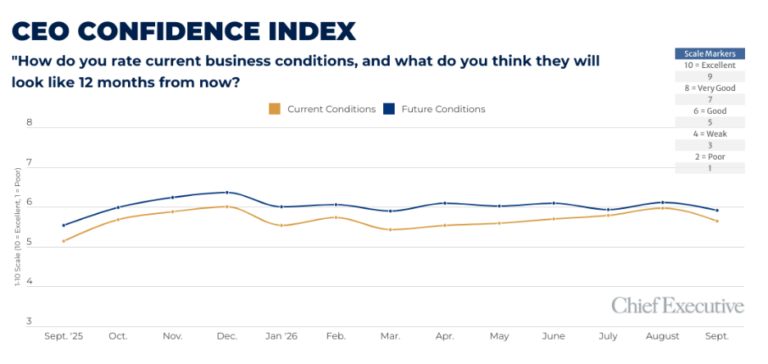
For CEOs, this infrastructure must show up in business performance. In Chief Executive’s own Spring 2026 CEO research, talent depth in key areas was the single biggest internal friction point companies reported—cited by 38 percent of CEOs—yet retaining and engaging existing employees ranked near the bottom of CEOs’ top 10 strategic priorities, at just 14 percent. That gap is exactly where a trust-based network pays for itself: Community accelerates growth through adoption, retention, referrals and expansion. It improves operating leverage by helping customers solve problems together and reducing duplicated support and training effort. And it sharpens decisions by surfacing unmet needs, risks and product signals earlier. Community doesn’t automatically produce ROI—it creates measurable value only when designed around a business problem and connected to the systems that own the outcome.
Five Ways CEOs Can Build Trust Infrastructure
1. Start with a business problem, not a platform. Identify where weak trust or connection is slowing retention, knowledge sharing, adoption or coordination. Design the community around that problem rather than launching a space and hoping engagement follows.
2. Design networks, not just org charts. Map where expertise and credibility live, then create repeatable ways for those people to exchange insight and influence decisions.
3. Reduce the risk of participation. Make it safe to question, disagree and share unfinished thinking. Then close the loop by showing participants what changed because they spoke up.
4. Build the intelligence layer. Connect community insight with product, support, learning and executive planning. Let AI analyze volume while people interpret meaning, context and consequences.
5. Measure business movement, not activity alone. Posts and attendance indicate participation, not strategic value. Measure whether the network improves retention, learning, adoption, advocacy and decision quality.
Trust Cannot Be Installed
Community requires patience, but patience does not mean passivity. Leaders can intentionally design the conditions in which trust compounds: clear purpose, consistent behavior, meaningful participation, visible responsiveness and shared value. What they cannot do is rush the outcome. You can’t microwave community.
The competitive opportunity is becoming clearer. As AI makes information more abundant and capable, technology alone creates less separation. Every company may gain powerful tools. Not every company will have customers who want to contribute, employees willing to challenge one another or partners invested in a shared future.
Attention gets you noticed. Trust gets you chosen
CEOs do not manufacture extraordinary outcomes. They design the conditions in which those outcomes can emerge. In the age of AI, one of the most important conditions they can design is community: the trust infrastructure that helps an organization continuously learn, adapt and thrive.