For more than two decades, in over 200 transformations, I’ve asked leadership teams one simple question: Who in this company owns customer profitability?
The answer is almost always silence, followed by a polite round of finger-pointing.
Every product has an owner. There’s a product manager, a brand manager, a category head, each with a P&L, a margin target and a bonus tied to both. When a product underperforms, someone’s name is on it and someone has to explain.
The customer, however, the only source of every dollar the company will ever earn, has no owner. Instead the customer is sliced among functions, each measured on its own slice:
- Marketing acquires customers and is measured on volume and cost per lead.
- Sales closes them and is measured on revenue.
- Operations serves them and is measured on efficiency.
- Customer service handles them and is measured on call time.
- Finance reports on them by product line, not by relationship.
Everyone touches the customer. Nobody is accountable for whether the customer is profitable.
Some will point to the chief customer officer. The role has certainly spread. By 2019, Gartner found that only about 10 percent of organisations lacked a chief customer officer or equivalent. But in most companies, that executive owns surveys, experience design and advocacy. They don’t own pricing, cost to serve, acquisition strategy or a customer P&L. They have a voice, not a vote.
This is not a minor organisational quirk. It’s a fundamental misunderstanding of the role of the customer in a company’s survival. We’ve built entire infrastructures, including systems, budgets, incentives, reporting lines and even our language, around products. Then we’re surprised when customers behave like transactions.
Follow the profit and you’ll find the customer
If you want proof that the customer relationship, not the product, is where profit lives, look at two iconic companies.
Delta Air Lines is in the business of flying people. That’s the product: seats, routes, schedules, aircraft. Yet in 2025, Delta received $8.2 billion in remuneration from American Express for its co-branded SkyMiles card, up 11 percent on the year. Delta’s entire operating income for 2025, according to the same report, was $5.8 billion.
Think about that. The payment Delta receives for the loyalty of its customers is larger than the total operating profit of the airline. Delta itself describes the card’s performance as reflecting “growing brand preference.” That’s not a flying metric. It’s a customer metric.
Best Buy is in the business of selling electronics. That’s the product: TVs, laptops, phones. Yet in 2005, the last year Best Buy itemised its profit centres in its filings, about one-third of its profits came from warranty sales. Consumers’ Checkbook reports that analysts now estimate half, or perhaps even all, of its profit comes from extended warranties. In the mid-2000s, BusinessWeek reported that margins on these contracts ran at 50–60 percent, nearly 18 times the margin on the goods themselves.
The TV is why the customer walks in. The relationship after the sale is where the money is.
Neither company would say its product doesn’t matter. Delta without reliable flights would have no loyalty to sell. Best Buy without the right products would have no one to protect. But both reveal the same truth: The product opens the door; the customer relationship pays the bills.
Short term vs. long term
Here’s the simplest way I know to frame the difference:
Product profitability is a short-term view. Customer profitability is a long-term view.
The product view asks: What margin did we make on this sale?
The customer view asks: What is this relationship worth over the next 10 years, and what are we doing to grow it?
Frederick Reichheld of Bain & Company documented why the long view matters. In industry after industry, the high cost of acquiring customers renders many relationships unprofitable in their early years. Only later, as the cost to serve falls and purchases rise, do relationships generate big returns. His much-quoted conclusion is that a 5 percent increase in customer retention can increase profits by 25 percent to 95 percent.
A company managed on product margins will never see this. It judges each transaction on its own and misses the relationship curve entirely. It cuts the service that would have created the fifth, 10th and 20th purchase, because in the quarterly product report that service looks like a cost.
Designing for the product or for the parenting
Let me make this concrete with an example from my own work.
I worked with a baby products company whose flagship product was the car seat. It’s a product every new parent must buy. In most places, you can’t take a newborn home from the hospital without one. It’s a guaranteed purchase at the most emotional moment of a family’s life. The average sale was about $200.
The company was very good at car seats. It designed them, engineered them, marketed them and competed hard for share.
But parenting is a much larger opportunity than a car seat. When we mapped the company’s own portfolio, it had about $3,000 worth of products it could sell to the same parents over the following years: strollers, high chairs, bigger seats, travel gear, accessories and more.
So we asked the leadership team a question that changed the conversation: Do you design for the product, or do you design for the parenting?
If you design for the product, you build a better car seat and fight for share, one $200 transaction at a time. Your competitors are other car seat makers, your metric is units sold and every sale is the end of the story.
If you design for the parenting, you’re in a completely different place. The car seat isn’t the product; it’s the first chapter of a relationship. You start caring about what happens after the hospital: the first trip, the first restaurant, the move to a toddler seat. You ask what parents are anxious about, and where you can help. Your metric becomes share of the parenting budget, not share of the car seat market. Your organisation has to follow the family’s journey, not the product catalogue.
The same company, the same products, the same factories. A completely different business, with a potential fifteen times larger per customer.
Every company has its own version of the parenting question. A bank sells a mortgage, but the customer is building a life. A software company sells a license, but the customer is trying to succeed at a job. A watchmaker sells a watch, but the collector is building a collection and a story. The question is always the same: What larger need is your product only the entry point to?
We’re still managing with the 1960s playbook
Why do so many companies get this wrong? Partly because the tools they manage with were built for a different era.
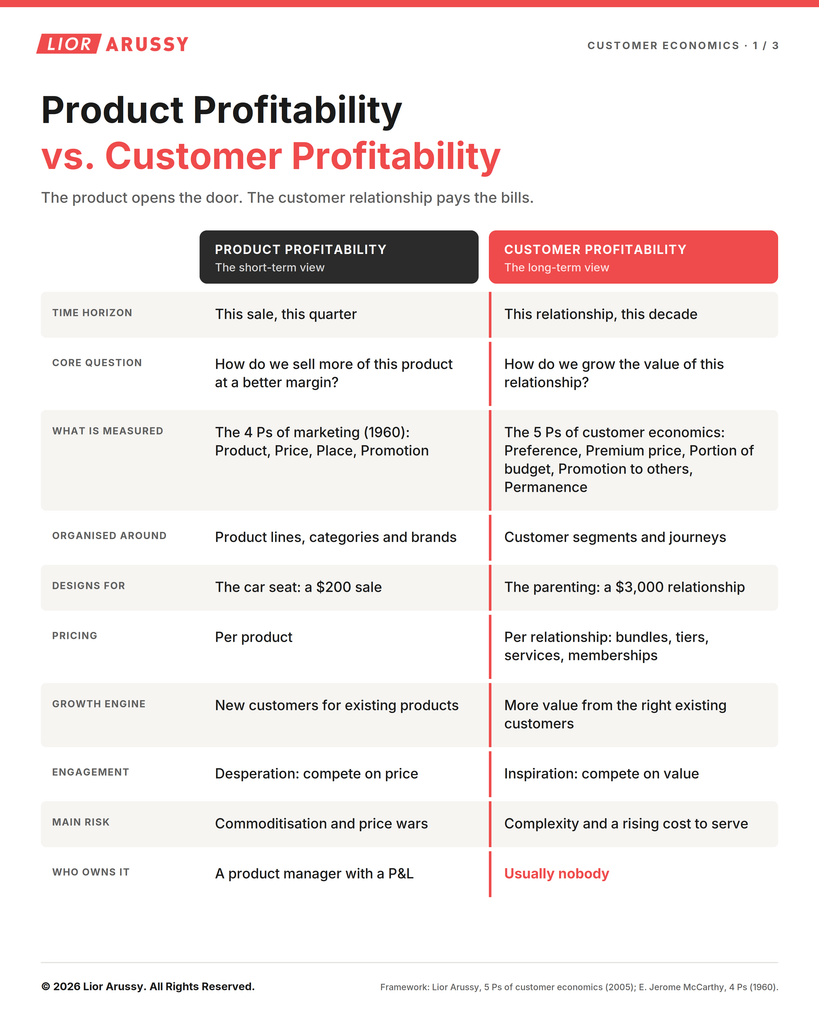
Most marketing organisations still run on the four Ps: Product, Price, Place and Promotion. E. Jerome McCarthy introduced them in his 1960 textbook Basic Marketing. They were brilliant for their time: a world of mass production, mass media and mass distribution. But notice what they have in common. They’re all about what we do to the market. The customer appears only as a target.
In 2005, in my book Passionate and Profitable, I introduced the five Ps of customer economics. Instead of measuring what we do to customers, they measure what customers do for us, because that’s where profit actually comes from:
- Preference: Customers choose your brand over the alternatives. Brand desirability.
- Premium price: They’re willing to pay more for what you offer. Higher margins.
- Portion of budget: You capture a growing share of their wallet. Larger orders.
- Promotion to others: They don’t just say they’d recommend you, they actually do. Referrals.
- Permanence of relationship: They stay, and stay profitable, over time. Customer lifetime value.
As I’ve argued in CustomerThink, the real return on a customer strategy shows up in these five behaviours, not just in cost savings.
Look back at Delta and Best Buy through this lens. Delta’s Amex income is Preference and Permanence turned into cash. Best Buy’s warranty profit is Portion of budget captured after the product sale. The baby products company’s $3,000 opportunity is Portion of budget and Permanence, unlocked only if you design for the parenting.
The four Ps tell you how well you sell a product. The five Ps tell you whether you’re building a business. Yet almost no company measures the five Ps, and almost no one is accountable for them.
The trade-offs between the two models
I’m not arguing that products don’t matter. A customer strategy built on a mediocre product won’t last. The product earns the right to the relationship. But the two business models run on different logic, and leaders need to choose deliberately.
| Profitable-product business | Profitable-customer business | |
| Time horizon | Short term: this sale, this quarter | Long term: this relationship, this decade |
| Core question | How do we sell more of this product at a better margin? | How do we grow the value of this relationship? |
| What’s measured | The 4 Ps: product margin, units, share | The 5 Ps: preference, premium, portion, promotion, permanence |
| Organisation | Product lines, categories, brands | Customer segments, journeys, relationships |
| Innovation | Better products pushed to market | Solutions designed around the customer’s larger need |
| Pricing | Per product | Per relationship: bundles, tiers, services, memberships |
| Growth engine | New customers for existing products | More value from the right existing customers |
| Main risk | Commoditisation and price wars | Complexity and a cost to serve that grows too high |
The product model is simpler and scales easily. It rewards focus and operational excellence, and it has clear accountability. Its weakness is that when competitors match the product, the only weapon left is price. That’s the engagement model I call desperation.
The customer model is stickier and far more defensible. A competitor can copy your product in months; copying years of relationship is much harder. That’s the engagement model of inspiration. Its weakness is complexity. Every tailored service, special price and dedicated team adds cost. Without discipline, “customer-centric” becomes a polite way of saying yes to everything.
The real trade-off is between scale and depth. Product businesses win by doing one thing for many. Customer businesses win by doing more for the right few.
Not every customer is profitable
Here’s where many customer-centric strategies go wrong: they treat all customers as equally valuable. They aren’t.
When Robert Kaplan applied activity-based costing at Kanthal, a Swedish heating-systems manufacturer, he found that its two largest-volume customers were among the least profitable, and only about 40 percent of its customers were profitable at all. Those large customers demanded small custom orders, frequent changes and special handling, and the cost of serving them wiped out the margin. Kanthal didn’t walk away. It introduced surcharges for order changes and minimum order sizes, turning a loss-making relationship into a profitable one that also helped the customer reduce its own costs.
Best Buy faced the same problem from the consumer side. In 2004, CEO Brad Anderson divided customers into “angels” and “devils”. The angels bought new technology at full price. The devils bought, claimed rebates, returned the goods and bought them back at a discount. The economics were sound, but the public reaction was a reminder that treating customers differently must feel fair to them.
The lesson: if you manage by revenue, you’ll reward the wrong customers. Your biggest customer may be your costliest.
How companies shift, and why
IBM is the landmark case. In the early 1990s, its hardware sales dropped by half in three years, erasing more than $14 billion in hardware profits. When Lou Gerstner went out and listened to customers, he discovered that they didn’t buy IBM for any single product; specialists often did each component better. They valued IBM’s ability to bring everything together into one working solution. Gerstner rebuilt the company around that insight, and by 1999 services mattered more than hardware.
IBM didn’t stop making products. It stopped designing for the product and started designing for the customer’s success.
Other forces are pushing every industry in the same direction: subscription models that make retention the core economic metric, data that finally lets companies see profit per customer, rising acquisition costs and customers whose expectations evolve faster than product cycles.
How the shift actually happens:
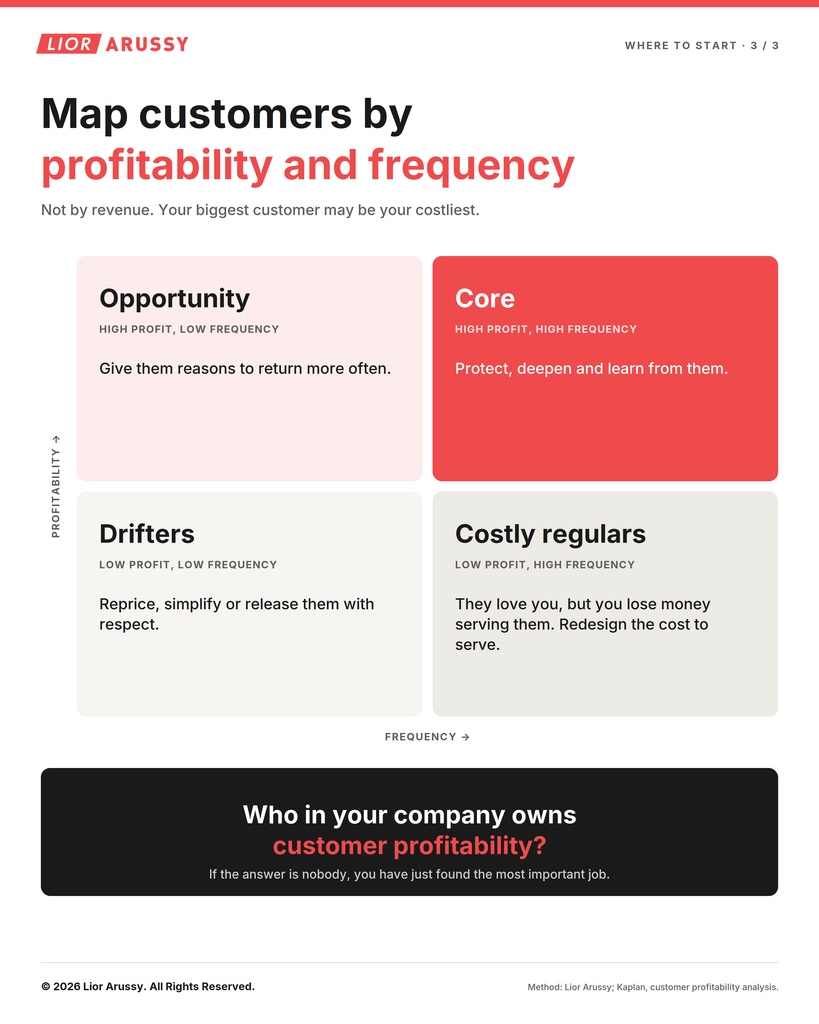
1. Map your customers by profitability and frequency, not by revenue. This is the single most important step, and the one most companies skip. Revenue is a vanity metric at the customer level; it hides the truth. Plot every customer, or every segment, on two axes: how profitable the relationship is, and how often the customer comes back. You’ll typically find four groups:
- High profit, high frequency: your core. Protect them, deepen them and learn from them.
- High profit, low frequency: your opportunity. They like what you offer; give them reasons to return more often.
- Low profit, high frequency: your costly regulars. They love you, but you lose money serving them. Redesign the cost to serve, as Kanthal did.
- Low profit, low frequency: your drifters. Reprice, simplify or release them with respect.
That one chart will change your next strategy meeting more than any product review.
2. Measure the full cost to serve. Returns, discounts, custom orders, service calls, sales time and delivery exceptions all belong to a customer, not to general overhead.
3. Assign ownership. Give someone a customer P&L by segment, with real authority over acquisition, pricing and service levels. Without an owner, customer profitability remains everyone’s concern and nobody’s job.
4. Change what you reward. If people are paid on product revenue, they’ll sell products. Reward retention, share of wallet, referrals and relationship margin: the five Ps.
5. Ask the parenting question. Identify the larger need your product is only the entry point to, and redesign your offer around that journey.
6. Price the relationship, not just the product. Bundles, service tiers, memberships and protection plans capture Portion of budget over time.
7. Manage the cost to serve deliberately. Customer-centric does not mean customer-indulgent. Decide what each segment receives, and what it pays for extras.
8. Keep product excellence. The relationship rests on the product. Never let customer strategy become an excuse for a weaker product.
9. Report the five Ps to the board every quarter, alongside the financials.
The seven questions of customer-centric strategy
When you consider customer profitability, don’t start with spreadsheets. Start with questions. These are the seven I put in front of every leadership team:
Customer value: What do our customers truly value?
Experience: How do we design experiences worth returning to?
Trust: How do we earn the right to deepen the relationship?
Growth: How does customer success translate into profitable growth?
Transformation: How do we transform our customers?
Collaboration: How do we co-create with our customers?
Relevance: How do we continue to evolve faster than the customer?
Notice that none of them asks about the product. Each one asks about the relationship, and each one leads directly to one of the five Ps. Value and experience drive Preference. Trust earns Premium price and Permanence. Growth and transformation expand Portion of budget. Collaboration turns customers into Promoters. Relevance keeps the whole relationship alive.
The bottom line
Products are copied. Prices are matched. Promotions are forgotten. Distribution is commoditised.
A profitable customer relationship is the one asset your competitor can’t simply buy.
Delta understood that the loyalty of its flyers is worth more than the flying itself. Best Buy discovered that the relationship after the sale was worth more than the sale. The baby products company learned that the car seat was not its business; parenting was.
Every company must eventually answer the same question: Are we designing for the product, or for the customer’s life?
And then the harder one: who in this company owns the answer?
If the answer is nobody, you’ve just found the most important job in your organisation. Fill it before your competitor does.