Not surprisingly, CEOs are a well-educated group. But, there are many educational pathways that lead to the top, according to the CEO1000 Tracker, a tool that tracks data on the CEOs of the top 1,000 public and private companies, developed by Chief Executive Group and RHR International, the premier firm in the development of top management leadership of Global 1000 companies.
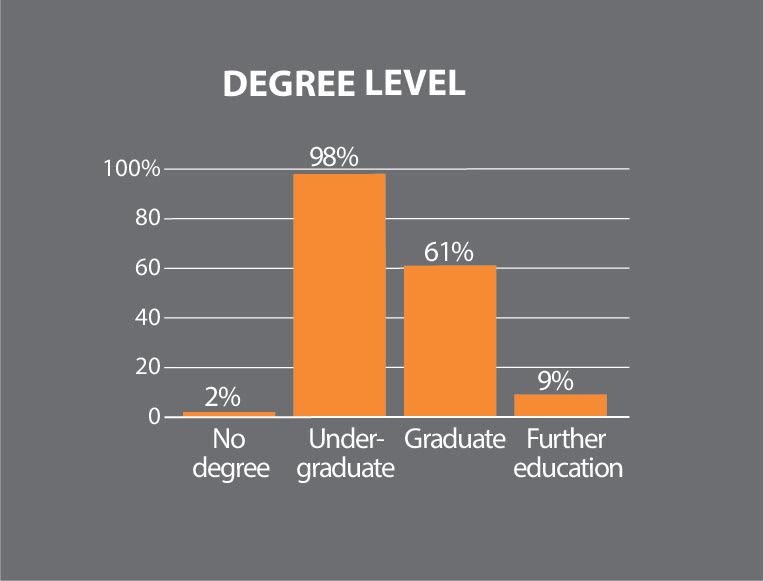
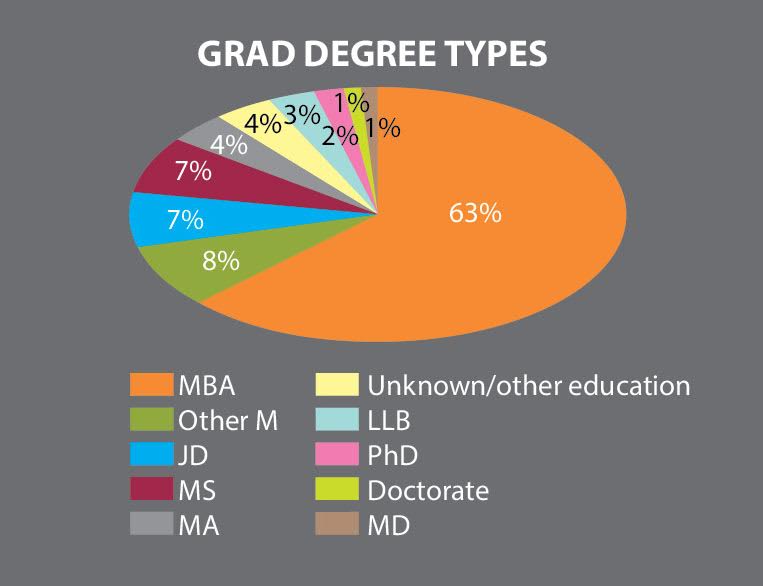
Nearly all of the top 1,000 CEOs have an undergraduate degree, and close to two-thirds have post-graduate degrees. Of the latter group, the MBA is the most common. But nearly 4 out of 10 have other types of upper-level degrees, including MD, JD and ME degrees. A handful (2%) do not have college degrees at all.
In terms of which undergraduate schools CEOs attended, the University of Pennsylvania tops the list, followed by Harvard and MIT. But CEOs come from a wide range of schools. Indeed, the top 10 undergraduate schools attended account for only about 15% of the CEOs. All told, there are more than 400 undergraduate and 260 graduate schools represented. Interestingly, CEOs from the more traditionally chosen private schools—Harvard, Yale and MIT—tend to be relatively older, with an average age above 61.
“Most CEOs did not attend
top-tier undergraduate schools,
and the split between public and private schools is fairly even.”
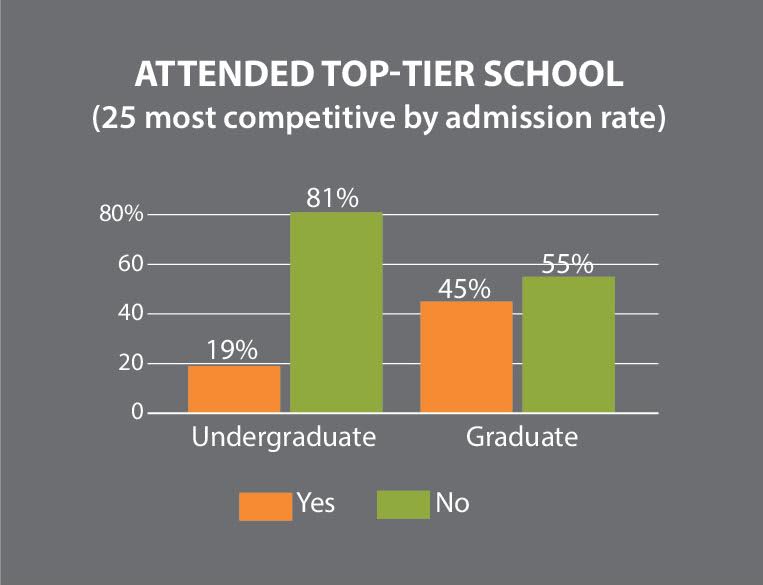
On the other hand, for graduates of schools such as Purdue, University of Michigan and Georgetown University, the average age is closer to 50. This may suggest a generational shift away from traditional choices. Most CEOs did not attend top-tier undergraduate schools, and the split between public and private institutions is fairly even. (It’s worth noting, however, that among U.S. college students in general, only about 20% attend non-profit private undergrad institutions.) Thus, the type of undergraduate school attended appears to make little difference in the making of a CEO.
But the picture shifts noticeably for graduate schools, with both the top-tier and private schools becoming more prevalent. Overall, this suggests that the route to the executive suite is wide and varied. This is underscored when looking at education and the financial performance of companies together—there is no clear correlation between those two factors, and a “premier” education does not necessarily make for a successful CEO.
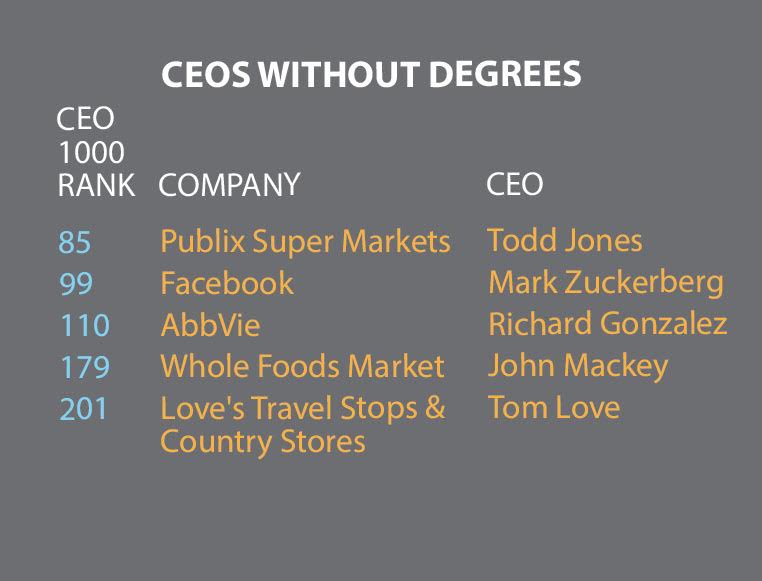
In fact, less than 15% of CEOs of top-performing companies attended top-tier undergraduate schools. What’s more, some of the CEOs who don’t have a degree head up large, successful companies—witness Facebook’s Mark Zuckerberg.
The lesson, it seems: While very important, education is just one of many ingredients that go into shaping the CEO to handle the complexities and challenges that are part of the job. As Dr. Paul Winum, senior partner, practice leader, Board & CEO Services, at RHR International puts it, “RHR consultants have worked with thousands of CEOs over the decades who have formal degrees from a wide range of universities, just as the CEO1000 Tracker shows. What we have found, however, is that successful CEOs are best schooled by the experiences resulting from the ambitious leadership challenges they have taken on throughout their lives, not their formal education.”