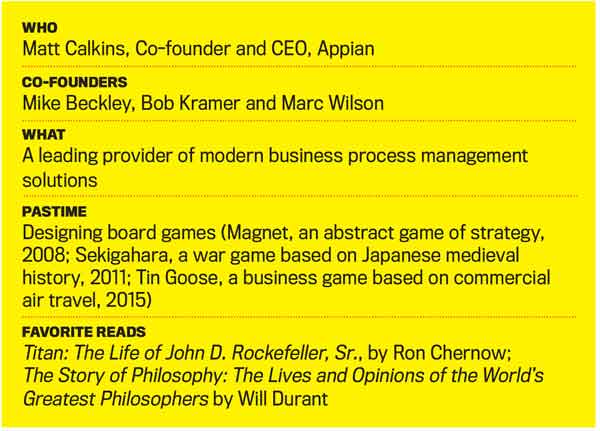
At age 26, you left a lucrative and successful career at a fast growing enterprise-software company—sacrificing millions in stock options—to start your own company. You didn’t have a business plan, funding or even a concept. Instead, you had three partners who shared your enthusiasm for taking on an entrepreneurial venture during the heady days of the dot-com boom. Together, you decided to tackle personalization—or the task of using algorithms to analyze data about people and the products and services they consume to enable companies like Netflix to tailor their marketing efforts to consumer preferences.
The Context
As it happens, your venture launches on the eve of the dotcom economy’s demise. “It got taken out by the bubble burst, even though it was a meaningful industry,” recounts Matt Calkins, CEO of Reston, Virginia-based Appian. Next, the company looked to market its algorithms to web portals like AOL as a way to tailor content to user profiles, but that idea, too, died on the vine. Fortunately, the company’s third effort finally bore fruit. “We jumped into business-process management,” says Calkins. “The idea was that instead of coding it, we would let you draw it like a flowchart and configure roles for people, then, we would automate the flowchart.”
The concept addressed a myriad of frustrations companies using custom software face, from headaches related to integrating the software and training people on it to the likelihood that the pricey and complex software you just purchased and struggled to implement will soon be obsolete. “The typical IT infrastructure right now is a forest of silos, each requiring its own upkeep, which is incredibly expensive,” explains Calkins. “Instead of 100 silos, we want you to have one Appian platform where everyone participates. If you have 10 applications, you log into them as one and you participate with everyone else logged into their applications because they’re also logged into the environment, not a silo.”
Because Appian continually updates the platform, companies can also run all of their custom applications on every type of device currently in use—a BlackBerry, an Android or an Apple Watch. “Ten years from now, even if we consume applications in a totally different way, everything you wrote on the Appian platform will work in that new environment because we will keep it fresh,” promises Calkins. Finally, when it’s time to update customized software, companies can use Appian’s drag-and-drop tools to change the flow charts on which the customized applications are based and the code automatically reconfigures, he adds.
The Resolution
Today, Appian is a $350 million company with an impressive roster of clients, among them UPS, Starbucks, Amazon and the U.S. government. Starbucks, for example, uses multiple applications on Appian’s platform, one of which involves conducting its North American store inspections on iPad devices. “They have hundreds of people whose job is to go to one Starbucks location after another and fill out forms, take pictures and give the manager tips on what is needed to be done better,” explains Calkins. “They used to do all that with pen and paper and drop it off in Seattle to be [tabulated]. Now they have instant scores and can make instant changes. Plus, the people who used to be form jockeys are connected to the conversations happening across the Appian platform inside Starbucks. It turns out that they are a gold mine of information.”
Given the company’s rapid growth rate—sales doubled last year, according to Calkins—and steadily building customer base, an IPO could easily be in the offing. In fact, back when New Enterprise
Associates invested $37.5 million in the company a year ago, some speculated that the capital injection was meant to pave the way for a public offering. However, Calkins says he plans to bide his time. “We want to establish the consciousness of our market before we try to sell our shares to The Street,” he says. “Right now, I still have to explain what an application platform is to people. I don’t think that will be the case in a year or two. I want to be at the point where when people hear, ‘Application platform,’ they say, ‘I love that market.’
Then I want to ride that wave.”
Jim Collins’ most ambitious research project yet tackles the biggest questions of all.
The leaders who matter most in the age of AI will be the ones who,…
When it comes to pay in 2026, our latest survey finds division heads and supervisors…
The companies that scale consistently are not the ones with the most heroic individual performers.…
The two-time NBA champion has taken the lessons he learned on the court and brought…
How this Shark Tank–winner apparel startup is forcing founder Justin Baer to make fast, high‑stakes…