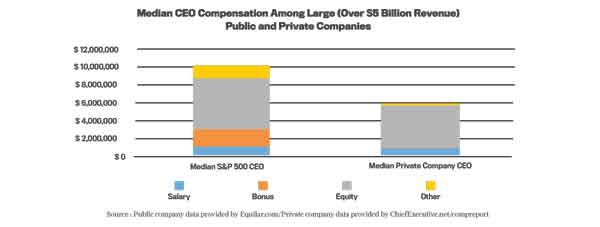
Of the roughly 30 million businesses in the U.S., fewer than 6,000 are publicly traded and only the largest 8 percent of these public companies make it into the S&P 500. Despite this reality, most media outlets focus on the $12 million
average pay package among S&P 500 company CEOs—or even more misleading, the $38.7 million average annual pay package for the CEOs of the largest 200 companies.
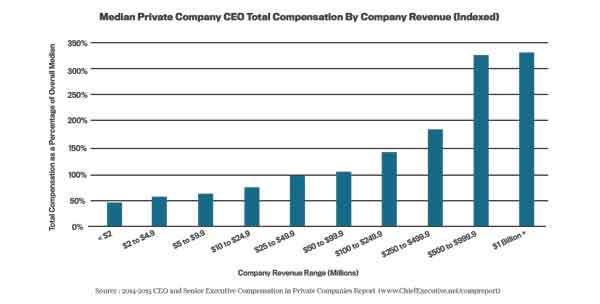
According to the just released 2014-2015 CEO and Senior Executive Compensation in Private Companies Report, produced by Chief Executive Group, the median private company CEO earned $343,000 in cash compensation in 2013 (base salary and bonus) and total compensation of $378,000 including benefi ts, perks and equity gains.
Median total compensation for private company CEOs was up approximately 5 percent from the prior year—outpacing the inflation rate of 1.5 percent in 2013—but not growing as fast as pubic-company CEO compensation packages. The S&P 500 median package increased by 9.5 percent over the same period.
As one would expect, CEO compensation is positively correlated with a company’s size and complexity, as well as its performance, and it accelerates quickly among the largest companies—given the leverage in value creation as a company’s scale increases.
Even when accounting for size, public company CEO’s make much more than CEOs of comparably sized private companies. It is understandable that public company CEOs would make more, on average, than their private company peers given the additional complexity (e.g., compliance requirements), increased scrutiny/pressure and the shorter tenures on average, but the size of the gap is noteworthy.
Most CEOs are leaders who build businesses, create jobs and contribute to their communities. While some people continue to vilify all CEOs for excess pay and mistakenly assume that all CEOs enjoy the rich compensation packages of the largest public company CEOs, the reality is far different. Regardless, even the highest paid CEOs make less on average than leading actors, sports stars and other celebrities, and they have much greater responsibilities.
For more information about the 2014-2015 CEO & Senior Executive Compensation Report for Private Companies, which includes benchmarking data by quartile on base salaries, bonuses, benefits, perks and equity compensation for CEOs and nine other senior executive positions (e.g. president, COO/GM, CFO, CMO, VP Sales, VP R&D, VP HR) and how these benchmarks vary by company size, industry, type of ownership and other key variables, please visit ChiefExecutive.net/compreport.
The bestselling author and advisor to CEOs shares what he’s counseling manufacturers as they navigate…
Market engineering is far more than clever marketing. It’s the operating system for category ownership…
Rising investment. Unclear outcomes. Increasing scrutiny on the executives responsible for both. The risk isn’t…
In a populist moment for America, standing your ground is the only strategy.
A useful model for how organizations in all sectors can lead responsibly when certainty disappears…
Staying cool and consistent under pressure shows your team that you are ready to handle…